


Incidence of uterine leiomyoma in relation to urinary concentrations of phthalate and phthalate alternative biomarkers: A prospective ultrasound study
- PMID: 33360166
- PMCID: PMC8630749
- DOI: 10.1016/j.envint.2020.106218
Incidence of uterine leiomyoma in relation to urinary concentrations of phthalate and phthalate alternative biomarkers: A prospective ultrasound study
Abstract
Background: Numerous studies suggest that some phthalates have adverse reproductive effects. However, literature on the association between phthalates and incidence of uterine leiomyomata (UL) is limited and inconsistent, with no existing prospective studies.
Objectives: We examined the association of urinary concentrations of phthalate and phthalate alternative biomarkers with UL incidence.
Methods: We conducted a case-cohort analysis within a subgroup of 754 participants in the Study of the Environment, Lifestyle, and Fibroids (SELF), a prospective cohort of premenopausal Black women aged 23-35 years who were recruited during 2010-2012. We quantified fourteen phthalates and two phthalate alternative [1,2-cyclohexane dicarboxylic acid, diisononyl ester (DINCH)] biomarkers in urine collected at baseline, 20 months, and 40 months. Transvaginal ultrasounds identified UL at baseline and every 20 months during 60 months of follow-up. We evaluated the individual biomarkers, molar sum of di(2-ethylhexyl) phthalate [ΣDEHP] and potency-weighted sum of anti-androgenic [WΣAA] biomarkers. We used Cox proportional hazards regression to estimate adjusted hazard ratios (HRs) and 95% confidence intervals (CIs) for the association between biomarkers and UL incidence. We then used quantile g-computation to examine joint associations of multiple phthalate biomarkers with UL incidence.
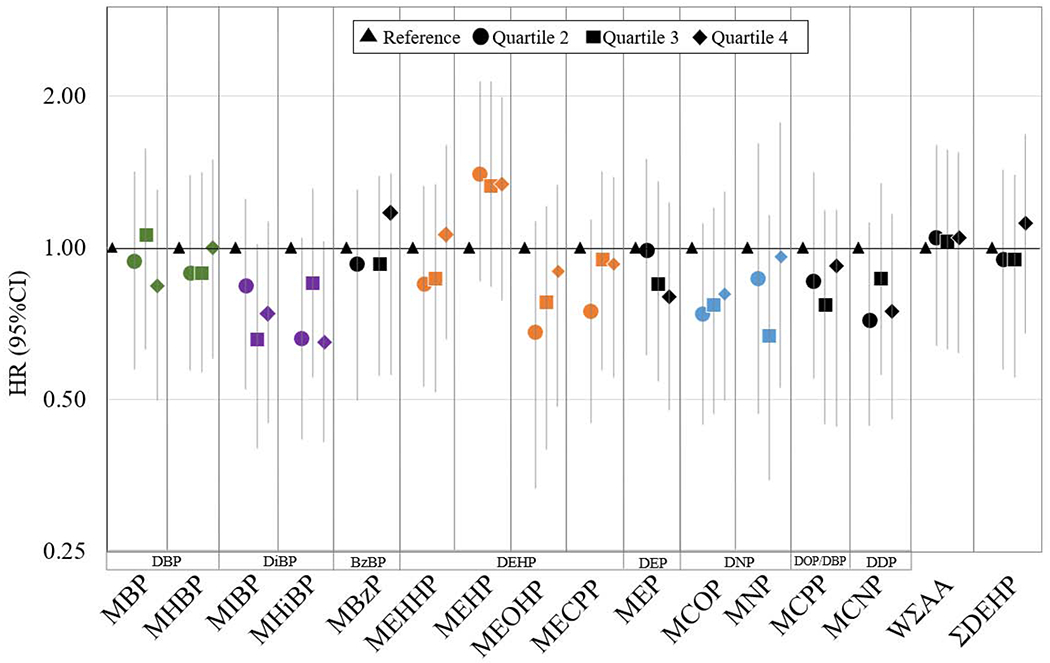
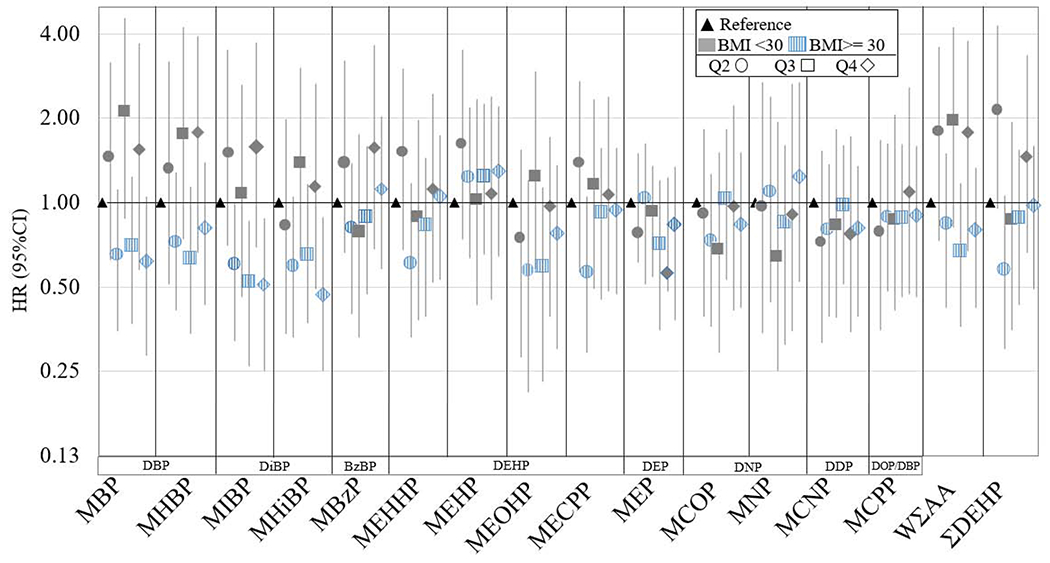
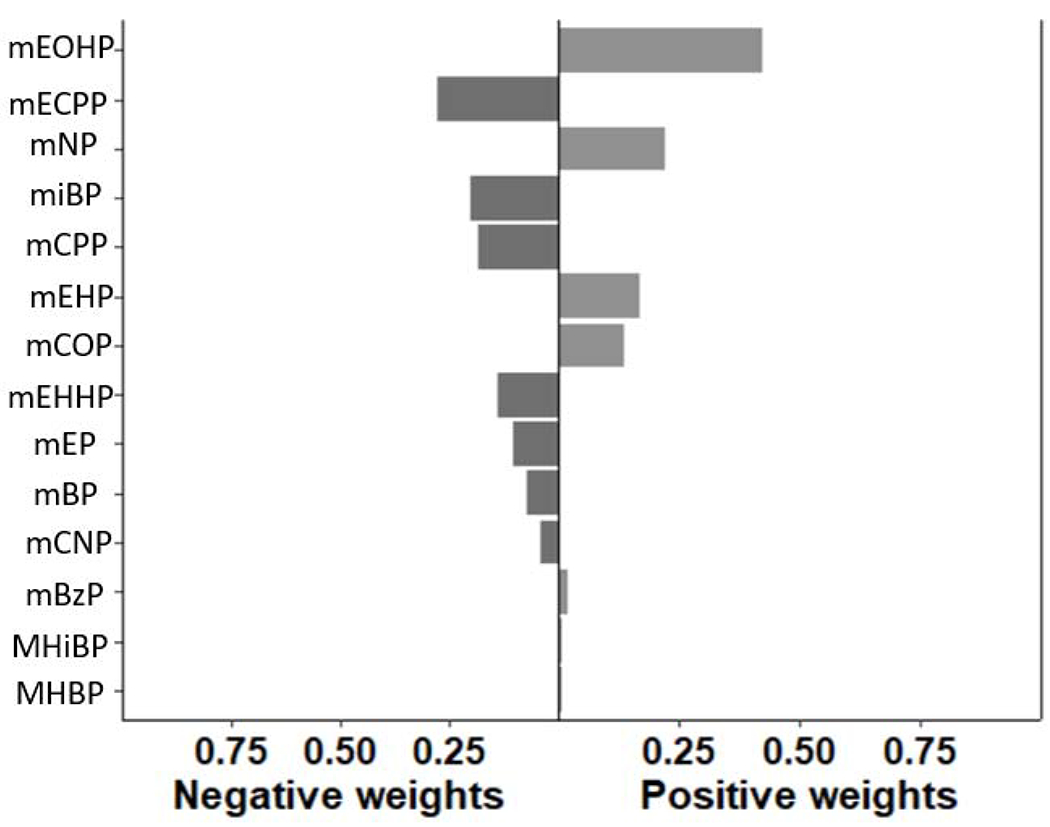
Results: Most individual biomarkers showed weak-to-moderate inverse associations with UL incidence. HRs comparing highest vs. lowest quartiles of mono-isobutyl phthalate (MiBP) and mono-hydroxyisobutyl phthalate (MHiBP) concentrations were 0.63 (95% CI: 0.40, 1.01) and 0.61 (95% CI: 0.38, 0.96), respectively. Inverse associations for specific phthalates were stronger among women with BMI ≥ 30 kg/m2. HRs comparing detectable vs. nondetectable concentrations of DINCH biomarkers were 0.92 (95% CI: 0.62, 1.35) for cyclohexane-1,2-dicarboxylic acid mono hydroxyisononyl ester (MHNCH) and 0.68 (95% CI: 0.38, 1.18) for cyclohexane-1,2-dicarboxylic acid mono carboxyisoocytl ester (MCOCH). For the DEHP metabolite of mono(2-ethylhexyl) phthalate (MEHP), we observed weak-to-moderate positive associations. HRs comparing highest vs. lowest quartiles for MEHP and ΣDEHP were 1.29 (95% CI: 0.82, 2.06) and 0.96 (95% CI: 0.61, 1.50), respectively. In the mixtures analysis, the HR for a joint quartile increase in phthalate biomarker concentrations was 0.90 (95% CI: 0.73, 1.08).
Discussion: In this prospective ultrasound study of reproductive-aged Black women, urinary concentrations of phthalate and DINCH biomarkers were not appreciably associated with higher risk of UL, either individually or jointly.
Keywords: Endocrine disrupting chemicals; Environmental epidemiology; Phthalates; Reproductive health; Uterine leiomyoma; Women's health.
Copyright © 2020 The Authors. Published by Elsevier Ltd.. All rights reserved.
Conflict of interest statement
The authors declare they have no actual or potential competing financial interests.
Figures
References
-
- Andersen J, Barbieri RL, 1995. Abnormal gene expression in uterine leiomyomas. J. Soc. Gynecol. Investig 2, 663–672. - PubMed
-
- ATSDR (Agency for Toxic Substances and Disease Registry), 2002. Toxicological Profile: Di(2-ethylhexyl)phthalate (DEHP) [WWW Document]. URL https://www.atsdr.cdc.gov/toxprofiles/tp.asp?id=684&tid=65 (accessed 6.27.19). - PubMed
-
- ATSDR (Agency for Toxic Substances and Disease Registry), 2001. Toxicological Profile: Di-n-butyl Phthalate [WWW Document]. URL https://www.atsdr.cdc.gov/toxprofiles/tp.asp?id=859&tid=167 (accessed 6.27.19). - PubMed
-
- ATSDR (Agency for Toxic Substances and Disease Registry), 1995. Toxicological Profile: Diethyl phthalate [WWW Document]. URL https://www.atsdr.cdc.gov/toxprofiles/TP.asp?id=603&tid=112 (accessed 6.27.19). - PubMed
Publication types
MeSH terms
Substances
Grants and funding
LinkOut - more resources
Full Text Sources
Other Literature Sources
