


Safety culture transformation-The impact of training on explicit and implicit safety attitudes
- PMID: 33362405
- PMCID: PMC7753658
- DOI: 10.1002/hfm.20879
Safety culture transformation-The impact of training on explicit and implicit safety attitudes
Abstract
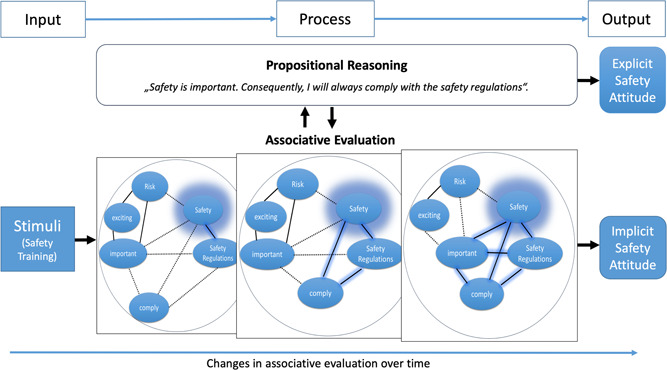
The present paper investigates the changeability of safety culture elements such as explicit and implicit safety attitudes by training. Therefore, three studies with different time frames, training durations, and settings will be presented. In the first study, the short-term attitude change of students from an international environmental sciences study program was measured after safety training in a chemical laboratory. In the second study, the medium-term attitude change was assessed after a Crew Resource Management training for German production workers in the automotive industry. In the third study, the long-term attitude changes were measured after safety ethics training in a sample of German occupational psychology and business students. Different self-report measures were used to evaluate the training effectiveness of explicit safety attitudes. The change of implicit safety attitudes was assessed by Implicit Association Tests. The results of all three studies revealed a significant training effect on the explicit safety attitudes, but not on the implicit ones. Besides the training effect on the explicit attitudes, there was no effect of time frame (short-, medium-, long-term), training duration (2 h, 2 days, 12 weeks), and setting (chemical laboratory, automotive industry, safety ethics study program) on the attitude change. Based on the results, conceptual, methodological, and practical implications for training effectiveness and safety culture transformation are discussed.
Keywords: Crew Resource Management training; Implicit Association Test; attitude change; evaluation; implicit attitudes; safety culture; safety training; social cognition.
© 2020 The Authors. Human Factors and Ergonomics in Manufacturing & Service Industries published by Wiley Periodicals LLC.
Conflict of interest statement
The authors declare that there are no conflict of interests.
Figures
References
-
- Aggarwal, R. , Mytton, O. T. , Derbrew, M. , Hananel, D. , Heydenburg, M. , Issenberg, B. , MacAulay, C. , Mancini, M. E. , Morimoto, T. , Soper, N. , Ziv, A. , & Reznick, R. (2010). Training and simulation for patient safety. Quality & Safety in Health Care, 19(2), i34–i43. 10.1136/qshc.2009.038562 - DOI - PubMed
-
- Barsuk, J. H. , McGaghie, W. C. , Cohen, E. R. , O'Leary, K. J. , & Wayne, D. B. (2009). Simulation‐based mastery learning reduces complications during central venous catheter insertion in a medical intensive care unit. Critical Care Medicine, 37(10), 2697–2701. 10.1097/CCM.0b013e3181a57bc1 - DOI - PubMed
-
- Berger, J. (2020). Implicit attitudes and awareness. Synthese, 197, 1291–1312. 10.1007/s11229-018-1754-3 - DOI
LinkOut - more resources
Full Text Sources