Review
. 2020 Dec 9:11:587451.
doi: 10.3389/fphar.2020.587451. eCollection 2020.

Prognostic Genetic Markers for Thrombosis in COVID-19 Patients: A Focused Analysis on D-Dimer, Homocysteine and Thromboembolism

Affiliations
Review

Prognostic Genetic Markers for Thrombosis in COVID-19 Patients: A Focused Analysis on D-Dimer, Homocysteine and Thromboembolism

Mohamed Abu-Farha et al. Front Pharmacol. .

Abstract

COVID-19 is caused by Severe Acute Respiratory Syndrome Coronavirus-2, which has infected over thirty eight million individuals worldwide. Emerging evidence indicates that COVID-19 patients are at a high risk of developing coagulopathy and thrombosis, conditions that elevate levels of D-dimer. It is believed that homocysteine, an amino acid that plays a crucial role in coagulation, may also contribute to these conditions. At present, multiple genes are implicated in the development of these disorders. For example, single-nucleotide polymorphisms (SNPs) in FGG, FGA, and F5 mediate increases in D-dimer and SNPs in ABO, CBS, CPS1 and MTHFR mediate differences in homocysteine levels, and SNPs in TDAG8 associate with Heparin-induced Thrombocytopenia. In this study, we aimed to uncover the genetic basis of the above conditions by examining genome-wide associations and tissue-specific gene expression to build a molecular network. Based on gene ontology, we annotated various SNPs with five ancestral terms: pulmonary embolism, venous thromboembolism, vascular diseases, cerebrovascular disorders, and stroke. The gene-gene interaction network revealed three clusters that each contained hallmark genes for D-dimer/fibrinogen levels, homocysteine levels, and arterial/venous thromboembolism with F2 and F5 acting as connecting nodes. We propose that genotyping COVID-19 patients for SNPs examined in this study will help identify those at greatest risk of complications linked to thrombosis.

Keywords: COVID-19; coagulopathy; d-dimer; heparin; homocysteine; pulmonary embolism; thrombocytopenia; venous thromboembolism.


Conflict of interest statement

The authors declare that the research was conducted in the absence of any commercial or financial relationships that could be construed as a potential conflict of interest.

Figures
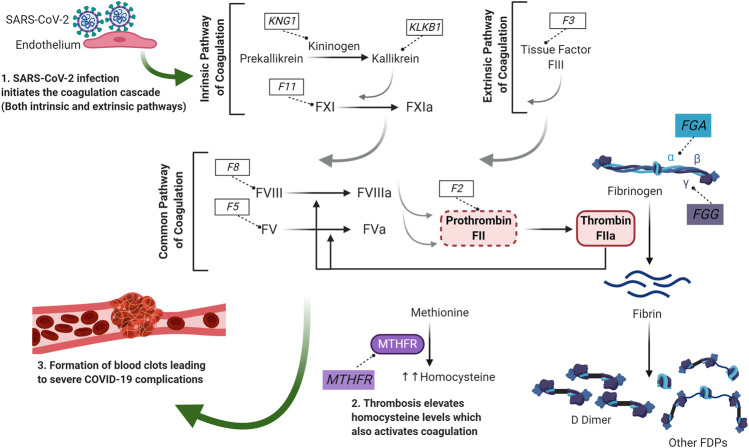
FIGURE 1
FIGURE 1
The molecular link between key genes in coagulation during COVID-19 infection. SARS-CoV-2 infection results in an injury in the endothelium which leads to the activation of the coagulation cascade; both the intrinsic and the extrinsic pathway. Within the extrinsic pathway, tissue factor (encoded by F3) initiates the cascade to activate the common pathway of coagulation. Within the intrinsic pathway, prekallikrein is converted to kallikrein via the action of kininogen and factor XI is activated. The activation of Factor XI initiates the common pathway of coagulation and leads to the activation of several coagulation factors including factor VIII and factor V. Thrombin converts Fibrinogen to Fibrin. Fibrin is then broken down to D-dimer and other FDPs. This SARS-CoV-2-induced thrombosis also leads to elevated levels of homocysteine which can eventually activate the coagulation cascade. Genes of interest are presented in boxes. For purpose of clarity, this illustration is only highlighting the genes of interest that were picked by XGR analysis to associate with thrombosis. Grey arrows indicate activation of other coagulation factors. F: Coagulation Factor, Fa: activated coagulation factor. FDPs: Fibrin degradation products, FGA: Fibrinogen alpha chain, FGG: Fibrinogen gamma chain, KLKB1: kallikrein, KNG1: Kininogen 1, MTHFR: methylenetetrahydrofolate reductase.

References

    1. Abou-Ismail M. Y., Diamond A., Kapoor S., Arafah Y., Nayak L. (2020). The hypercoagulable state in COVID-19: incidence, pathophysiology, and management. Thromb. Res. 194, 101–115. 10.1016/j.thromres.2020.06.029 - DOI - PMC - PubMed
    1. Abu-Farha M., Thanaraj T. A., Qaddoumi M. G., Hashem A., Abubaker J., Al-Mulla F. (2020). The role of lipid metabolism in COVID-19 virus infection and as a drug target. Int. J. Mol. Sci. 21 (10), 3544 10.3390/ijms21103544 - DOI - PMC - PubMed
    1. Al-Shamsi A. M., Ben-Salem S., Hertecant J., Al-Jasmi F. (2015). Transaldolase deficiency caused by the homozygous p.R192C mutation of the TALDO1 gene in four Emirati patients with considerable phenotypic variability. Eur. J. Pediatr. 174 (5), 661–668. 10.1007/s00431-014-2449-5 - DOI - PubMed
    1. Auton A., Brooks L. D., Durbin R. M., Garrison E. P., Kang H. M., Korbel J. O., et al. (2015). A global reference for human genetic variation. Nature 526 (7571), 68–74. 10.1038/nature15393 - DOI - PMC - PubMed
    1. Bai Y., Yao L., Wei T., Tian F., Jin D. Y., Chen L., et al. (2020). Presumed asymptomatic carrier transmission of COVID-19. Jama 323 (14), 1406–1407. 10.1001/jama.2020.2565 - DOI - PMC - PubMed
