


Integrating Mental Health and Psychosocial Support Into Health Facilities in Conflict Settings: A Retrospective Review From Six African Countries
- PMID: 33363086
- PMCID: PMC7759644
- DOI: 10.3389/fpubh.2020.591369
Integrating Mental Health and Psychosocial Support Into Health Facilities in Conflict Settings: A Retrospective Review From Six African Countries
Abstract
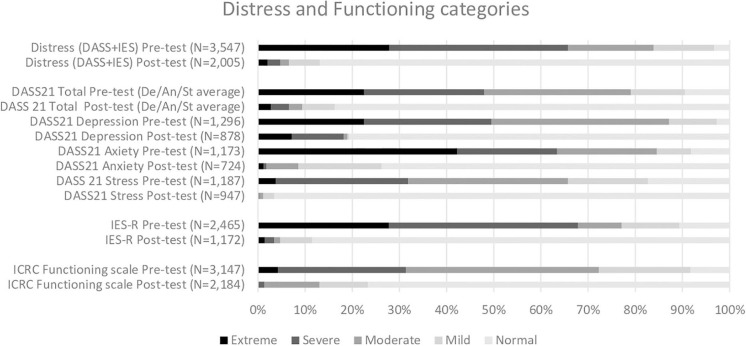
Introduction: The International Committee of the Red Cross runs an increasing number of mental health and psychosocial programmes integrated into health facilities in conflict settings across Africa. This study looks at changes in symptoms of psychological distress and impaired functioning among patients supported through such programmes. Material and Methods: Between January and December 2019, 5,527 victims of violence received mental health and psychosocial support in 29 health facilities in Burundi, Central African Republic, Democratic Republic of the Congo, Mali, Nigeria and South Sudan. Symptoms of psychological distress (IES-R or DASS21) and daily functioning (ICRC scale) were assessed before and after the intervention. Logistical regression models were used to measure associations between these symptoms and the other variables. Results: Factors associated with high distress prior to receiving support included age (peaking at 45-54 years), intervening within three months, rape, caretaker neglect, internal displacement, secondary education level and referral pathway. Anxiety levels in particular were higher among victims of violence committed by unknown civilians, the military or armed groups. Low functioning was associated with divorce, grief and violence committed by the military or armed groups. Following the intervention, the vast majority of patients reported reduced psychological distress (97.25% for IES-R and 99.11% for DASS21) and improved daily functioning (93.58%). A linear trend was found between number of individual sessions and reduction in symptoms of distress. Financial losses were associated with less reduction in symptoms of depression and stress. Discussion: To further address the mental health and psychosocial needs of victims of violence, intervening quickly and increasing the number of individual sessions per patient is crucial. This requires proximity-being in the right place at the right time-which is challenging when working in stable health structures. Symptoms of depression should not be overlooked, and financial losses must be addressed in order to holistically meet the needs of victims of violence.
Keywords: Africa; International Committee of the Red Cross (ICRC); armed conflict; lay counselors; mental health and psychosocial support (MHPSS); primary healthcare (PHC); sexual violence.
Copyright © 2020 Andersen, Rossi, Yabutu and Hubloue.
Conflict of interest statement
The authors declare that the research was conducted in the absence of any commercial or financial relationships that could be construed as a potential conflict of interest.
Figures
References
-
- Schneider A, Conrad D, Pfeiffer A, Elbert T, Kolassa IT, Wilker S. stigmatization is associated with increased PTSD risk after traumatic stress and diminished likelihood of spontaneous remission–a study with East-African conflict survivors. Front Psychiatry. (2018) 9:423. 10.3389/fpsyt.2018.00423 - DOI - PMC - PubMed
MeSH terms
LinkOut - more resources
Full Text Sources
Medical
