


Incidence, delays, and outcomes of STEMI during COVID-19 outbreak: Analysis from the France PCI registry
- PMID: 33363285
- PMCID: PMC7753646
- DOI: 10.1002/emp2.12325
Incidence, delays, and outcomes of STEMI during COVID-19 outbreak: Analysis from the France PCI registry
Abstract
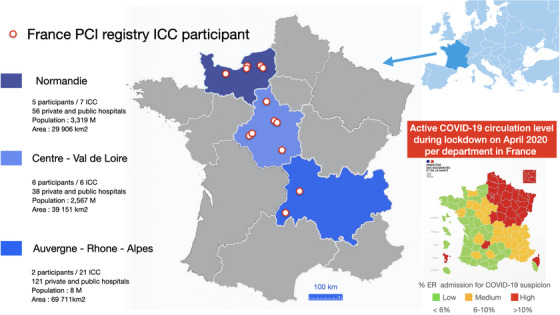
Objectives: The aim of this study was to assess the impact of the coronavirus disease 2019 (COVID-19) outbreak on incidence, delays, and outcomes of ST-elevation myocardial infarction (STEMI) patients undergoing primary percutaneous coronary intervention (PPCI) in France.
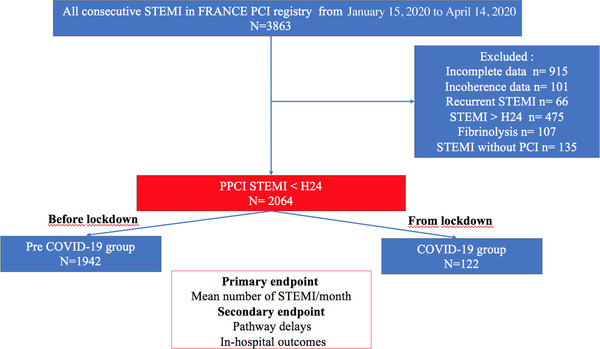
Methods: We analyzed all patients undergoing PPCI <24 hours STEMI included in the prospective France PCI registry. The 2 groups were compared on mean monthly number of patients, delays in the pathway care, and in-hospital major adverse cardiac events (MACE: death, stent thrombosis, myocardial infarction, unplanned coronary revascularization, stroke, and major bleeding).
Results: From January 15, 2019 to April 14, 2020, 2064 STEMI patients undergoing PPCI were included: 1942 in the prelockdown group and 122 in the lockdown group. Only 2 cases in the lockdown group were positive for COVID-19. A significant drop (12%) in mean number of STEMI/month was observed in the lockdown group compared with prelockdown (139 vs 122, P < 0.04). A significant increase in "symptom onset to first medical contact" delay was found for patients who presented directly to the emergency department (ED) (238 minutes vs 450 minutes; P = 0.04). There were higher rates of in-hospital MACE (7.7% vs 12.3%; P = 0.06) and mortality (4.9% vs 8.2%; P = 0.11) in the lockdown group but the differences were not significant.
Conclusion: According to the multicenter France PCI registry, the COVID-19 outbreak in France was associated with a significant decline in STEMI undergoing PPCI and longer transfer time for patients who presented directly to the ED. Mortality rates doubled, but the difference was not statistically significant.
Keywords: Acute coronary syndrom; COVID‐19; Myocardial infarction; Percutaneous coronary intervention; STEMI.
© 2020 The Authors. JACEP Open published by Wiley Periodicals LLC on behalf of the American College of Emergency Physicians.
Conflict of interest statement
The authors have no conflicts of interest to declare.
Figures
References
-
- Cannon CP, Gibson CM, Lambrew CT, et al. Relationship of symptom‐onset‐to‐balloon time and door‐to‐balloon time with mortality in patients undergoing angioplasty for acute myocardial infarction. JAMA 2000;283:2941‐2947. - PubMed
-
- Keeley EC, Boura JA, Grines CL. Primary angioplasty versus intravenous thrombolytic therapy for acute myocardial infarction: a quantitative review of 23 randomized trials. Lancet 2003;361:13–20. - PubMed
-
- Huber K, Gersh BI, Goldstein P, Granger CB, Armstrong PW. The organization, function, and outcomes of ST‐elevation myocardial infarction networks worldwide: current state, unmet needs and future directions. Eur Heart J 2014;35:1526‐1532. - PubMed
-
- Szerlip M, Anwaruddin S, Aronow HD, et al. Considerations for cardiac catheterization laboratory procedures during the COVID‐19 pandemic. Perspectives from the Society for Cardiovascular Angiography and Interventions Emerging Leader Mentorship (SCAI ELM) Members and Graduates. Catheter Cardiovasc Interv 2020;96(3):586‐597.. - PubMed
-
- Chieffo A, Stefanini GG, Price S, et al. EAPCI position statement on invasive management of acute coronary syndromes during the COVID‐19 pandemic. Eurointervention 2020;16:233‐246. - PubMed
LinkOut - more resources
Full Text Sources
Miscellaneous
