


Personality Traits and Disorders in Adolescents at Clinical High Risk for Psychosis: Toward a Clinically Meaningful Diagnosis
- PMID: 33363479
- PMCID: PMC7753018
- DOI: 10.3389/fpsyt.2020.562835
Personality Traits and Disorders in Adolescents at Clinical High Risk for Psychosis: Toward a Clinically Meaningful Diagnosis
Abstract
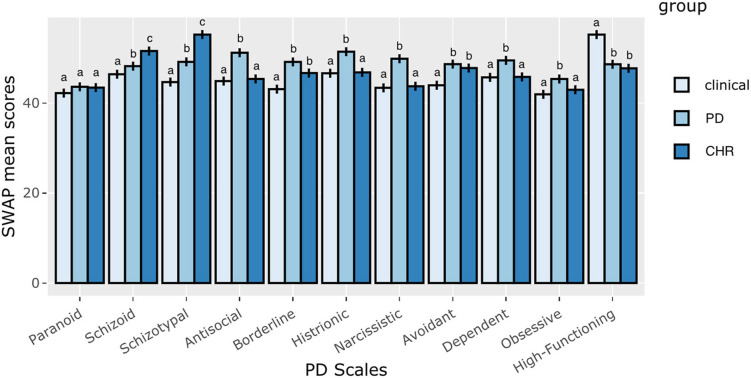
Aims: Recent meta-analytic data show that approximately 40% of individuals at clinical high risk for psychosis (CHR) receive at least one personality disorder (PD) diagnosis. Personality pathology could significantly influence CHR patients' prognosis and response to treatment. We aimed at exploring the PD traits of CHR adolescents, in order to outline a prototypic description of their most frequently observed personality characteristics. Methods: One hundred and twenty-three psychiatrists and psychologists used a Q-sort procedure [i.e., the Shedler-Westen Assessment Procedure-200 for Adolescents (SWAP-200-A)] to assess personality traits and disorders in 58 (30 male; mean age = 16 years, range = 13-19 years) CHR adolescents and two gender- and age-matched samples, respectively, with (n = 60) and without PDs (n = 59). Results: Differences between the CHR, PD, and clinical groups showed that CHR adolescents had pervasive and more clinically relevant schizoid, schizotypal, borderline, and avoidant traits, as well as poorer adaptive functioning. Moreover, by collecting the highest mean SWAP-200-A items, we empirically outlined a prototypic description of CHR youths, comprised of avoidance of social relationships; suspiciousness; obsessional thoughts; lack of psychological insight; dysphoric and overwhelming feelings of anxiety and depression; odd and anomalous reasoning processes or perceptual experiences; symptoms of depersonalization and derealization; and negative symptoms of avolition, abulia, blunted affects, and impaired role functioning. Conclusions: The results suggest that avoidant interpersonal strategies, impaired mentalization, and difficulties in emotional regulation could become important targets for psychosocial interventions with CHR adolescent populations.
Keywords: adolescence; clinical high risk (CHR) for psychosis; early detection & prevention; personality; personality traits.
Copyright © 2020 Boldrini, Tanzilli, Di Cicilia, Gualco, Lingiardi, Salcuni, Tata, Vicari and Pontillo.
Conflict of interest statement
The authors declare that the research was conducted in the absence of any commercial or financial relationships that could be construed as a potential conflict of interest. The handling editor declared a past collaboration with one of the authors SV.
Figures
References
LinkOut - more resources
Full Text Sources
Miscellaneous
