


THE ROLE OF TUMOR-SEEKING RADIOPHARMACEUTICALS IN THE DIAGNOSIS AND MANAGEMENT OF ADRENAL TUMORS
- PMID: 33363653
- PMCID: PMC7748228
- DOI: 10.4183/aeb.2020.316
THE ROLE OF TUMOR-SEEKING RADIOPHARMACEUTICALS IN THE DIAGNOSIS AND MANAGEMENT OF ADRENAL TUMORS
Abstract
Context: The variety of tumor-seeking radiopharmaceuticals, which are currently in clinical use, may have a potential role as imaging agents for adrenal gland tumors, due to physiological characteristics of this organ.
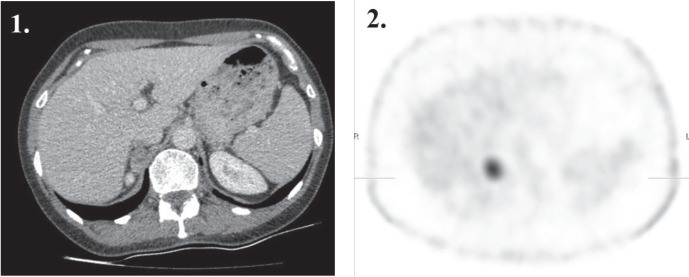
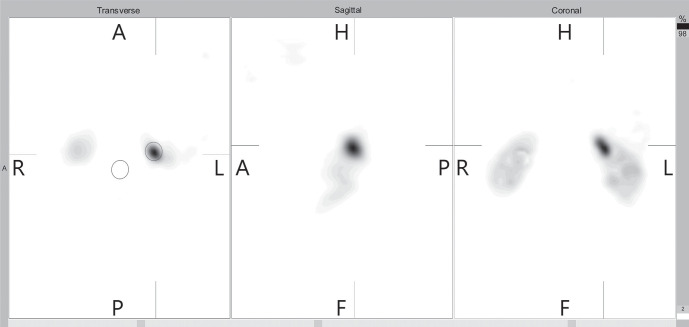
Objective: The purpose of this study was to evaluate the diagnostic potential of 99mTc-HYNIC-TOC, 99mTc(V)-DMSA, and 99mTc-MIBI in the assessment of adrenal tumors, by correlating with imaging findings and histopathologic results.
Design: The research is designed as a cross-sectional prospective study.
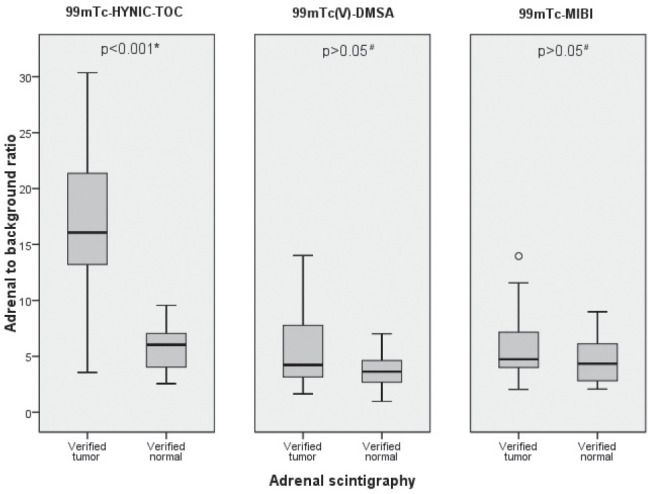
Patients and method: The study included 50 patients with adrenal tumors (19 hormone-secreting and 31 nonfunctioning) and 23 controls without adrenal involvement. In all patients, single-photon emission computed tomography (SPECT) was performed, using qualitative and semiquantitative analysis. The tumor to non-tumor tracer uptake was conducted by using a region-of-interest technique. Adrenal to background (A/B) ratio was calculated in all cases.
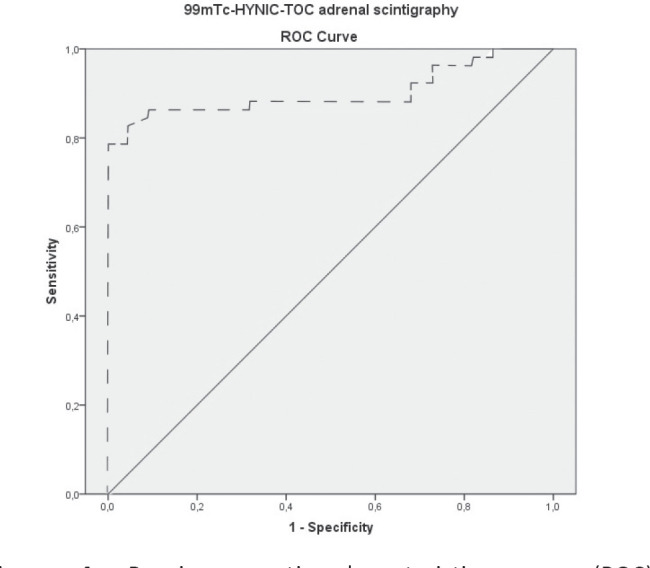
Results: 99mTc-HYNIC-TOC scintigraphy showed a high statistical significance between A/B ratios, while other two tracers resulted in a lower sensitivity, specificity and accuracy. Futhermore, 99mTc-HYNIC-TOC could have a high diagnostic yield to detect adrenal tumors (the receiver-operating-characteristic curve analysis, A/B ratio cut-off value of 8.40).
Conclusion: A semiquantitative SPECT analysis showed that 99mTc-HYNIC-TOC is a highly sensitive tumor-seeking agent for the accurate localization of adrenal tumors.
Keywords: 99mTc(V)-DMSA; 99mTc-HYNIC-TOC; 99mTc-MIBI; adrenal tumor; scintigraphy.
©by Acta Endocrinologica Foundation.
Conflict of interest statement
The authors declare that they have no conflict of interest.
Figures
References
-
- Lirov R, Else T, Lerario AM, Hammer GD. Adrenal Tumors. In: DeVita VT Jr, Lawrence TS, Rosenberg SA, editors. DeVita, Hellman, and Rosenberg’s Cancer: principles & practice of oncology. 10th ed. Philadelphia: Wolters Kluwer Health/Lippincott Williams & Wilkins; 2015. pp. 1195–1204.
-
- Fassnacht M, Arlt W, Bancos I, Dralle H, Newell-Price J, Sahdev A, Tabarin A, Terzolo M, Tsagarakis S, Dekkers OM. Management of adrenal incidentalomas: European society of endocrinology clinical practice guideline in collaboration with the European network for the study of adrenal tumors. Eur J Endocrinol. 2016;175(2):G1–G34. - PubMed
-
- Terzolo M, Stigliano A, Chiodini I, Loli P, Furlani L, Arnaldi G, Reimondo G, Pia A, Toscano V, Zini M, Borretta G, Papini E, Garofalo P, Allolio B, Dupas B, Mantero F, Tabarin A, Italian Association of Clinical Endocrinologists AME position statement on adrenal incidentaloma. Eur J Endocrinol. 2011;164(6):851–870. - PubMed
-
- Young WF. Clinical practice. The incidentally discovered adrenal mass. N Engl J Med. 2007;356(6):601–610. - PubMed
LinkOut - more resources
Full Text Sources