Inflammasome Proteins as Inflammatory Biomarkers of Age-Related Macular Degeneration
- PMID: 33364081
- PMCID: PMC7746957
- DOI: 10.1167/tvst.9.13.27
Inflammasome Proteins as Inflammatory Biomarkers of Age-Related Macular Degeneration
Abstract
Purpose: Age-related macular degeneration (AMD) can result in severe vision loss and blurriness in the older population. The early and intermediate stages of AMD typically start without noticeable symptoms and can only be detected with a comprehensive eye exam. Because of the quiet onset of the disease, it is necessary to identify potential biomarkers to aid in the diagnosis, staging, and association with disease onset. Inflammasome signaling proteins are prominent biomarkers in the central nervous system, and the inflammasome has been shown to play a role in the innate inflammatory response in aging and AMD.
Methods: Serum from healthy controls and AMD patients were analyzed for the protein levels of Apoptosis-associated speck-like protein containing a caspase recruitment domain (ASC), interleukin (IL)-18 and C-reactive protein (CRP) to determine cutoff points, positive and negative predictive values, and receiver operator characteristic curves, as well as univariate and multivariate linear and logistic regression models.
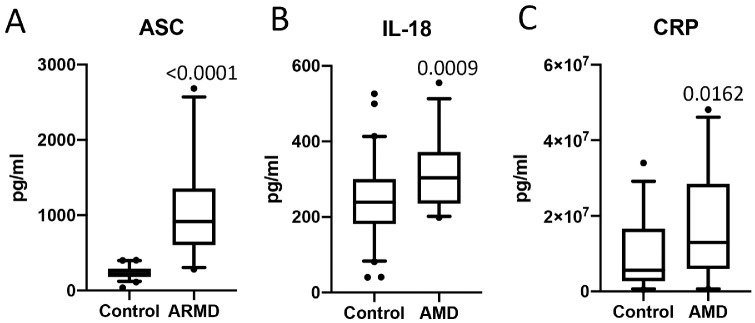
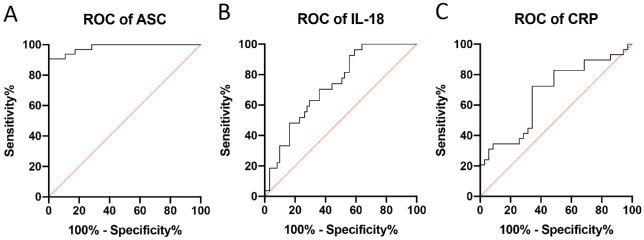
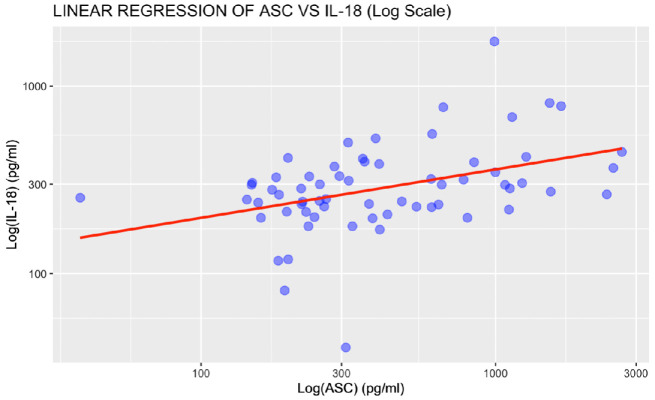
Results: ASC, IL-18, and CRP were elevated in the serum of AMD patients when compared to healthy controls. The area under the curve (AUC) for ASC was 0.98 with a cutoff point of 365.6 pg/mL, whereas IL-18 had an AUC of 0.73 and a cutoff point of 242.4 pg/mL, and the AUC for CRP was 0.67 with a cutoff point of 8,684,152 pg/mL. Levels of IL-18 had a statistically significant linear correlation with that of ASC with an adjusted R2 of 0.1906, indicating that 19% of IL-18 could be explained by ASC protein levels in serum. Moreover, a logistic regression model for the diagnosis of AMD consists of ASC and having a diagnosis of hypertension, indicating that these two factors (elevated levels of ASC and a diagnosis of hypertension [HTN]) are associated with the diagnosis of AMD.
Conclusions: ASC, IL-18, and CRP are elevated in patients with AMD, and the protein levels of IL-18 are partially the result of ASC protein expression. Moreover, elevated protein levels of ASC in serum and a diagnosis of HTN increase the odds of patients having a diagnosis of AMD.
Translational relevance: Biomarkers of AMD may be used to monitor disease risk, response to treatment and disease progression.
Keywords: ASC, IL-18; biomarkers; inflammasome; macular degeneration.
Copyright 2020 The Authors.
Conflict of interest statement
Disclosure: C. Weaver, None; B. Cyr, None; J.C. de Rivero Vaccari, None; J.P. de Rivero Vaccari, InflamaCORE, LLC (P); ZyVersa Therapeutics (C)
Figures
References
-
- Wong WL, Su X, Li X, et al.. Global prevalence of age-related macular degeneration and disease burden projection for 2020 and 2040: a systematic review and meta-analysis. Lancet Glob Health. 2014; 2: e106–e116. - PubMed
-
- Bird AC, Bressler NM, Bressler SB, et al.. An international classification and grading system for age-related maculopathy and age-related macular degeneration. The International ARM Epidemiological Study Group. Surv Ophthalmol. 1995; 39: 367–374. - PubMed
-
- Zarbin MA. Current concepts in the pathogenesis of age-related macular degeneration. Arch Ophthalmol. 2004; 122: 598–614. - PubMed
-
- Ozaki E, Campbell M, Kiang AS, Humphries M, Doyle SL, Humphries P. Inflammation in age-related macular degeneration. Adv Exp Med Biol. 2014; 801: 229–235. - PubMed
Publication types
MeSH terms
Substances
LinkOut - more resources
Full Text Sources
Medical
Research Materials
Miscellaneous