Review
. 2020 Dec 8:8:608412.
doi: 10.3389/fcell.2020.608412. eCollection 2020.

Microenvironmental Determinants of Breast Cancer Metastasis: Focus on the Crucial Interplay Between Estrogen and Insulin/Insulin-Like Growth Factor Signaling

Affiliations
Review

Microenvironmental Determinants of Breast Cancer Metastasis: Focus on the Crucial Interplay Between Estrogen and Insulin/Insulin-Like Growth Factor Signaling

Veronica Vella et al. Front Cell Dev Biol. .

Abstract

The development and progression of the great majority of breast cancers (BCs) are mainly dependent on the biological action elicited by estrogens through the classical estrogen receptor (ER), as well as the alternate receptor named G-protein-coupled estrogen receptor (GPER). In addition to estrogens, other hormones and growth factors, including the insulin and insulin-like growth factor system (IIGFs), play a role in BC. IIGFs cooperates with estrogen signaling to generate a multilevel cross-communication that ultimately facilitates the transition toward aggressive and life-threatening BC phenotypes. In this regard, the majority of BC deaths are correlated with the formation of metastatic lesions at distant sites. A thorough scrutiny of the biological and biochemical events orchestrating metastasis formation and dissemination has shown that virtually all cell types within the tumor microenvironment work closely with BC cells to seed cancerous units at distant sites. By establishing an intricate scheme of paracrine interactions that lead to the expression of genes involved in metastasis initiation, progression, and virulence, the cross-talk between BC cells and the surrounding microenvironmental components does dictate tumor fate and patients' prognosis. Following (i) a description of the main microenvironmental events prompting BC metastases and (ii) a concise overview of estrogen and the IIGFs signaling and their major regulatory functions in BC, here we provide a comprehensive analysis of the most recent findings on the role of these transduction pathways toward metastatic dissemination. In particular, we focused our attention on the main microenvironmental targets of the estrogen-IIGFs interplay, and we recapitulated relevant molecular nodes that orientate shared biological responses fostering the metastatic program. On the basis of available studies, we propose that a functional cross-talk between estrogens and IIGFs, by affecting the BC microenvironment, may contribute to the metastatic process and may be regarded as a novel target for combination therapies aimed at preventing the metastatic evolution.

Keywords: GPER; breast cancer; estrogen receptor; insulin/IGF signaling; metastasis; targeted therapies; tumor microenvionment.


Conflict of interest statement

The authors declare that the research was conducted in the absence of any commercial or financial relationships that could be construed as a potential conflict of interest.

Figures
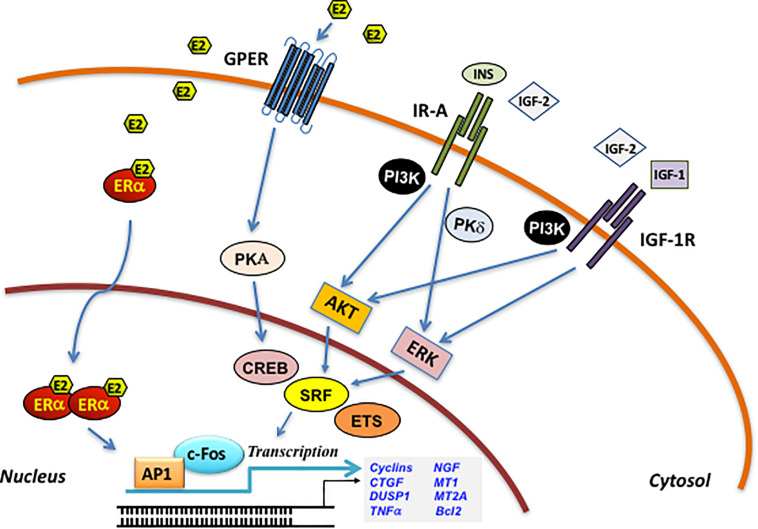
FIGURE 1
FIGURE 1
Schematic illustration of the ERα/GPER and IIGFs cross-talk. Insulin, IGF-2, and IGF-1 bind to their specific receptors and stimulate rapid signals converging to the activation of PI3K, MAPK, and PKδ networks. These pathways, in turn, trigger the activation of transcription factors including CREB, SRF, and ETS, which favor c-fos induction and its recruitment to the AP-1 site. ERα/GPER activation by E2, through the activation of various intermediates, cross-talks with the IIGFs leading to enhanced mitogenic signals. PKA, protein kinase A; PKCδ, protein kinase C, δ isoform; MAPK, mitogen-activated protein kinases; PI3K, phosphatidyl-inositol-3-kinases; ERK, extracellular signal-regulated kinases; AKT, protein kinase B; CREB, cAMP-response element-binding protein; ETS, E26 transformation specific; SRF, serum response factor; c-fos, FBJ murine osteosarcoma virus; AP-1, activator protein-1; CTGF, connective tissue growth factor; DUSP1, dual specificity protein phosphatase 1; TNF-α, tumor necrosis factor α; NGF, nerve growth factor; MT1, metallothionein 1; MT2A, metallothionein 2A; Bcl2, B-cell lymphoma 2.
FIGURE 2
FIGURE 2
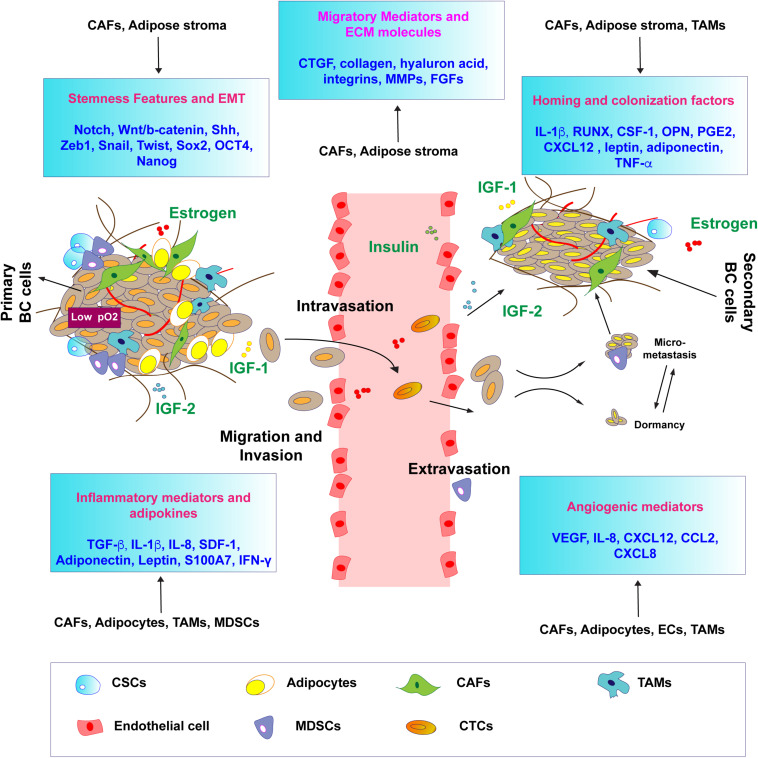
Estrogen and IIGF-prompted microenvironmental responses conducive to BC metastasis. Schematic representation of the main biological responses and shared mediators (in boxes) regulated by both estrogen signaling and by IIGFs, shaping the tumor microenvironment toward metastatic progression. Both estrogen and IIGFs signaling regulate the expression of inflammatory, migratory, and angiogenic mediators by modulating paracrine responses in the tumor microenvironment. The activation of developmental pathways and EMT programs, under the control of estrogen and IIGFs-regulated genes, is responsible for the acquisition of stemness features associated with metastatic progression. Homing and colonization factors under the influence of estrogen and IIGFs trigger BC cells priming to the metastatic sites. CTCs, circulating tumor cell; CSCs, cancer stem cells; CAFs; cancer-associated fibroblasts; TAMs, tumor-associated fibroblasts; MDSCs, myeloid-derived suppressor cells.

References

    1. Aceto N., Bardia A., Miyamoto D. T., Donaldson M. C., Wittner B. S., Spencer J. A., et al. (2014). Circulating tumor cell clusters are oligoclonal precursors of breast cancer metastasis. Cell 158 1110–1122. 10.1016/j.cell.2014.07.013 - DOI - PMC - PubMed
    1. Alba-Castellón L., Olivera-Salguero R., Mestre-Farrera A., Peña R., Herrera M., Bonilla F., et al. (2016). Snail1-dependent activation of cancer-associated fibroblast controls epithelial tumor cell invasion and metastasis. Cancer Res. 76 6205–6217. 10.1158/0008-5472.CAN-16-0176 - DOI - PubMed
    1. Alferez D. G., Simões B. M., Howell S. J., Clarke R. B. (2018). The Role of steroid hormones in breast and effects on cancer stem cells. Curr. Stem Cell Rep. 4 81–94. 10.1007/s40778-018-0114-z - DOI - PMC - PubMed
    1. Ao Z., Shah S. H., Machlin L. M., Parajuli R., Miller P. C., Rawal S., et al. (2015). Identification of cancer-associated fibroblasts in circulating blood from patients with metastatic breast cancer. Cancer Res. 75 4681–4687. 10.1158/0008-5472.CAN-15-1633 - DOI - PubMed
    1. Auricchio F., Migliaccio A., Castoria G. (2008). Sex-steroid hormones and EGF signalling in breast and prostate cancer cells: targeting the association of Src with steroid receptors. Steroids 73 880–884. 10.1016/j.steroids.2008.01.023 - DOI - PubMed

LinkOut - more resources