. 2020 Nov;2(4):539-552.
doi: 10.1016/j.jaccao.2020.09.006. Epub 2020 Dec 22.

Genetics of Anthracycline Cardiomyopathy in Cancer Survivors: JACC: CardioOncology State-of-the-Art Review

Affiliations

Genetics of Anthracycline Cardiomyopathy in Cancer Survivors: JACC: CardioOncology State-of-the-Art Review

Smita Bhatia. JACC CardioOncol. 2020 Nov.

Abstract

Anthracyclines are an integral part of chemotherapy regimens used to treat a variety of childhood-onset and adult-onset cancers. However, the development of cardiac dysfunction and heart failure often compromises the clinical utility of anthracyclines. The risk of cardiac dysfunction increases with anthracycline dose. This anthracycline-cardiac dysfunction association is modified by several demographic and clinical factors, such as age at anthracycline exposure (<4 years and ≥65 years); female sex; chest radiation; presence of cardiovascular risk factors (diabetes, hypertension); and concurrent use of cyclophosphamide, paclitaxel, and trastuzumab. However, the clinical variables alone yield modest predictive power in detecting cardiac dysfunction. Recently, attention has focused on the molecular basis of anthracycline-related cardiac dysfunction, providing an initial understanding of the mechanism of anthracycline-related cardiomyopathy. This review describes the current state of knowledge with respect to the pathogenesis of anthracycline-related cardiomyopathy and identifies the critical next steps to mitigate this problem.

Keywords: anthracycline chemotherapy; cardiomyopathy; genomics; heart failure; metabolomics; prediction.


Conflict of interest statement

Dr. Bhatia has received funding from the National Institutes of Health (R35CA220502), Leukemia Lymphoma Society (6563-19), and V Foundation (DT2019-010).

Figures

None
Graphical abstract
Figure 1
Figure 1
Dose-Response Relationship Between Cumulative Anthracycline Exposure and Risk of Cardiomyopathy The dose-response relationship between cumulative anthracycline exposure and risk of cardiomyopathy is shown. A total of 170 survivors with cardiomyopathy (cases) were compared with 317 survivors with no cardiomyopathy (control subjects; matched on cancer diagnosis, year of diagnosis, length of follow-up, and race/ethnicity) using conditional logistic regression techniques. A dose-dependent association was observed between cumulative anthracycline exposure and cardiomyopathy risk (0 mg/m2: reference; 1 to 100 mg/m2: odds ratio [OR]: 1.65; 101 to 150 mg/m2: OR: 3.85; 151 to 200 mg/m2: OR: 3.69; 201 to 250 mg/m2: OR: 7.23; 251 to 300 mg/m2: OR: 23.47; >300 mg/m2: OR: 27.59; ptrend <0.001). Reprinted with permission from Blanco et al. (28).
Central Illustration
Proposed Pathogenesis of Anthracycline-Related Cardiomyopathy The identified genetic associations are placed in the context of a proposed pathogenesis of anthracycline-related cardiomyopathy. The proposed mechanisms include transport of anthracyclines across the cardiomyocyte cell membrane, generation of reactive oxygen species (ROS), deoxyribonucleic damage response and repair, mitochondrial dysfunction, generation of cardiotoxic anthracycline metabolites, and sarcomere disruption. Top2b = topoisomerase-IIβ
Figure 2
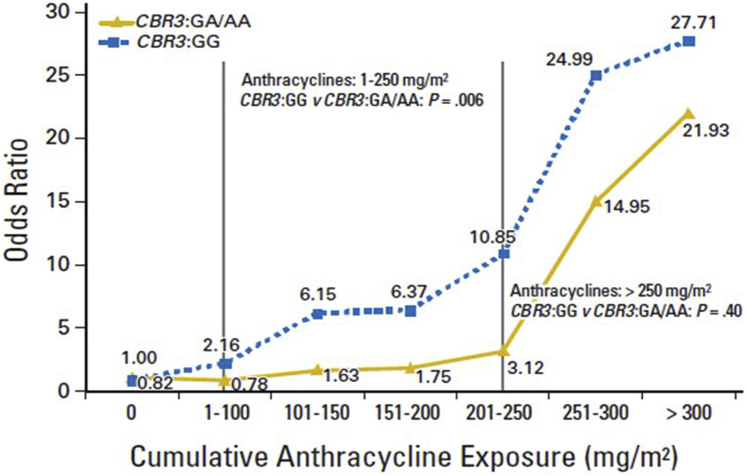
Figure 2
Dose-Response Relationship Between Cumulative Anthracycline Exposure and Risk of Cardiomyopathy Stratified by Patient CBR3 Genotype Status The dose-response relationship between cumulative anthracycline exposure and risk of cardiomyopathy stratified by patients’ CBR3 genotype status (CBR3:GG and CBR3:GA/AA) is shown. A total of 170 survivors with cardiomyopathy (cases) were compared with 317 survivors with no cardiomyopathy (control subjects; matched on cancer diagnosis, year of diagnosis, length of follow-up, and race/ethnicity) using conditional logistic regression techniques. Among individuals carrying the variant A allele (CBR1:GA/AA and/or CBR3:GA/AA), exposure to low- to moderate-dose anthracyclines (1 to 250 mg/m2) did not increase the risk of cardiomyopathy. Among individuals with CBR3 V244M homozygous G genotypes (CBR3:GG), exposure to low- to moderate-dose anthracyclines increased cardiomyopathy risk when compared with individuals with CBR3:GA/AA genotypes unexposed to anthracyclines (odds ratio: 5.48; p = 0.003), as well as exposed to low- to moderate-dose anthracyclines (odds ratio: 3.30; p = 0.006). High-dose anthracyclines (>250 mg/m2) were associated with increased cardiomyopathy risk, irrespective of CBR genotype status. Reprinted with permission from Blanco et al. (28).
Figure 3
Figure 3
Risk of Cardiomyopathy by Anthracycline Dose and HAS3 rs2232228 Genotype Status The risks of cardiomyopathy by anthracycline dose and HAS3 rs2232228 genotype status (AA, GA, GG) are shown. By using a matched case-control design (93 cases, 194 control subjects), a common single nucleotide polymorphism, rs2232228, in HAS3 was identified. This single nucleotide polymorphism exerted a modifying effect on anthracycline dose-dependent cardiomyopathy risk (p = 5.3 × 10−7). Among individuals with rs2232228 GG genotype, cardiomyopathy was infrequent and not dose related. However, in individuals exposed to high-dose (>250 mg/m2) anthracyclines, the rs2232228 AA genotype conferred an 8.9-fold (95% confidence interval: 2.1- to 37.5-fold; p = 0.003) increased cardiomyopathy risk compared with the GG genotype. Reprinted with permission from Wang et al. (20). OR = odds ratio.
Figure 4
Figure 4
Risk of Cardiomyopathy by Anthracycline Dose and CELF4 rs1786814 Genotype Status The risks of cardiomyopathy by anthracycline dose and CELF4 rs1786814 genotype status (AA, GA, GG) are shown. A genome-wide association study was conducted in childhood cancer survivors with and without cardiomyopathy (cases and control subjects, respectively). No single nucleotide polymorphism was marginally associated with cardiomyopathy. However, single nucleotide polymorphism rs1786814 on CELF4 passed the significance cutoff for gene-environment interaction (pGE = 1.14 × 10−5). Multivariable analyses adjusted for age at cancer diagnosis, sex, anthracycline dose, and chest radiation revealed that, among patients with the A allele, cardiomyopathy was infrequent and not dose related. However, among those exposed to >300 mg/m2 of anthracyclines, the rs1786814 GG genotype conferred a 10.2-fold (95% confidence interval: 3.8- to 27.3-fold; p < 0.001) increased risk of cardiomyopathy compared with those who had GA/AA genotypes and anthracycline exposure of 300 mg/m2 or less. Reprinted with permission from Wang et al. (21). OR = odds ratio.

References

    1. Baech J., Hansen S.M., Lund P.E. Cumulative anthracycline exposure and risk of cardiotoxicity; a Danish nationwide cohort study of 2440 lymphoma patients treated with or without anthracyclines. Br J Haematol. 2018;183:717–726. - PubMed
    1. Nabhan C., Byrtek M., Rai A. Disease characteristics, treatment patterns, prognosis, outcomes and lymphoma-related mortality in elderly follicular lymphoma in the United States. Br J Haematol. 2015;170:85–95. - PMC - PubMed
    1. Chihara D., Westin J.R., Oki Y. Management strategies and outcomes for very elderly patients with diffuse large B-cell lymphoma. Cancer. 2016;122:3145–3151. - PubMed
    1. van Dalen E.C., van der Pal H.J., Kok W.E., Caron H.N., Kremer L.C. Clinical heart failure in a cohort of children treated with anthracyclines: a long-term follow-up study. Eur J Cancer. 2006;42:3191–3198. - PubMed
    1. Krischer J.P., Epstein S., Cuthbertson D.D., Goorin A.M., Epstein M.L., Lipshultz S.E. Clinical cardiotoxicity following anthracycline treatment for childhood cancer: the Pediatric Oncology Group experience. J Clin Oncol. 1997;15:1544–1552. - PubMed