


Behavioral and Neural Effects of Familiarization on Object-Background Associations
- PMID: 33365002
- PMCID: PMC7750435
- DOI: 10.3389/fpsyg.2020.591231
Behavioral and Neural Effects of Familiarization on Object-Background Associations
Abstract
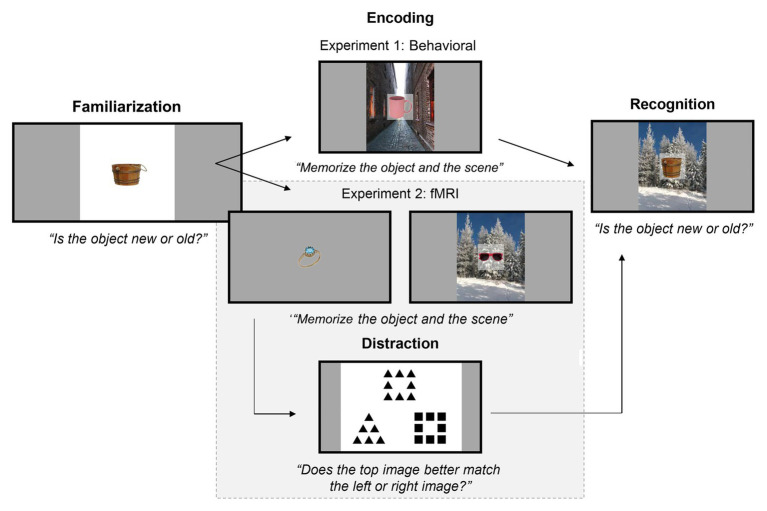
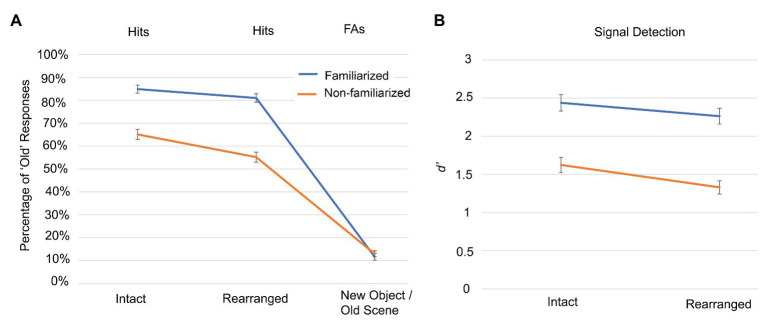
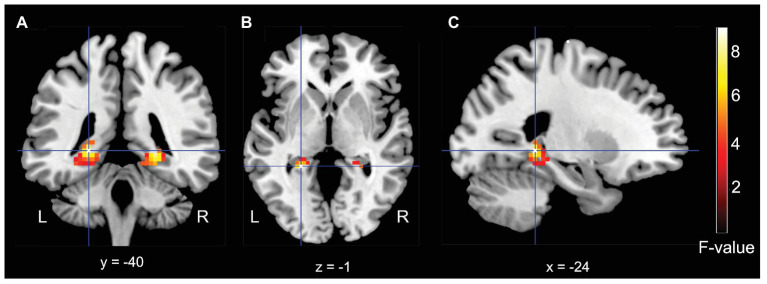
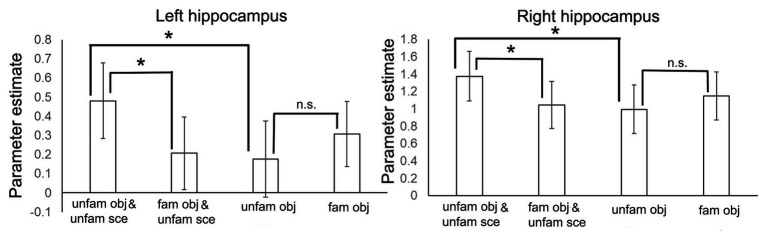
Associative memory is the ability to link together components of stimuli. Previous evidence suggests that prior familiarization with study items affects the nature of the association between stimuli. More specifically, novel stimuli are learned in a more context-dependent fashion than stimuli that have been encountered previously without the current context. In the current study, we first acquired behavioral data from 62 human participants to conceptually replicate this effect. Participants were instructed to memorize multiple object-scene pairs (study phase) and were then tested on their recognition memory for the objects (test phase). Importantly, 1 day prior, participants had been familiarized with half of the object stimuli. During the test phase, the objects were either matched to the same scene as during study (intact pair) or swapped with a different object's scene (rearranged pair). Our results conceptually replicated the context-dependency effect by showing that breaking up a studied object-context pairing is more detrimental to object recognition performance for non-familiarized objects than for familiarized objects. Second, we used functional magnetic resonance imaging (fMRI) to determine whether medial temporal lobe encoding-related activity patterns are reflective of this familiarity-related context effect. Data acquired from 25 human participants indicated a larger effect of familiarization on encoding-related hippocampal activity for objects presented within a scene context compared to objects presented alone. Our results showed that both retrieval-related accuracy patterns and hippocampal activation patterns were in line with a familiarization-mediated context-dependency effect.
Keywords: associative memory; context-dependent; functional magnetic resonance imaging; hippocampus; medial temporal lobe.
Copyright © 2020 Baumann, McFadyen and Humphreys.
Conflict of interest statement
The authors declare that the research was conducted in the absence of any commercial or financial relationships that could be construed as a potential conflict of interest.
Figures
References
-
- Ashburner J., Barnes G., Chen C.-C., Daunizeau J., Flandin G., Friston K., et al. (2014). SPM12 manual. London, UK: Wellcome Trust Centre for neuroimaging.
-
- Bain J. D., Humphreys M. S. (1988). “The relational context effect: cues, meanings or configurations?” in Memory in context: Context in memory. eds. Davies G., Thomson D. (London: Wiley; ), 97–138.
-
- Chalmers K. A., Humphreys M. S. (1998). Role of generalized and episode specific memories in the word frequency effect in recognition. J. Exp. Psychol. Learn. Mem. Cogn. 24, 610–632. 10.1037/0278-7393.24.3.610 - DOI
Publication types
LinkOut - more resources
Full Text Sources
