


Complement Inhibition for the Treatment of Myasthenia Gravis
- PMID: 33365280
- PMCID: PMC7751298
- DOI: 10.2147/ITT.S261414
Complement Inhibition for the Treatment of Myasthenia Gravis
Abstract
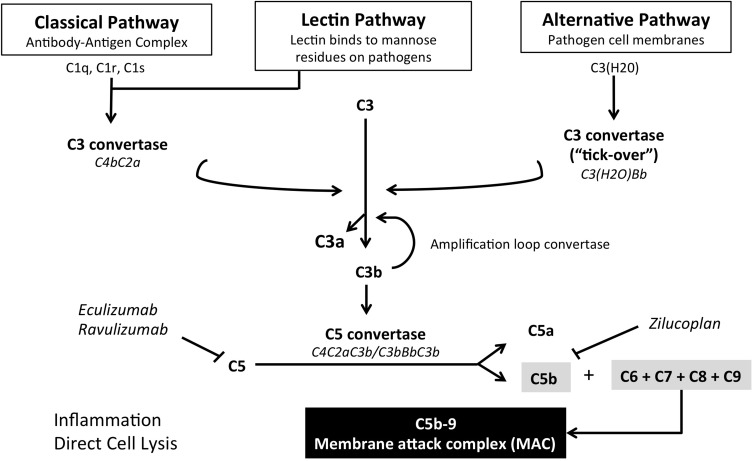
Generalized myasthenia gravis (gMG) is a rare autoimmune disorder affecting the neuromuscular junction (NMJ). Approximately 80-90% of patients display antibodies directed against the nicotinic acetylcholine receptor (AChR). A major drive of AChR antibody-positive MG pathology is represented by complement activation. The role of the complement cascade has been largely demonstrated in patients and in MG animal models. Complement activation at the NMJ leads to focal lysis of the post-synaptic membrane, disruption of the characteristic folds, and reduction of AChR. Given that the complement system works as an activation cascade, there are many potential targets that can be considered for therapeutic intervention. Preclinical studies have confirmed the efficacy of complement inhibition in ameliorating MG symptoms. Eculizumab, an antibody directed towards C5, has recently been approved for the treatment of AChR antibody-positive gMG. Other complement inhibitors, targeting C5 as well, are currently under phase III study. Complement inhibitors, however, may present prohibitive costs. Therefore, the identification of a subset of patients more or less prone to respond to such therapies would be beneficial. For such purpose, there is a critical need to identify possible biomarkers predictive of therapeutic response, a field not yet sufficiently explored in MG. This review aims to give an overview of the complement cascade involvement in MG, the evolution of complement-inhibiting therapies and possible biomarkers useful to tailor and monitor complement-directed therapies.
Keywords: C5; biological drugs; biomarkers; complement system; myasthenia gravis.
© 2020 Mantegazza et al.
Conflict of interest statement
Renato Mantegazza has received compensation for partecipating on Advisory Boards in relation to MG clinical trial design, Congress partecipations and research support in the last 5 years from: Alexion Pharmaceuticals, ARGENX Pharma, and Biomarin. The other authors report no potential conflicts of interest for this work.
Figures
References
-
- Gilhus NE, Tzartos S, Evoli A, Palace J, Burns TM, Verschuuren JJGM. Myasthenia gravis. Nat Rev Dis Primers. 2019;5(1):30. - PubMed
Publication types
LinkOut - more resources
Full Text Sources
Other Literature Sources
Miscellaneous
