Review
. 2020 Feb 13;1(2):100030.
doi: 10.1016/j.xplc.2020.100030. eCollection 2020 Mar 9.

Light Regulation of Stomatal Development and Patterning: Shifting the Paradigm from Arabidopsis to Grasses

Affiliations
Review

Light Regulation of Stomatal Development and Patterning: Shifting the Paradigm from Arabidopsis to Grasses

Hongbin Wei et al. Plant Commun. .

Abstract

The stomatal pores of plant leaves control gas exchange with the environment. Stomatal development is prevised regulated by both internal genetic programs and environmental cues. Among various environmental factors, light regulation of stomata formation has been extensively studied in Arabidopsis. In this review, we summarize recent advances in the genetic control of stomata development and its regulation by light. We also present a comparative analysis of the conserved and diverged stomatal regulatory networks between Arabidopsis and cereal grasses. Lastly, we provide our perspectives on manipulation of the stomata density on plant leaves for the purpose of breeding crops that are better adapted to the adverse environment and high-density planting conditions.

Keywords: Arabidopsis; cereal crops; light signaling; spacing patterns; stomatal development.


Figures

Figure 1
Figure 1
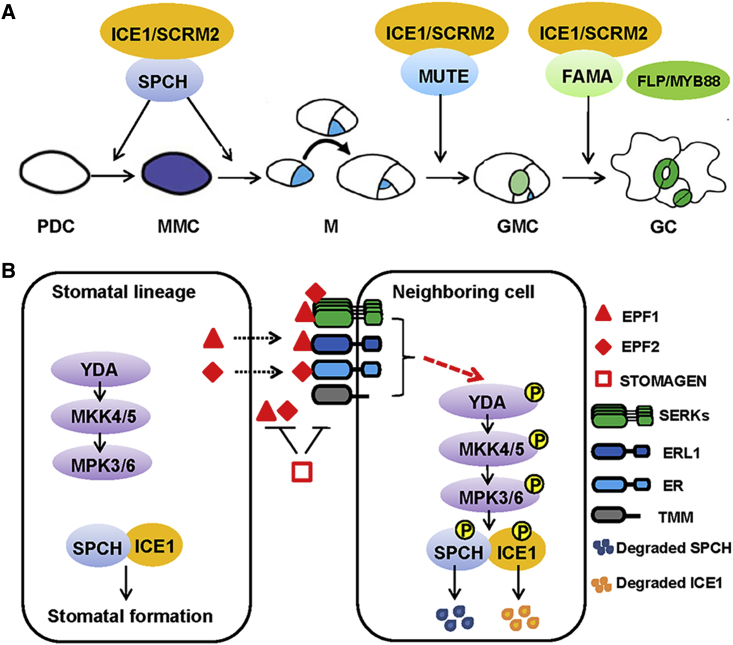
Schematic Model of the Signal Transduction Networks Regulating Stomatal Development in Arabidopsis. (A) Diagram of cell-state transitional steps within stomatal cell lineages in Arabidopsis. The schematic model is modified from Torii (2015). The bHLH transcription factors SPCHLESS (SPCH), MUTE, and FAMA sequentially control the initiation, transition, and differentiation steps, respectively. ICE1/SCRM promotes stomatal development through forming heterodimers with SPCH, MUTE, or FAMA. FOUR LIPS (FLP) and its redundant paralog MYB88 also regulate the GMC symmetric division and GC maturation. PDC, protoderm cell; MMC, meristemoid mother cell; M, meristemoid; GMC, guard mother cell; GC, guard cell. (B) The negative regulatory pathways involve ligands EPIDERMAL PATTERNING FACTORS (EPF1, EPF2), membrane localized receptor-like kinases including the ERECTA family receptors (ER, ERL1), the kinase-like protein TOO MANY MOUTH (TMM) and SOMATIC EMBRYOGENESIS RECEPTOR KINASEs (SERKs) family receptors (SERK1, SERK2, SERK3/BAK1, SERK4), and the downstream YDA-MKK4/5-MPK3/6 signaling cascade. EPF2 and EPF1 are highly expressed in the stomatal lineage cells, and are secreted from stomatal precursors to restrict the neighboring cells from entering into the stomatal lineage. STOMAGEN/EPF9, expressed in the internal mesophyll cells, competes with EPF2/EPF1 to bind ER/ERL1, thus inhibiting signaling via TMM. SERKs form heterodimers with ER/ERL1 and TMM in a ligand-induced manner. The ligand–receptor–coreceptor complexes activate the YDA-MKK4/5-MPK3/6 signaling cascade by an as yet unidentified mechanism, which leads to phosphorylation and proteasome-mediated degradation of SPCH/ICE1 and eventual arrest of stomatal development in the neighboring cells.
Figure 2
Figure 2
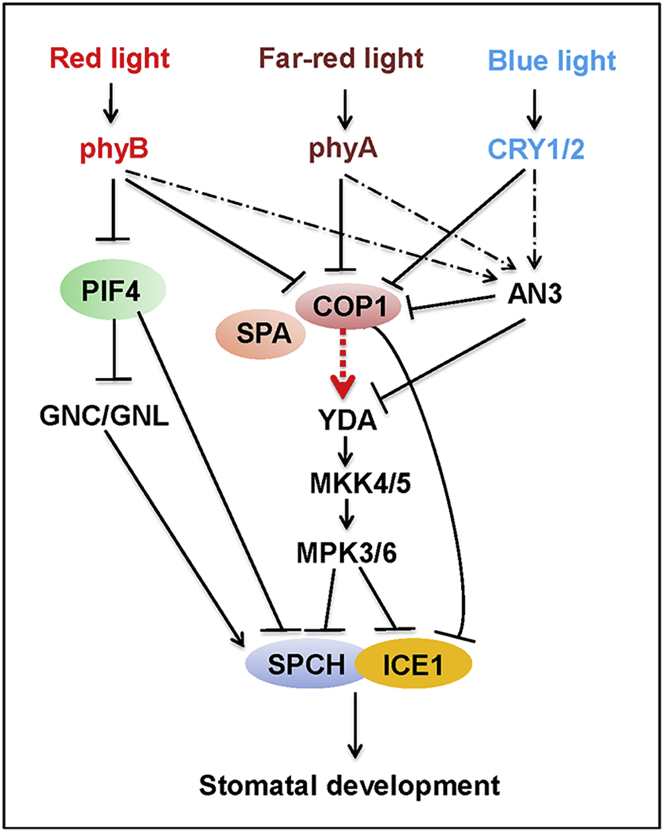
Model for the Light Regulation of Stomatal Development and Patterning. COP1 activates the YDA-MKK4/5-MAPK3/6 cascade to mediate protein degradation of SPCH and ICE1, or directly mediates the degradation of ICE1. How COP1 regulates YDA remains an intriguing question to be elucidated. Meanwhile, PIF4 represses transcription of SPCH and GNC/GNL that promotes stomatal development through upregulating the expression of SPCH. In conditions of light, red- and far-red light photoreceptors (phyB and phyA) and blue-light photoreceptors CRY1/2 act in concert to suppress COP1 and PIF4 activity and the associated downstream networks, thus promoting stomatal development. Besides, light promotes transcription and protein abundance of AN3, likely through the photoreceptor-mediated pathways, which then repress the expression of COP1 and YDA. Arrow and bar-ended lines represent activation and inhibition, respectively. Solid lines indicate direct regulation. Dotted lines indicate indirect regulation or through an unidentified mechanism.
Figure 3
Figure 3
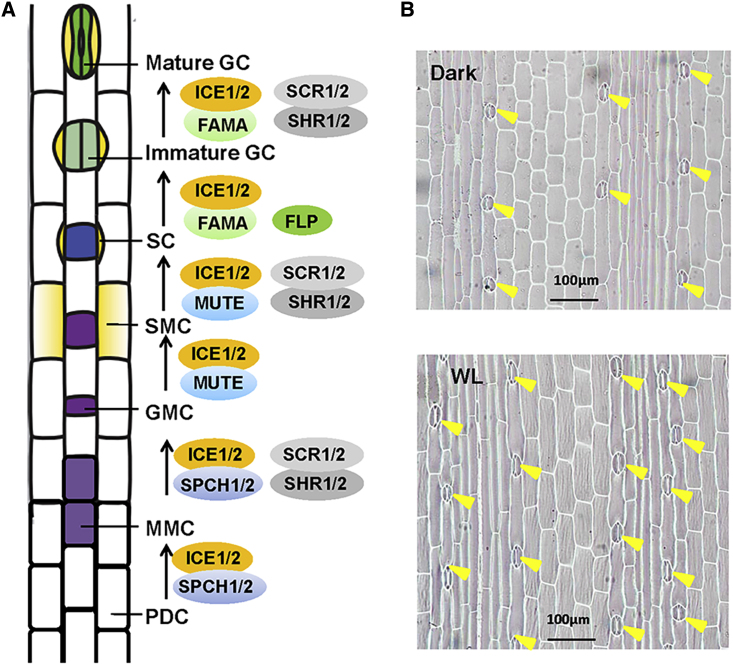
Schematic Model for Stomatal Development in Grasses. (A) A schematic model of stomata development in monocots based on Brachypodium and rice, modified from Raissig et al. (2017). The developmental process of stomata in grasses can be divided into six steps: (1) stomatal file establishment, (2) asymmetric entry division to produce GMC, (3) establishment of SMC, (4) SMC asymmetric division to form SC, (5) GMC symmetric division to form two immature GCs, and (6) maturation of two dumbbell-shaped GCs flanked by two SCs. Grass SPCH1/2 proteins promote the acquisition of stomata file identity and asymmetric entry division to form GMC. The grass MUTE has a unique feature to move from GMCs into SMC where it acts to promote the asymmetric division of SMC to form SCs. FAMA and FLP regulate the symmetric division of GMC and the maturation of GCs. Like the Arabidopsis counterparts, grass ICE1/2 proteins form heterodimers with SPCH1/2, MUTE, or FAMA. In rice, SCR1/2 and SHR1/2, which encode GRAS family proteins, have been shown to act together to control the initiation of stomatal lineage cells, formation of subsidiary cells, and maturation of GCs. PDC, protoderm cells; MMC, meristemoid mother cell; GMC, guard mother cell; SMC, subsidiary mother cell; SC, subsidiary cell; GC, guard cell. (B) Light promotes stomata formation in maize leaves. Five-day-old maize seedlings grown in darkness were transferred to white light (WL) for 36 h. Light exposure significantly increased the stomata number per unit area of seedling leaf. The stomata are indicated by yellow arrowheads.

References

    1. Abrash E., Anleu G.M.X., Matos J.L., Bergmann D.C. Conservation and divergence of YODA MAPKKK function in regulation of grass epidermal patterning. Development. 2018;145 doi: 10.1242/dev.165860. - DOI - PMC - PubMed
    1. Balcerowicz M., Ranjan A., Rupprecht L., Fiene G., Hoecker U. Auxin represses stomatal development in dark-grown seedlings via Aux/IAA proteins. Development. 2014;141:3165–3176. - PubMed
    1. Caine R.S., Yin X., Sloan J., Harrison E.L., Mohammed U., Fulton T., Biswal A.K., Dionora J., Chater C.C., Coe R.A. Rice with reduced stomatal density conserves water and has improved drought tolerance under future climate conditions. New Phytol. 2019;221:371–384. - PMC - PubMed
    1. Camilleri C., Azimzadeh J., Pastuglia M., Bellini C., Grandjean O., Bouchez D. The Arabidopsis TONNEAU2 gene encodes a putative novel protein phosphatase 2A regulatory subunit essential for the control of the cortical cytoskeleton. Plant Cell. 2002;14:833–845. - PMC - PubMed
    1. Cartwright H.N., Humphries J.A., Smith L.G. PAN1: a receptor-like protein that promotes polarization of an asymmetric cell division in maize. Science. 2009;323:649–651. - PubMed

Publication types

LinkOut - more resources