


Effect of Whole-Genome Duplication on the Evolutionary Rescue of Sterile Hybrid Monkeyflowers
- PMID: 33367262
- PMCID: PMC7747968
- DOI: 10.1016/j.xplc.2020.100093
Effect of Whole-Genome Duplication on the Evolutionary Rescue of Sterile Hybrid Monkeyflowers
Abstract
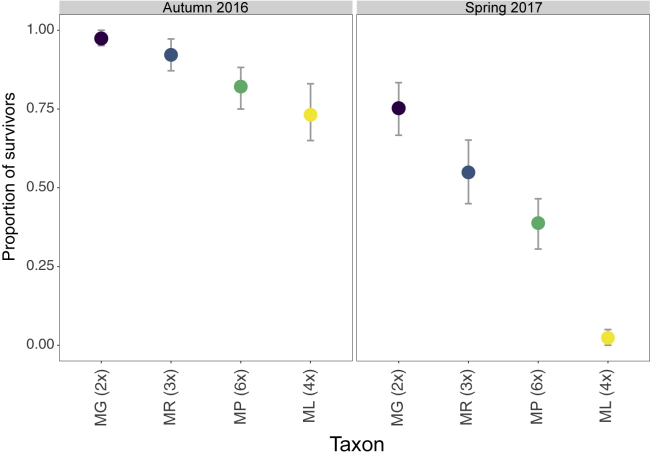
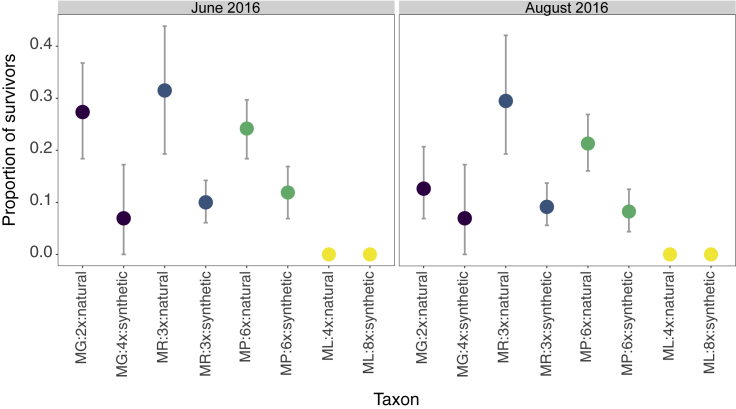
Hybridization is a creative evolutionary force, increasing genomic diversity and facilitating adaptation and even speciation. Hybrids often face significant challenges to establishment, including reduced fertility that arises from genomic incompatibilities between their parents. Whole-genome duplication in hybrids (allopolyploidy) can restore fertility, cause immediate phenotypic changes, and generate reproductive isolation. Yet the survival of polyploid lineages is uncertain, and few studies have compared the performance of recently formed allopolyploids and their parents under field conditions. Here, we use natural and synthetically produced hybrid and polyploid monkeyflowers (Mimulus spp.) to study how polyploidy contributes to the fertility, reproductive isolation, phenotype, and performance of hybrids in the field. We find that polyploidization restores fertility and that allopolyploids are reproductively isolated from their parents. The phenotype of allopolyploids displays the classic gigas effect of whole-genome duplication, in which plants have larger organs and are slower to flower. Field experiments indicate that survival of synthetic hybrids before and after polyploidization is intermediate between that of the parents, whereas natural hybrids have higher survival than all other taxa. We conclude that hybridization and polyploidy can act as sources of genomic novelty, but adaptive evolution is key in mediating the establishment of young allopolyploid lineages.
Keywords: Erythranthe; Mimulus; allopolyploid; polyploidy; speciation; whole-genome duplication.
© 2020 The Authors.
Figures
Comment in
-
Plant Evolutionary Adaptation.Plant Commun. 2020 Oct 31;1(6):100118. doi: 10.1016/j.xplc.2020.100118. eCollection 2020 Nov 9. Plant Commun. 2020. PMID: 33367271 Free PMC article. No abstract available.
References
-
- Abbott R., Albach D., Ansell S., Arntzen J.W., Baird S.J., Bierne N., Boughman J., Brelsford A., Buerkle C.A., Buggs R. Hybridization and speciation. J. Evol. Biol. 2013;26:229–246. - PubMed
-
- Abbott R.J., Hegarty M.J., Hiscock S.J., Brennan A.C. Homoploid hybrid speciation in action. Taxon. 2010;59:1375–1386.
-
- Abbott R.J., Lowe A.J. Origins, establishment and evolution of new polyploid species: Senecio cambrensis and S. eboracensis in the British Isles. Biol. J. Linn. Soc. 2004;82:467–474.
-
- Ainouche M.L., Baumel A., Salmon A., Yannic G. Hybridization, polyploidy and speciation in Spartina (Poaceae) New Phytol. 2003;161:165–172.
-
- Ainouche M.L., Fortune P.M., Salmon A., Parisod C., Grandbastien M.A., Fukunaga K., Ricou M., Misset M.T. Hybridization, polyploidy and invasion: lessons from Spartina (Poaceae) Biol. Inv. 2009;11:1159–1173.
Publication types
MeSH terms
LinkOut - more resources
Full Text Sources
Miscellaneous
