


Outcome of Ulcerative Colitis 20 Years after Diagnosis in a Prospective Population-based Inception Cohort from South-Eastern Norway, the IBSEN Study
- PMID: 33367569
- PMCID: PMC8218709
- DOI: 10.1093/ecco-jcc/jjaa232
Outcome of Ulcerative Colitis 20 Years after Diagnosis in a Prospective Population-based Inception Cohort from South-Eastern Norway, the IBSEN Study
Abstract
Background and aims: The long-term course of ulcerative colitis [UC] is difficult to predict. Mortality, colectomy, cancer, and hospitalisation represent hard outcomes of disease. Moreover, knowledge on the risk of relapses and need for potent medication add important information about living with UC. We aimed to evaluate the course and prognosis of UC during the first 20 years after diagnosis, and to identify early prognostic risk factors.
Methods: From 1990 to 1994, a population-based inception cohort of patients with inflammatory bowel disease was enrolled in South-Eastern Norway. A systematic follow-up [FU] was conducted at 1,5, 10, and 20 years after diagnosis. Clinical outcomes were recorded continuously, and possible relationships between early disease characteristics and outcomes were analysed using multiple regression analysis.
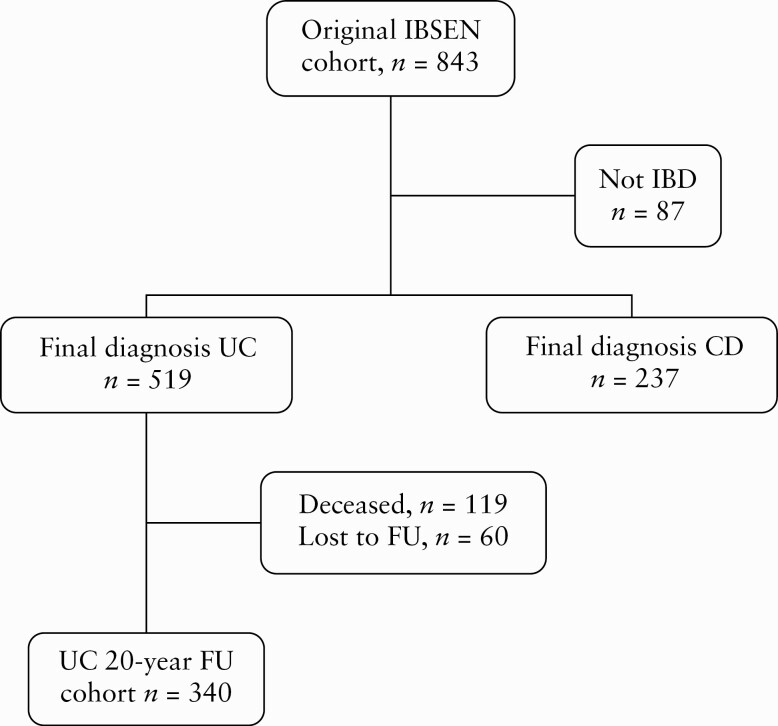
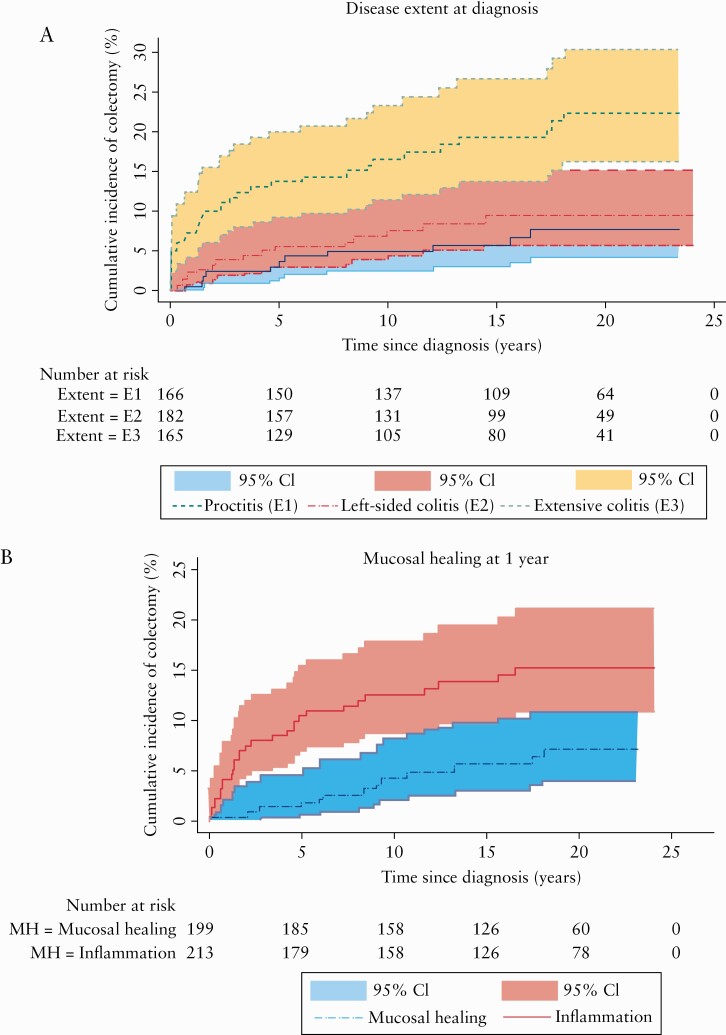
Results: Among 519 UC patients, 119 died, 60 were lost to FU, and 340 were included in the FU cohort. The 20-year cumulative risk of colectomy was 13.0% (95% confidence interval [CI] [11.4-14.6]). Extensive colitis at diagnosis was independently associated with an increased risk of colectomy compared with proctitis (hazard ratio [HR] = 2].8, 95% CI [1.3-6.1]). In contrast, mucosal healing at 1-year FU was independently associated with reduced risk of colectomy [HR = 0.4, 95% CI [0.2-0.8]), and inversely associated with subsequent risk of relapse [adjusted HR = 0.5, 95% CI [0.3-0.7]).
Conclusions: The overall risk of colectomy in our cohort was lower than expected from previous studies, although considerable for patients with extensive colitis at diagnosis. Early mucosal healing was associated with better disease outcomes 20 years after diagnosis.
Keywords: Ulcerative colitis; clinical outcome; population-based inception cohort.
© The Author(s) 2020. Published by Oxford University Press on behalf of European Crohn’s and Colitis Organisation.
Figures
References
-
- Danese S, Fiocchi C. Ulcerative colitis. N Engl J Med 2011;365:1713–25. - PubMed
-
- Moum B, Vatn MH, Ekbom A, et al. Incidence of inflammatory bowel disease in southeastern Norway: evaluation of methods after 1 year of registration. Southeastern Norway IBD Study Group of Gastroenterologists. Digestion 1995;56:377–81. - PubMed
-
- Henriksen M, Jahnsen J, Lygren I, et al. ; IBSEN Study Group. Ulcerative colitis and clinical course: results of a 5-year population-based follow-up study [the IBSEN study]. Inflamm Bowel Dis 2006;12:543–50. - PubMed
-
- Moum B, Ekbom A, Vatn MH, et al. Clinical course during the 1st year after diagnosis in ulcerative colitis and Crohn’s disease. Results of a large, prospective population-based study in southeastern Norway, 1990-93. Scand J Gastroenterol 1997;32:1005–12. - PubMed
MeSH terms
LinkOut - more resources
Full Text Sources
Medical
