


Electronic health records and clinician burnout: A story of three eras
- PMID: 33367815
- PMCID: PMC8068425
- DOI: 10.1093/jamia/ocaa274
Electronic health records and clinician burnout: A story of three eras
Abstract
Objective: The study sought to provide physicians, informaticians, and institutional policymakers with an introductory tutorial about the history of medical documentation, sources of clinician burnout, and opportunities to improve electronic health records (EHRs). We now have unprecedented opportunities in health care, with the promise of new cures, improved equity, greater sensitivity to social and behavioral determinants of health, and data-driven precision medicine all on the horizon. EHRs have succeeded in making many aspects of care safer and more reliable. Unfortunately, current limitations in EHR usability and problems with clinician burnout distract from these successes. A complex interplay of technology, policy, and healthcare delivery has contributed to our current frustrations with EHRs. Fortunately, there are opportunities to improve the EHR and health system. A stronger emphasis on improving the clinician's experience through close collaboration by informaticians, clinicians, and vendors can combine with specific policy changes to address the causes of burnout.
Target audience: This tutorial is intended for clinicians, informaticians, policymakers, and regulators, who are essential participants in discussions focused on improving clinician burnout. Learners in biomedicine, regardless of clinical discipline, also may benefit from this primer and review.
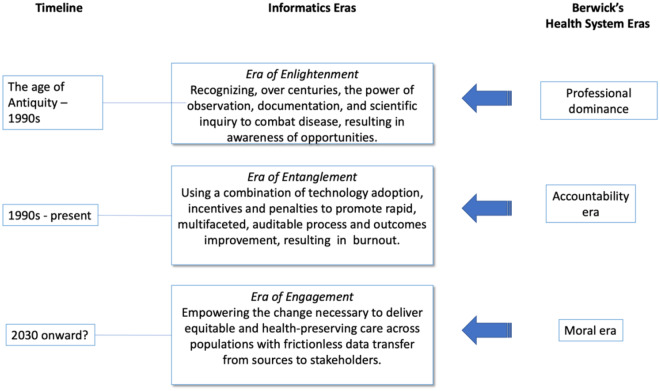
Scope: We include (1) an overview of medical documentation from a historical perspective; (2) a summary of the forces converging over the past 20 years to develop and disseminate the modern EHR; and (3) future opportunities to improve EHR structure, function, user base, and time required to collect and extract information.
Keywords: burnout; electronic health records; health policy; history of medicine; population health; professional.
© The Author(s) 2020. Published by Oxford University Press on behalf of the American Medical Informatics Association. All rights reserved. For permissions, please email: journals.permissions@oup.com.
Figures
References
-
- Myrick K, Ogburn D, Ward B. National Electronic Health Records Survey, 2017. Hyattsville, MD: National Center for Health Statistics; 2019.
-
- Blumenthal D, Tavenner M.. The “meaningful use” regulation for electronic health records. N Engl J Med 2010; 363 (6): 501–4. - PubMed
-
- Goldzweig CL, Orshansky G, Paige NM, et al. Electronic patient portals: evidence on health outcomes, satisfaction, efficiency, and attitudes: a systematic review. Ann Intern Med 2013; 159 (10): 677–87. - PubMed
Publication types
MeSH terms
LinkOut - more resources
Full Text Sources
Miscellaneous
