. 2021 Aug 16;224(4):632-642.
doi: 10.1093/infdis/jiaa781.

Intensive Care Unit-Like Care of Nonhuman Primates with Ebola Virus Disease

Affiliations

Intensive Care Unit-Like Care of Nonhuman Primates with Ebola Virus Disease

Paul W Blair et al. J Infect Dis. .

Abstract

Background: Ebola virus disease (EVD) supportive care strategies are largely guided by retrospective observational research. This study investigated the effect of EVD supportive care algorithms on duration of survival in a controlled nonhuman primate (NHP) model.

Methods: Fourteen rhesus macaques were challenged intramuscularly with a target dose of Ebola virus (1000 plaque-forming units; Kikwit). NHPs were allocated to intensive care unit (ICU)-like algorithms (n = 7), intravenous fluids plus levofloxacin (n = 2), or a control group (n = 5). The primary outcome measure was duration of survival, and secondary outcomes included changes in clinical laboratory values.

Results: Duration of survival was not significantly different between the pooled ICU-like algorithm and control groups (8.2 vs 6.9 days of survival; hazard ratio; 0.50; P = .25). Norepinephrine was effective in transiently maintaining baseline blood pressure. NHPs treated with ICU-like algorithms had delayed onset of liver and kidney injury.

Conclusions: While an obvious survival difference was not observed with ICU-like care, clinical observations from this model may aid in EVD supportive care NHP model refinement.

Keywords: Ebola virus disease; Filoviridae; Mononegavirales; animal; hemorrhagic fevers; intensive care; models; viral.


Figures

Figure 1.
Figure 1.
Clinical laboratory values and supportive treatments in the longest living nonhuman primate (NHP) in the intensive care unit (ICU)–like care group (NHP D4) (A) and the longest living NHP assigned as a control (NHP A3) (B). Abbreviations: CRP, C-reactive protein; VL, viral load.
Figure 2.
Figure 2.
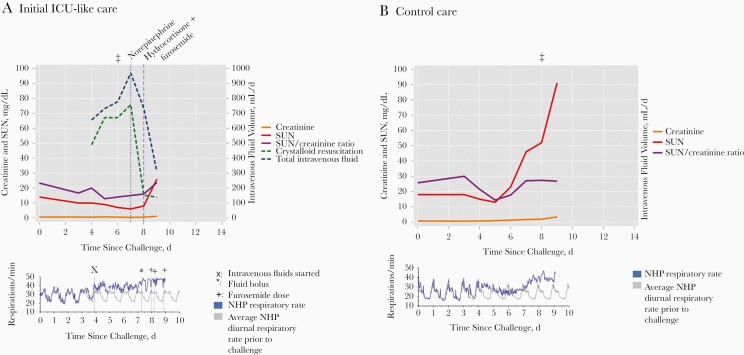
Renal laboratory values, daily intravenous fluid, respiratory rate, and clinical edema in the longest living nonhuman primate (NHP) that received furosemide (NHP C2) (A) and the longest living NHP in the control group (NHP A3) (B). Facial or extremity edema was observed clinically on day 6 in C2 and on day 8 in A3 (denoted by ‡ above each graph). Abbreviations: ICU, intensive care unit; SUN, serum urea nitrogen.
Figure 3.
Figure 3.
Comparison of mean arterial pressure between groups by nonhuman primates (NHPs) with functioning telemetry blood pressure (BP) sensors. A, Controls (A3 and A5). B, Intravenous fluids plus levofloxacin treatment (B2) and revised intensive care unit (ICU)–like algorithm without norepinephrine (D1 and D2). C, Initial ICU-like algorithm (C1 and C2). D, Revised ICU-like algorithm with norepinephrine (D3 and D4). Dotted vertical lines indicate when norepinephrine was started in each treated NHP.
Figure 4.
Figure 4.
A, Kaplan-Meier curve comparing treatment groups, grouping initial and revised intensive treatment groups. B, Plasma viral load (VL) over time, by treatment group. Abbreviations: ICU, intensive care units; LLOD, lower level of detection; LLOQ, lower level of quantification; NE, norepinephrine.
Figure 5.
Figure 5.
Clinical laboratory kinetics between treatment groups A, Alanine aminotransferase (ALT). B, Creatinine. C, Troponin I. D, Creatine kinase). Red lines represent locally estimated scatterplot smoothing curves of control group values; gray-shaded bands, control group confidence interval; and red dashed horizontal lines, upper limits of normal. No confidence intervals are shown in C because values among controls were low (≤0.8 ng/mL) compared with extreme elevations in 2 nonhuman primate. (Serum urea nitrogen and aspartate aminotransferase plots are included in Supplement I, Supplementary Figure 8.) Abbreviations: ICU, intensive care unit; NE, norepinephrine.

References

    1. Garske T, Cori A, Ariyarajah A, et al. Heterogeneities in the case fatality ratio in the West African Ebola outbreak 2013–2016. Philos Trans R Soc Lond B Biol Sci 2017; 372. - PMC - PubMed
    1. Uyeki TM, Mehta AK, Davey RT Jr, et al. Clinical management of Ebola virus disease in the United States and Europe. N Engl J Med 2016; 374:636–46. - PMC - PubMed
    1. Lamontagne F, Fowler RA, Adhikari NK, et al. Evidence-based guidelines for supportive care of patients with Ebola virus disease. Lancet 2018; 391:700–8. - PMC - PubMed
    1. Lamontagne F, Clément C, Kojan R, Godin M, Kabuni P, Fowler RA. The evolution of supportive care for Ebola virus disease. Lancet 2019; 393:620–1. - PubMed
    1. Fischer WA 2nd, Crozier I, Bausch DG, et al. Shifting the paradigm—applying universal standards of care to Ebola virus disease. N Engl J Med 2019; 380:1389–91. - PubMed

Publication types