


Age of walking and intellectual ability in autism spectrum disorder and other neurodevelopmental disorders: a population-based study
- PMID: 33369747
- PMCID: PMC8236490
- DOI: 10.1111/jcpp.13369
Age of walking and intellectual ability in autism spectrum disorder and other neurodevelopmental disorders: a population-based study
Abstract
Background: Delayed walking is common in intellectual disability (ID) but may be less common when ID occurs with autism spectrum disorder (ASD). Previous studies examining this were limited by reliance on clinical samples and exclusion of children with severe motor deficits.
Objective: To examine in a population-based sample if age of walking is differentially related to intellectual ability in children with ASD versus other neurodevelopmental disorders (NDD).
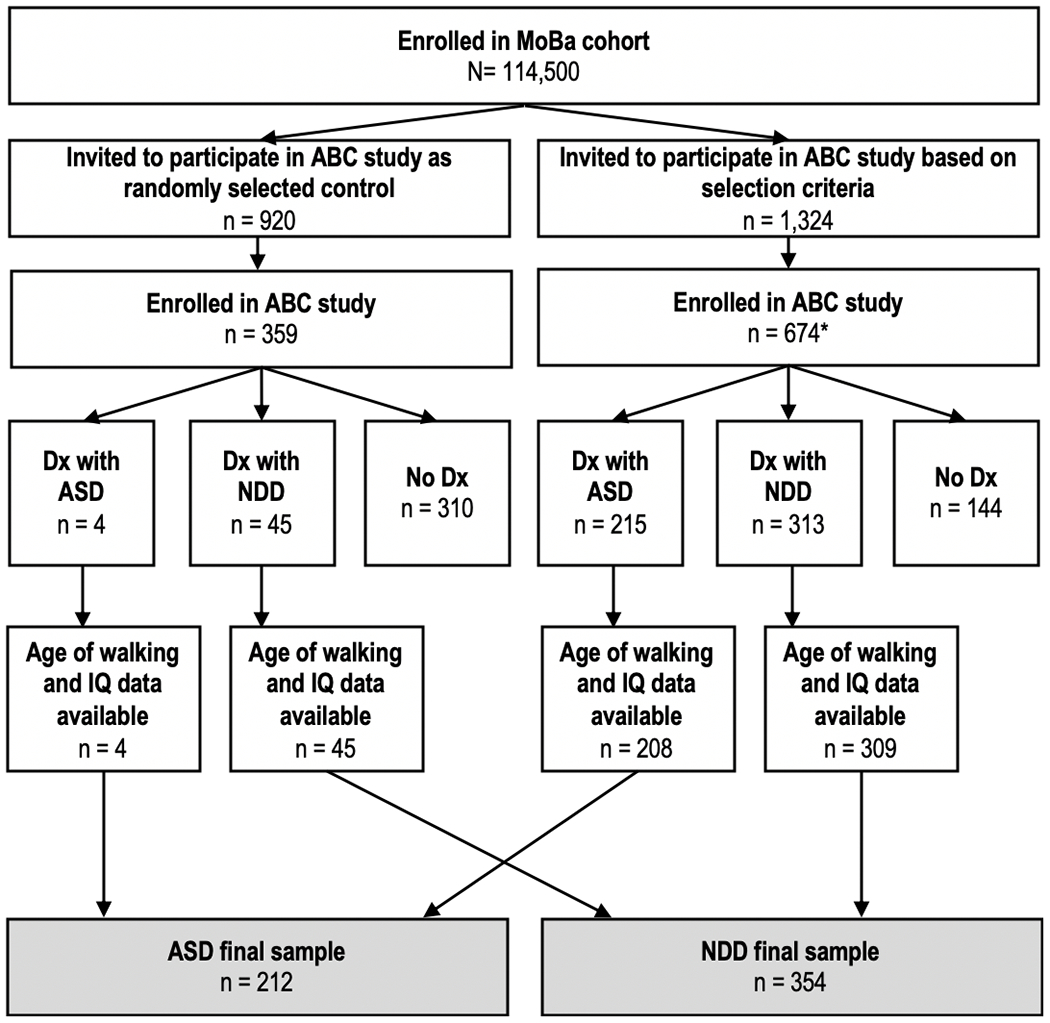
Methods: Participants were from the nested Autism Birth Cohort Study of the Norwegian Mother, Father and Child Cohort Study (MoBa). Cox proportional hazards regression assessed if diagnosis (ASD n = 212 vs. NDD n = 354), continuous nonverbal IQ, and their interaction, were associated with continuous age of walking.
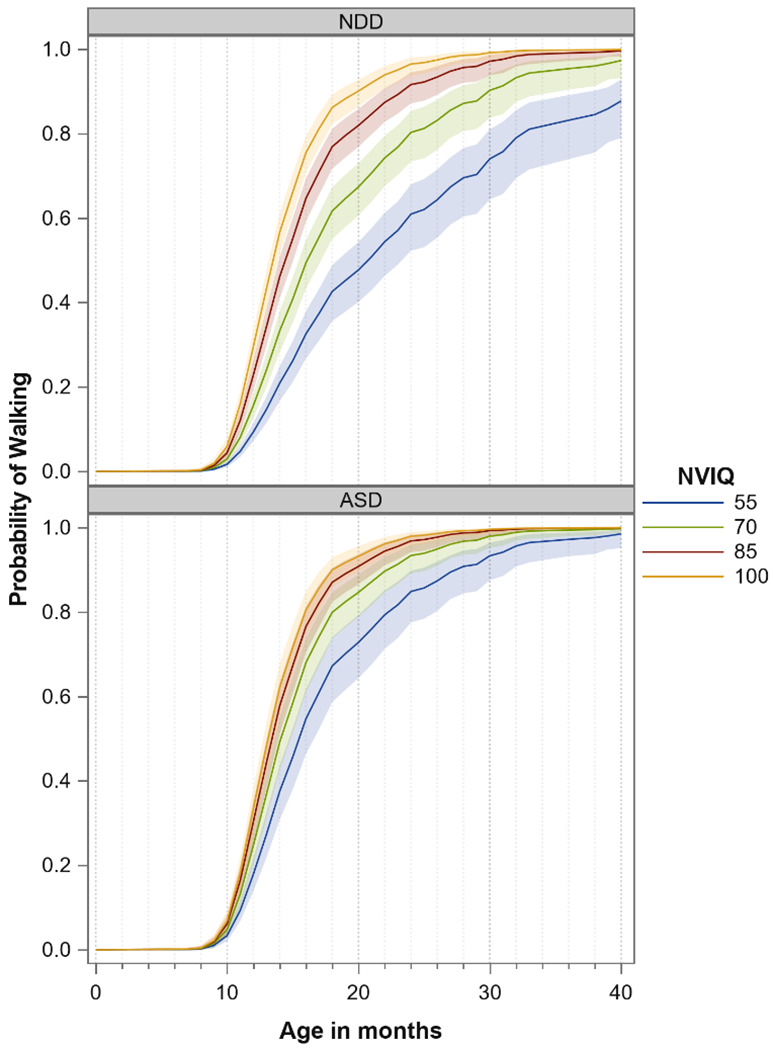
Results: The relationship between nonverbal IQ and age of walking was stronger for NDD than for ASD (Group × nonverbal IQ interaction, χ2 = 13.93, p = .0002). This interaction was characterized by a 21% decrease in the likelihood of walking onset at any given time during the observation period per 10-point decrease in nonverbal IQ (hazard ratio = 0.79, 95% CI: 0.78-0.85) in the NDD group compared to 8% (hazard ratio = 0.92, 95% CI: 0.86-0.98) in the ASD group.
Conclusions: The finding that age of walking is less strongly related to low intellectual ability in children with ASD than in children without other NDDs supports the hypothesis that ID in ASD may result from heterogeneous developmental pathways. Late walking may be a useful stratification variable in etiological research focused on ASD and other NDDs.
Keywords: Intellectual disability; MoBa; epidemiology; gross motor milestones; late walking.
© 2020 Association for Child and Adolescent Mental Health.
Conflict of interest statement
Conflicts of Interest:
Drs. Bishop and Lord have received royalties from the ADOS-2. All profits from their research are donated to charity. The other authors report no conflicts of interest.
Figures
References
-
- American Psychiatric Association. (1994). Diagnostic and statistical manual of mental disorders (4th ed.). Washington, DC.
-
- American Psychiatric Association. (2000). Diagnostic and statistical manual of mental disorders (4th ed., text rev.). Washington, DC.
-
- American Psychiatric Association. (2013). Diagnostic and Statistical Manual of Mental Disorders (5th ed.). Arlington, VA: American Psychiatric Publishing.
