Review
. 2020 Dec 21;21(24):9742.
doi: 10.3390/ijms21249742.

Roles and Mechanisms of the Long Noncoding RNAs in Cervical Cancer

Affiliations
Review

Roles and Mechanisms of the Long Noncoding RNAs in Cervical Cancer

Miguel Ángel Cáceres-Durán et al. Int J Mol Sci. .

Abstract

Cervical cancer (CC) continues to be one of the leading causes of death for women across the world. Although it has been determined that papillomavirus infection is one of the main causes of the etiology of the disease, genetic and epigenetic factors are also required for its progression. Among the epigenetic factors are included the long noncoding RNAs (lncRNAs), transcripts of more than 200 nucleotides (nt) that generally do not code for proteins and have been associated with diverse functions such as the regulation of transcription, translation, RNA metabolism, as well as stem cell maintenance and differentiation, cell autophagy and apoptosis. Recently, studies have begun to characterize the aberrant regulation of lncRNAs in CC cells and tissues, including Homeobox transcript antisense RNA (HOTAIR), H19, Metastasis-associated lung adenocarcinoma transcript 1 (MALAT1), Cervical Carcinoma High-Expressed 1 (CCHE1), Antisense noncoding RNA in the inhibitors of cyclin-dependent kinase 4 (ANRIL), Growth arrest special 5 (GAS5) and Plasmacytoma variant translocation 1 (PVT1). They have been associated with several disease-related processes such as cell growth, cell proliferation, cell survival, metastasis and invasion as well as therapeutic resistance, and are novel potential biomarkers for diagnosis and prognosis in CC. In this review, we summarize the current literature regarding the knowledge we have about the roles and mechanisms of the lncRNAs in cervical neoplasia.

Keywords: biological function; cervical cancer; epigenetics; long noncoding RNAs; tumorigenesis.


Conflict of interest statement

The authors declare no conflict of interest.

Figures
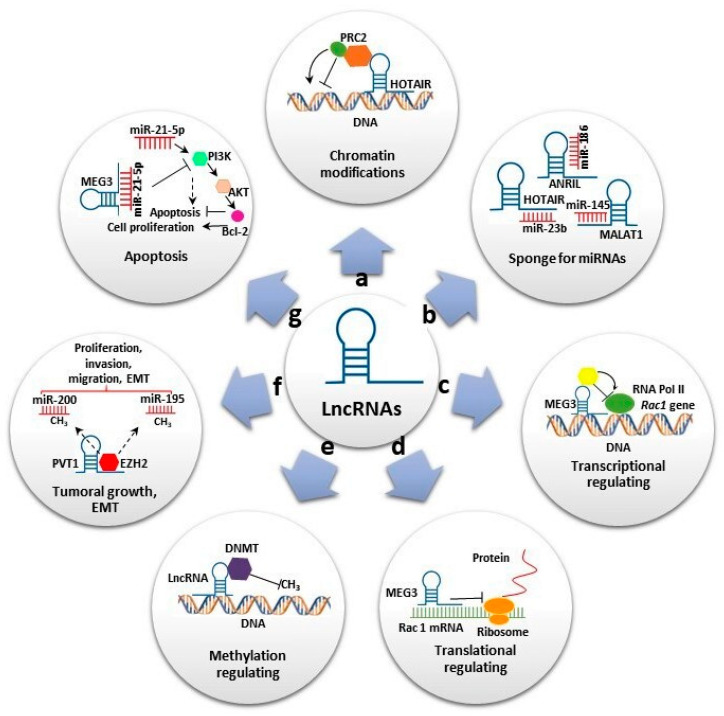
Figure 1
Figure 1
Long noncoding RNAs’ (lncRNAs) biological roles. (a) Some lncRNAs regulate gene expression by assembling chromatin-modifying complexes. Homeobox transcript antisense RNA (HOTAIR) interacts with polycomb repressive complex 2 (PRC2) and establishes the repressive H3K27me3 chromatin mark. (b) lncRNAs can act as miRNA sponges. HOTAIR, Metastasis-associated lung adenocarcinoma transcript 1 (MALAT1) and Antisense noncoding RNA in the inhibitors of cyclin-dependent kinase 4 (ANRIL) sponge miR-23-b, miR-154 and miR-186, respectively, to reverse suppression of their target genes. (c,d) Some lncRNAs promote or suppress gene expression. Maternally expressed gene 3 (MEG3) inhibits Rac1 at both transcriptional and translational levels. (e) Some lncRNAs interact with diverse DNMT members, promoting or repressing DNA methylation. (f) Some lncRNAs play important roles in cell migration, proliferation and invasion. Plasmacytoma variant translocation 1 (PVT1) binds to EZH2, increasing H3K27me3 level on miR-195 and miR-200b promoters and promoting epithelial–mesenchymal transition (EMT). (g) lncRNAs also play significant roles in apoptosis. MEG3 reduce the level of miR-21-5p expression, inhibiting cell proliferation and increasing apoptosis by regulating the PI3K/AKT/BCL-2/Bax/P21 pathway.
Figure 2
Figure 2
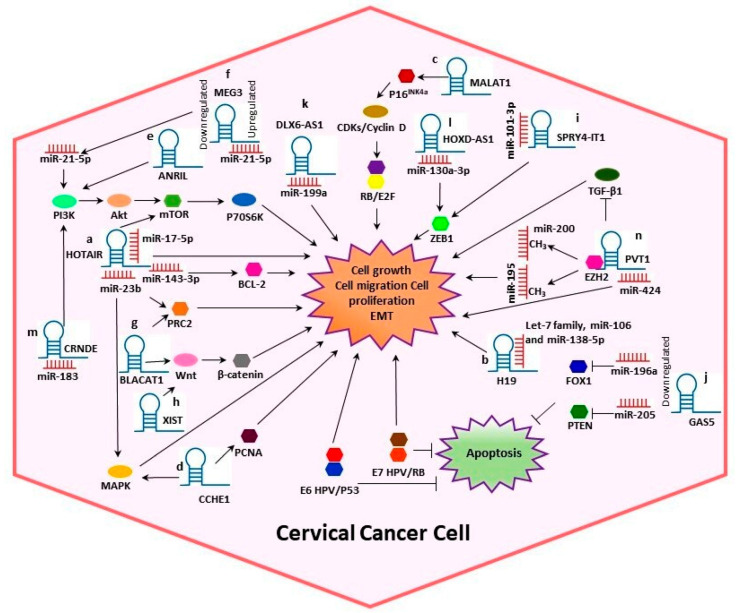
Potential mechanisms of several lncRNAs in CC. Some lncRNAs play significant roles in CC progression by sponging miRNAs and interacting with other proteins, altering the cell cycle. (a) HOTAIR could act as a sponge for miR-143-3p, promoting BCL-2 expression. Also, HOTAIR exerts its tumor-promoting effect by sponging miR-17-5p and may indirectly modulate MAPK1 expression by binding to miR-23b. (b) H19 interacts with miRNAs of the let-7 family regulating diverse cellular processes. (c) MALAT1 may regulate cell proliferation through the P16INK4A/CDKs/RB pathway. (d) Cervical Carcinoma High-Expressed 1 (CCHE1) enhancing the expression of PCNA, CCHE1 also participates in the ERK/MAPK pathway. (e) ANRIL inhibition guides the inactivation of the PI3K/Akt pathway. (f) Maternally expressed gene 3 (MEG3) functions as a tumor-suppressor via regulating miR-21-5p. (g) Bladder cancer-associated transcript 1 (BLACAT1) binds to PRC2 and promotes proliferation, migration and invasion by modulating Wnt/β-catenin pathway. (h) X-inactive specific transcript (XIST) can play the role of an oncogene activating the Wnt/β-catenin pathway. (i) SPRY4-Intronic transcript or Sprouty4-Intronic transcript 1 (SPRY4-IT1) could bind to miR-101-3p to regulate the expression of the target gene ZEB1. (j) GAS5 expression is decreased in CC, leading to dysregulation of miR-196a and miR-205, which function as oncogenic miRNAs by targeting FOXO1 and PTEN, respectively. (k) DLX6 antisense RNA 1 (DLX6-AS1) may promote cell proliferation by sponging miR‑199a. (l) HOXD-AS1 upregulates ZEB1 through binding to miR-130a-3p. (m) CRNDE acts as an oncogene in CC through sponging miR-183. (n) PVT1 acts as a sponge for miR-424, miR-195 and miR-200b. Overall, the figure shows some summarized molecular mechanisms by which the lncRNAs promote cell growth, migration and proliferation and EMT in a CC cell. Information extended in the text.

References

    1. WHO Draft Global Strategy towards Eliminating Cervical Cancer as a Public Health Problem. [(accessed on 27 September 2020)]; Available online: https://www.who.int/publications/m/item/draft-global-strategy-towards-el....

    1. Bava S.V., Thulasidasan A.K.T., Sreekanth C.N., Anto R.J. Cervical cancer: A comprehensive approach towards extermination. Ann. Med. 2016;48:149–161. doi: 10.3109/07853890.2016.1145796. - DOI - PubMed
    1. Kessler T.A. Cervical Cancer: Prevention and Early Detection. Semin. Oncol. Nurs. 2017;33:172–183. doi: 10.1016/j.soncn.2017.02.005. - DOI - PubMed
    1. Dong J., Su M., Chang W., Zhang K., Wu S., Xu T. Long non-coding RNAs on the stage of cervical cancer. Oncol. Rep. 2017;38:1923–1931. doi: 10.3892/or.2017.5905. - DOI - PubMed
    1. Dasari S., Wudayagiri R., Valluru L. Cervical cancer: Biomarkers for diagnosis and treatment. Clin. Chim. Acta. 2015;445:7–11. doi: 10.1016/j.cca.2015.03.005. - DOI - PubMed

Substances