


The Effect of the Type of Non-Caged Housing System, Genotype and Age on the Behaviour of Laying Hens
- PMID: 33371385
- PMCID: PMC7767380
- DOI: 10.3390/ani10122450
The Effect of the Type of Non-Caged Housing System, Genotype and Age on the Behaviour of Laying Hens
Abstract
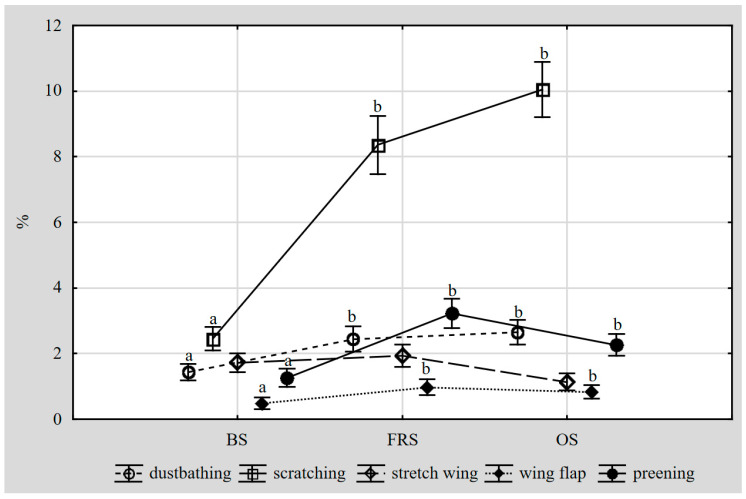
This study investigated the welfare of laying hens in different non-caged housing systems, namely a deep-litter barn system (BS), a free-range system (FRS) and an organic system (OS). The study was conducted on 270 hens of a native breed Green-legged Partridge (Z-11) and 270 Hy-Line Brown hybrids. Visual scans were performed to record behaviour of hens. Hens were housed in groups of 30 and observed over the course of one day at 20, 36 and 56 weeks of age. Dustbathing, scratching, wing stretching, wing flapping and preening were recorded as comfort behaviours. Pecking, fighting, threatening and chasing were recorded as agonistic behaviours. The percentage of run use was higher in native hens than in commercial hens (p < 0.05). The proportion of hens exhibiting comfort behaviours housed in the FRS and OS was similar but over twice as high as in the BS (p < 0.05). In the FRS and OS, the percentage of hens displaying comfort behaviours increased with age (p < 0.05). In all the production systems, the percentage of birds displaying comfort behaviours was higher in native breed hens than in commercial breeds (p < 0.05). In the BS, the higher proportion of hens displaying an agonistic behaviour was seen more in commercial breed than in the native breed hens (p < 0.05). The percentage of birds displaying an agonistic behaviour declined with hen age, both in commercial and native breed hens.
Keywords: agonistic behaviour; alternative housing system; behaviour of laying hens; comfort behaviour; commercial hybrid; native breed.
Conflict of interest statement
The authors declare that there is no conflict of interest.
Figures
References
-
- Council Directive 1999/74/EC of 19 July 1999 Laying Down Minimum Standards for the Protection of Laying Hens. [(accessed on 15 June 2020)];Off. J. Eur. Communities. 1999 42:53–56. Available online: https://eur-lex.europa.eu/eli/dir/1999/74/oj.
-
- Windhorst H.W. Dynamics and Patterns of the EU Egg Industry. [(accessed on 15 June 2020)];Lohmann Tierz. 2017 51:42–48. Available online: http://www.ltz.de/en/news/lohmann-information/2017-2/6_Dynamics_and_patt....
-
- Official Website of the European Commision. [(accessed on 15 June 2020)];2020 Available online: https://ec.europa.eu/info/sites/info/files/food-farming-fisheries/farmin....
-
- Pettersson I.C., Weeks C.A., Wilson L.R.M., Nicol C.J. Consumer perceptions of free-range laying hen welfare. Br. Food J. 2016;118:1999–2013. doi: 10.1108/BFJ-02-2016-0065. - DOI
-
- Maciel C.T., Bock B. Modern politics in animal welfare: The changing character of governance of animal welfare and the role of private standards. Int. J. Soc. Agric. Food. 2013;20:219–235.
LinkOut - more resources
Full Text Sources
