


Synthetic Scaffold/Dental Pulp Stem Cell (DPSC) Tissue Engineering Constructs for Bone Defect Treatment: An Animal Studies Literature Review
- PMID: 33371390
- PMCID: PMC7767470
- DOI: 10.3390/ijms21249765
Synthetic Scaffold/Dental Pulp Stem Cell (DPSC) Tissue Engineering Constructs for Bone Defect Treatment: An Animal Studies Literature Review
Abstract
Background: Recently a greater interest in tissue engineering for the treatment of large bone defect has been reported. The aim of the present systematic review and meta-analysis was to investigate the effectiveness of dental pulp stem cells and synthetic block complexes for bone defect treatment in preclinical in vivo articles.
Methods: The electronic database and manual search was conducted on Pubmed, Scopus, and EMBASE. The papers identified were submitted for risk-of-bias assessment and classified according to new bone formation, bone graft characteristics, dental pulp stem cells (DPSCs) culture passages and amount of experimental data. The meta-analysis assessment was conducted to assess new bone formation in test sites with DPSCs/synthetic blocks vs. synthetic block alone.
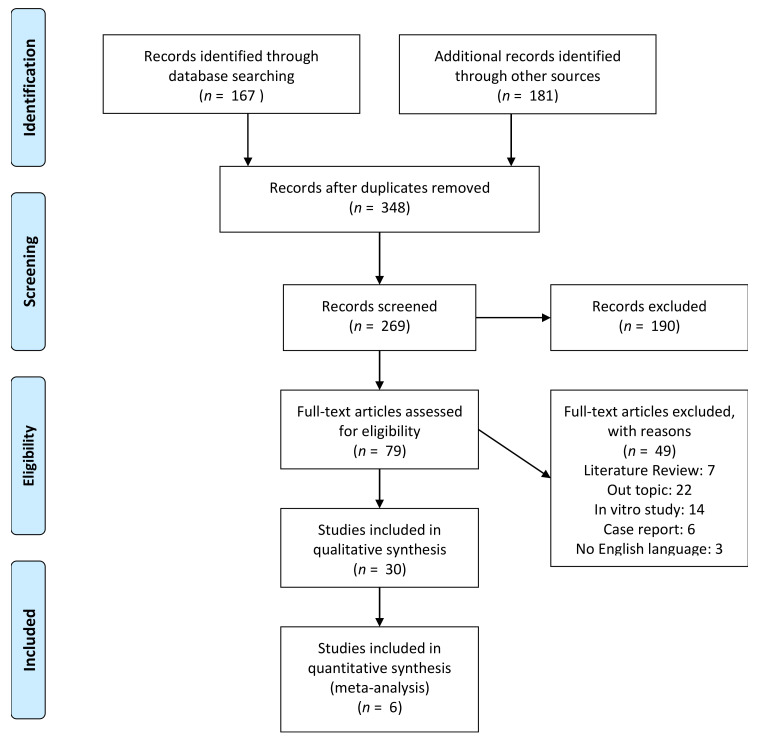
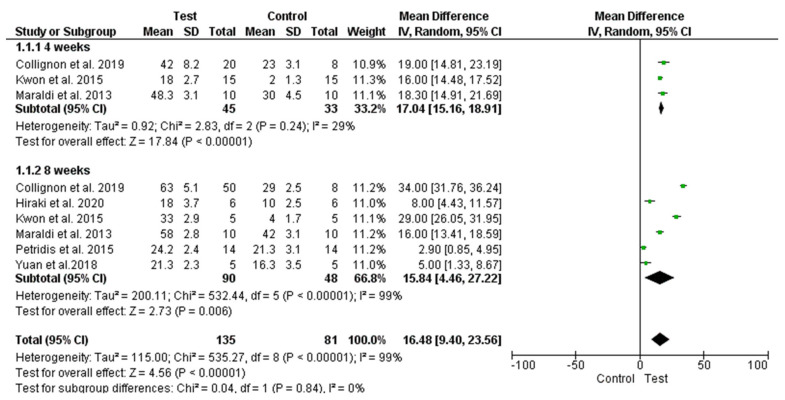
Results: The database search identified a total of 348 papers. After the initial screening, 30 studies were included, according to the different animal models: 19 papers on rats, 3 articles on rabbits, 2 manuscripts on sheep and 4 papers on swine. The meta-analysis evaluation showed a significantly increase in new bone formation in favor of DPSCs/synthetic scaffold complexes, if compared to the control at 4 weeks (Mean Diff: 17.09%, 95% CI: 15.16-18.91%, p < 0.01) and at 8 weeks (Mean Diff: 14.86%, 95% CI: 1.82-27.91%, p < 0.01) in rats calvaria bone defects.
Conclusion: The synthetic scaffolds in association of DPSCs used for the treatment of bone defects showed encouraging results of early new bone formation in preclinical animal studies and could represent a useful resource for regenerative bone augmentation procedures.
Keywords: bone regeneration; dental pulp stem cells; synthetic scaffold; tissue engineering.
Conflict of interest statement
The authors declare no conflict of interest for the present research.
Figures
References
-
- Papaccio G., Graziano A., d’Aquino R., Graziano M.F., Pirozzi G., Menditti D., De Rosa A., Carinci F., Laino G. Long-Term cryopreservation of dental pulp stem cells (SBP-DPSCs) and their differentiated osteoblasts: A cell source for tissue repair. J.Cell. Physiol. 2006;208:319–325. doi: 10.1002/jcp.20667. - DOI - PubMed
-
- Ballini A., Cantore S., Farronato D., Cirulli N., Inchingolo F., Papa F., Malcangi G., Inchingolo A.D., Dipalma G., Sardaro N., et al. Periodontal disease and bone pathogenesis: The crosstalk between cytokines and porphyromonas gingivalis. J. Biol. Regul. Homeost. Agents. 2015;29:273–281. - PubMed
-
- Gargiulo Isacco C., Ballini A., Paduanelli G., Inchingolo A.D., Nguyen K.C.D., Inchingolo A.M., Pham V.H., Aityan S.K., Schiffman M., et al. DENTAL SUPPLEMENT Bone decay and beyond: How can we approach it better. J. Biol. Regul. Homeost. Agents. 2019;33:143–154. - PubMed
Publication types
MeSH terms
LinkOut - more resources
Full Text Sources
Medical
