


Neurological update: use of cardiac troponin in patients with stroke
- PMID: 33372247
- PMCID: PMC8179917
- DOI: 10.1007/s00415-020-10349-w
Neurological update: use of cardiac troponin in patients with stroke
Erratum in
-
Correction to: Neurological update: use of cardiac troponin in patients with stroke.J Neurol. 2021 Jun;268(6):2293. doi: 10.1007/s00415-021-10434-8. J Neurol. 2021. PMID: 33634339 Free PMC article. No abstract available.
Abstract
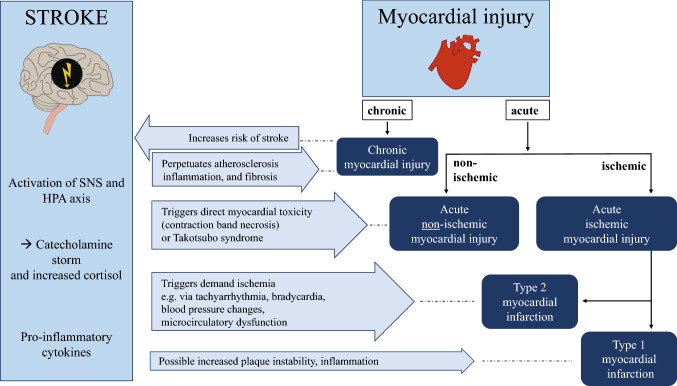
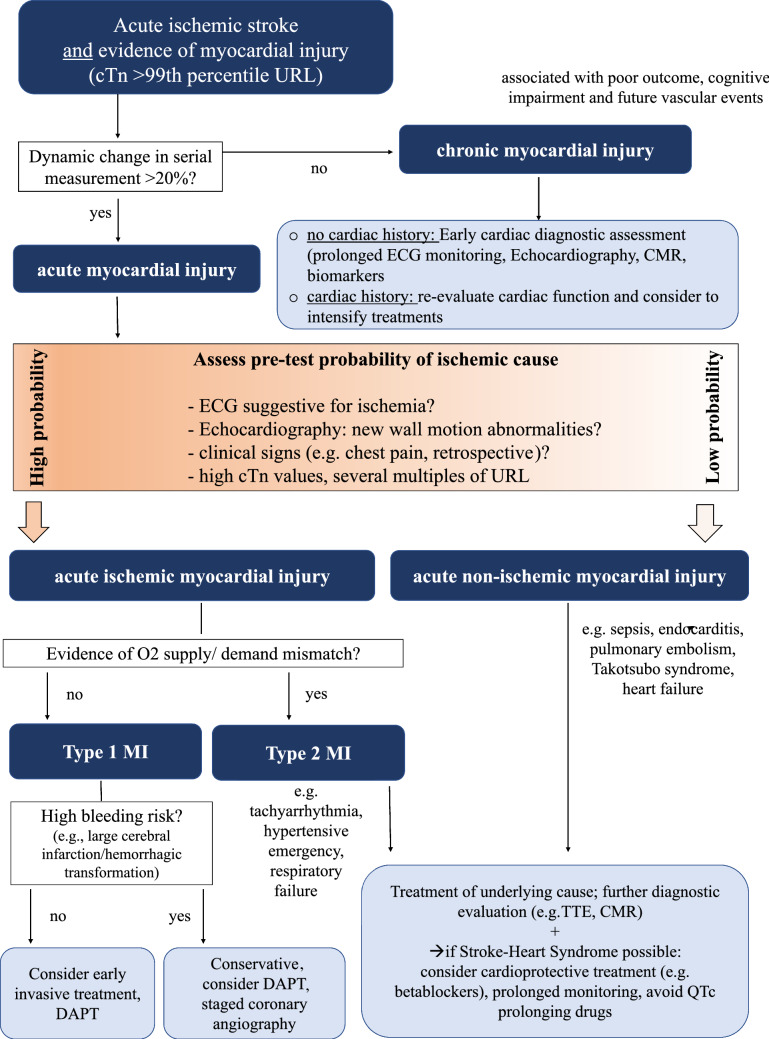
Cardiac troponin is a specific and sensitive biomarker to identify and quantify myocardial injury. Myocardial injury is frequently detected after acute ischemic stroke and strongly associated with unfavorable outcomes. Concomitant acute coronary syndrome is only one of several possible differential diagnoses that may cause elevation of cardiac troponin after stroke. As a result, there are uncertainties regarding the correct interpretation and optimal management of stroke patients with myocardial injury in clinical practice. Elevation of cardiac troponin may occur as part of a 'Stroke-Heart Syndrome'. The term 'Stroke-Heart Syndrome' subsumes a clinical spectrum of cardiac complications after stroke including cardiac injury, dysfunction, and arrhythmia which may relate to disturbances of autonomic function and the brain-heart axis. In this review, we provide an up-to-date overview about prognostic implications, mechanisms, and management of elevated cardiac troponin levels in patients with acute ischemic stroke.
Keywords: Brain–heart interaction; Cardiac biomarker; Cardiac troponin; Ischemic stroke; Myocardial infarction; Myocardial injury; Stroke-heart-syndrome.
Conflict of interest statement
ME reports grants from Bayer and fees paid to the Charité from Bayer, Boehringer Ingelheim, BMS, Daiichi Sankyo, Amgen, GSK, Sanofi, Covidien, Novartis, Pfizer, all outside the submitted work. Dr Nolte received speaker and/or consultation fees from Boehringer Ingelheim, Bristol-Myers Squibb, Pfizer Pharma, Abbott and W.L. Gore and Associates, all outside the submitted work. The other authors report no conflicts of interest.
Figures
References
-
- Powers WJ, Rabinstein AA, Ackerson T, Adeoye OM, Bambakidis NC, Becker K, Biller J, Brown M, Demaerschalk BM, Hoh B, Jauch EC, Kidwell CS, Leslie-Mazwi TM, Ovbiagele B, Scott PA, Sheth KN, Southerland AM, Summers DV, Tirschwell DL, American Heart Association Stroke C 2018 Guidelines for the early management of patients with acute ischemic stroke: a guideline for healthcare professionals From the American Heart Association/American Stroke Association. Stroke. 2018;49(3):e46–e110. doi: 10.1161/STR.0000000000000158. - DOI - PubMed
-
- Jauch EC, Saver JL, Adams HP, Jr, Bruno A, Connors JJ, Demaerschalk BM, Khatri P, McMullan PW, Jr, Qureshi AI, Rosenfield K, Scott PA, Summers DR, Wang DZ, Wintermark M, Yonas H, American Heart Association Stroke C, Council on Cardiovascular N, Council on Peripheral Vascular D, Council on Clinical C Guidelines for the early management of patients with acute ischemic stroke: a guideline for healthcare professionals from the American Heart Association/American Stroke Association. Stroke. 2013;44(3):870–947. doi: 10.1161/STR.0b013e318284056a. - DOI - PubMed
Publication types
MeSH terms
Substances
LinkOut - more resources
Full Text Sources
Medical
Research Materials
