


Performance of Breast Cancer Polygenic Risk Scores in 760 Female CHEK2 Germline Mutation Carriers
- PMID: 33372680
- PMCID: PMC8246885
- DOI: 10.1093/jnci/djaa203
Performance of Breast Cancer Polygenic Risk Scores in 760 Female CHEK2 Germline Mutation Carriers
Abstract
Background: Genome-wide association studies suggest that the combined effects of breast cancer (BC)-associated single nucleotide polymorphisms (SNPs) can improve BC risk stratification using polygenic risk scores (PRSs). The performance of PRSs in genome-wide association studies-independent clinical cohorts is poorly studied in individuals carrying mutations in moderately penetrant BC predisposition genes such as CHEK2.
Methods: A total of 760 female CHEK2 mutation carriers were included; 561 women were affected with BC, of whom 74 developed metachronous contralateral BC (mCBC). For PRS calculations, 2 SNP sets covering 77 (SNP set 1, developed for BC risk stratification in women unselected for their BRCA1/2 germline mutation status) and 88 (SNP set 2, developed for BC risk stratification in female BRCA1/2 mutation carriers) BC-associated SNPs were used. All statistical tests were 2-sided.
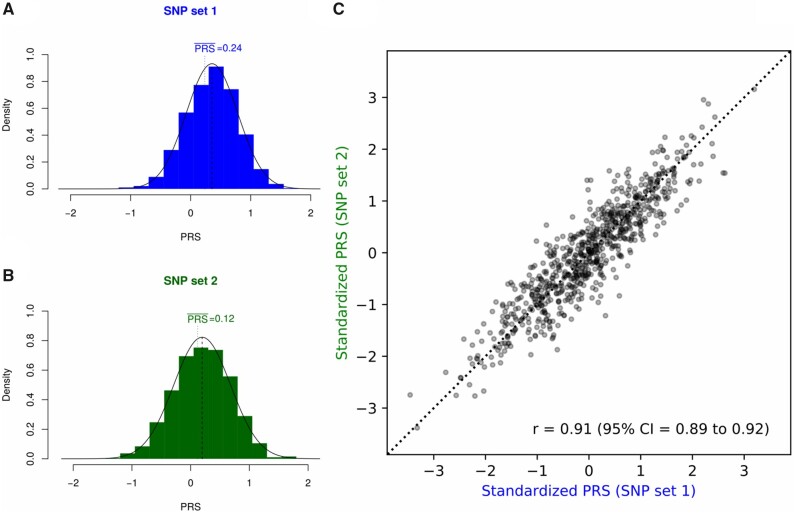
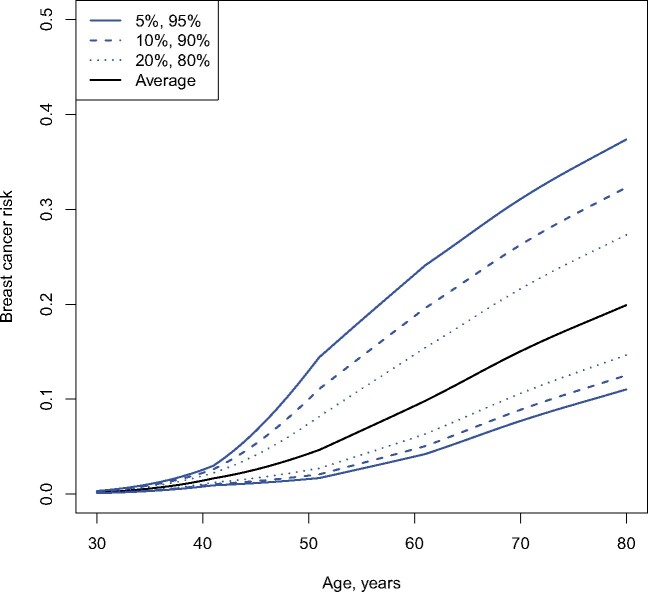
Results: Both SNP sets provided concordant PRS results at the individual level (r = 0.91, P < 2.20 × 10⁻¹⁶). Weighted cohort Cox regression analyses revealed statistically significant associations of PRSs with the risk for first BC. For SNP set 1, a hazard ratio of 1.71 per SD of the PRS was observed (95% confidence interval = 1.36 to 2.15, P = 3.87 × 10⁻⁶). PRSs identify a subgroup of CHEK2 mutation carriers with a predicted lifetime risk for first BC that exceeds the surveillance thresholds defined by international guidelines. Association of PRS with mCBC was examined via Cox regression analysis (SNP set 1 hazard ratio = 1.23, 95% confidence interval = 0.86 to 1.78, P = .26).
Conclusions: PRSs may be used to personalize risk-adapted preventive measures for women with CHEK2 mutations. Larger studies are required to assess the role of PRSs in mCBC predisposition.
© The Author(s) 2020. Published by Oxford University Press. All rights reserved. For permissions, please email: journals.permissions@oup.com.
Figures
References
-
- Bleyer A, Welch HG.. Effect of three decades of screening mammography on breast-cancer incidence. N Engl J Med. 2012;367(21):1998–2005. - PubMed
-
- Howell A, Astley S, Warwick J, et al. Prevention of breast cancer in the context of a national breast screening programme. J Intern Med. 2012;271(4):321–330. - PubMed
-
- Burton H, Chowdhury S, Dent T, et al. Public health implications from COGS and potential for risk stratification and screening. Nat Genet. 2013;45(4):349–351. - PubMed
Publication types
MeSH terms
Substances
Grants and funding
LinkOut - more resources
Full Text Sources
Medical
Miscellaneous
