


Quadriceps Strength Symmetry Does Not Modify Gait Mechanics After Anterior Cruciate Ligament Reconstruction, Rehabilitation, and Return-to-Sport Training
- PMID: 33373534
- PMCID: PMC7863565
- DOI: 10.1177/0363546520980079
Quadriceps Strength Symmetry Does Not Modify Gait Mechanics After Anterior Cruciate Ligament Reconstruction, Rehabilitation, and Return-to-Sport Training
Abstract
Background: After anterior cruciate ligament (ACL) reconstruction (ACLR), biomechanical asymmetries during gait are highly prevalent, persistent, and linked to posttraumatic knee osteoarthritis. Quadriceps strength is an important clinical measure associated with preoperative gait asymmetries and postoperative function and is a primary criterion for return-to-sport clearance. Evidence relating symmetry in quadriceps strength with gait biomechanics is limited to preoperative and early rehabilitation time points before return-to-sport training.
Purpose/hypothesis: The purpose was to determine the relationship between symmetry in isometric quadriceps strength and gait biomechanics after return-to-sport training in athletes after ACLR. We hypothesized that as quadriceps strength symmetry increases, athletes will demonstrate more symmetric knee joint biomechanics, including tibiofemoral joint loading during gait.
Study design: Cross-sectional study; Level of evidence, 3.
Methods: Of 79 athletes enrolled in the ACL-SPORTS Trial, 76 were participants in this study after completing postoperative rehabilitation and 10 return-to-sport training sessions (mean ± SD, 7.1 ± 2.0 months after ACLR). All participants completed biomechanical walking gait analysis and isometric quadriceps strength assessment using an electromechanical dynamometer. Quadriceps strength was calculated using a limb symmetry index (involved limb value / uninvolved limb value × 100). The biomechanical variables of interest included peak knee flexion angle, peak knee internal extension moment, sagittal plane knee excursion at weight acceptance and midstance, quadriceps muscle force at peak knee flexion angle, and peak medial compartment contact force. Spearman rank correlation (ρ) coefficients were used to determine the relationship between limb symmetry indexes in quadriceps strength and each biomechanical variable; alpha was set to .05.
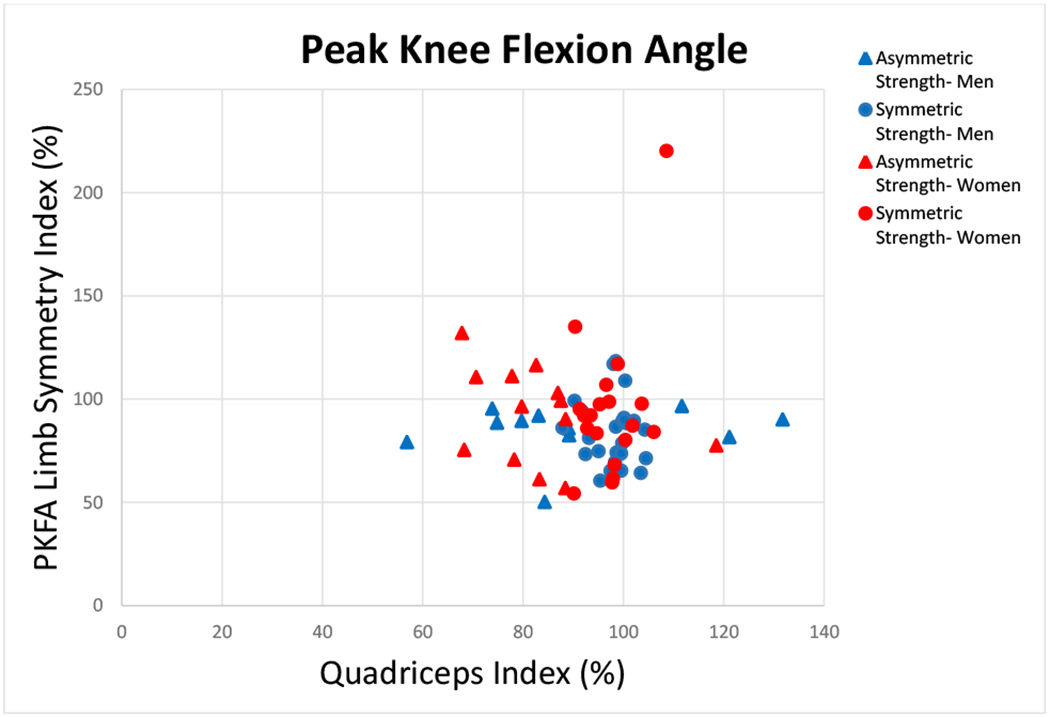
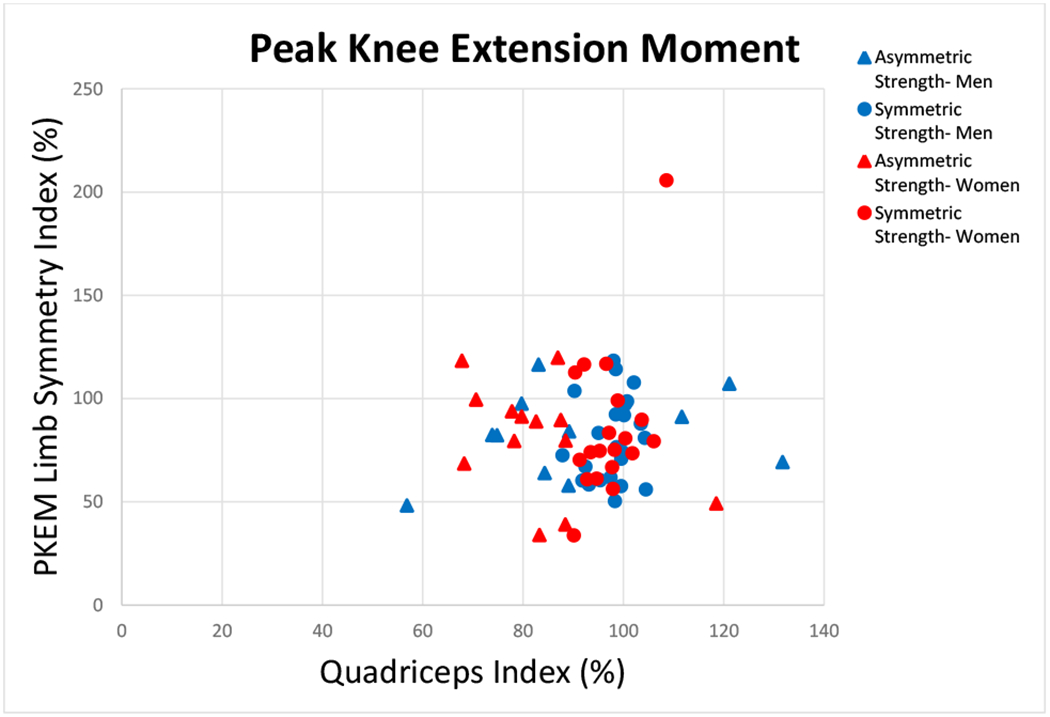
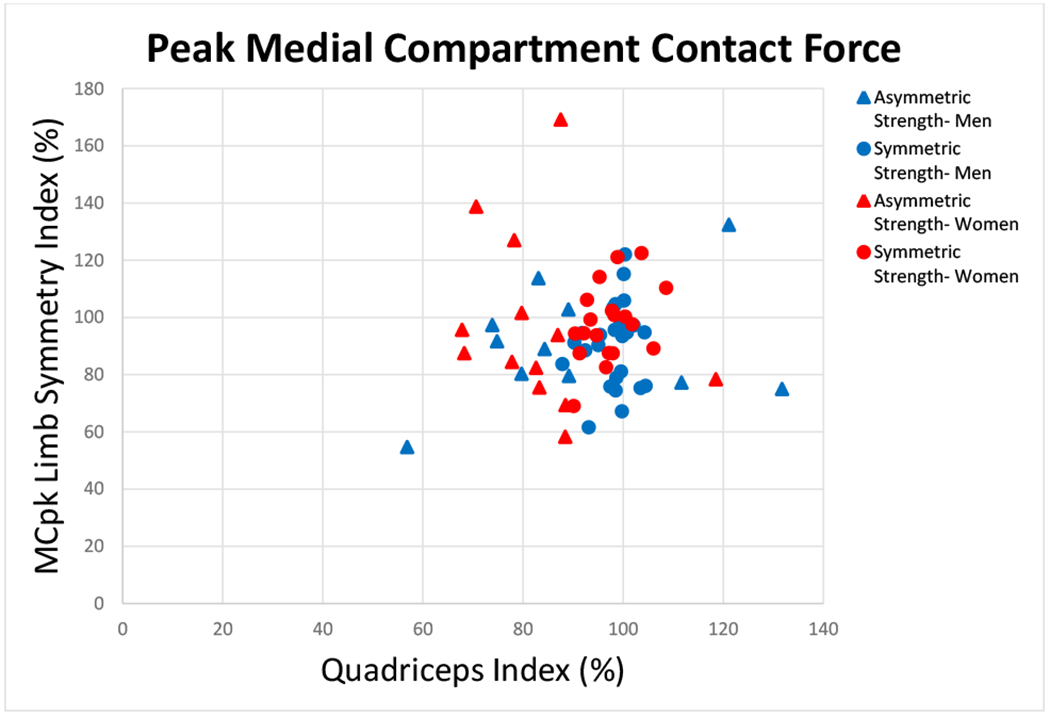
Results: Of the 76 participants, 27 (35%) demonstrated asymmetries in quadriceps strength, defined by quadriceps strength symmetry <90% (n = 23) or >110% (n = 4) (range, 56.9%-131.7%). For the biomechanical variables of interest, 67% demonstrated asymmetry in peak knee flexion angle; 68% and 83% in knee excursion during weight acceptance and midstance, respectively; 74% in internal peak knee extension moment; 57% in medial compartment contact force; and 74% in quadriceps muscle force. There were no significant correlations between quadriceps strength index and limb symmetry indexes for any biomechanical variable after return-to-sport training (P > .129).
Conclusion: Among those who completed return-to-sport training after ACLR, subsequent quadriceps strength symmetry was not correlated with the persistent asymmetries in gait biomechanics. After a threshold of quadriceps strength is reached, restoring strength alone may not ameliorate gait asymmetries, and current clinical interventions and return-to-sport training may not adequately target gait.
Keywords: anterior cruciate ligament reconstruction; biomechanics; gait; rehabilitation.
Figures
References
-
- Andriacchi TP, Mündermann A, Smith RL, Alexander EJ, Dyrby CO, Koo S. A framework for the in vivo pathomechanics of osteoarthritis at the knee. Ann Biomed Eng. 2004;32(3):447–457. http://www.ncbi.nlm.nih.gov/pubmed/15095819. - PubMed
Publication types
MeSH terms
Grants and funding
LinkOut - more resources
Full Text Sources
Medical
