Review
. 2020 Dec 24;22(1):117.
doi: 10.3390/ijms22010117.

Plant Responses to Heat Stress: Physiology, Transcription, Noncoding RNAs, and Epigenetics

Affiliations
Review

Plant Responses to Heat Stress: Physiology, Transcription, Noncoding RNAs, and Epigenetics

Jianguo Zhao et al. Int J Mol Sci. .

Abstract

Global warming has increased the frequency of extreme high temperature events. High temperature is a major abiotic stress that limits the growth and production of plants. Therefore, the plant response to heat stress (HS) has been a focus of research. However, the plant response to HS involves complex physiological traits and molecular or gene networks that are not fully understood. Here, we review recent progress in the physiological (photosynthesis, cell membrane thermostability, oxidative damage, and others), transcriptional, and post-transcriptional (noncoding RNAs) regulation of the plant response to HS. We also summarize advances in understanding of the epigenetic regulation (DNA methylation, histone modification, and chromatin remodeling) and epigenetic memory underlying plant-heat interactions. Finally, we discuss the challenges and opportunities of future research in the plant response to HS.

Keywords: epigenetics; heat stress; molecular; non-coding RNA; physiological.


Conflict of interest statement

The authors declare no conflict of interest.

Figures
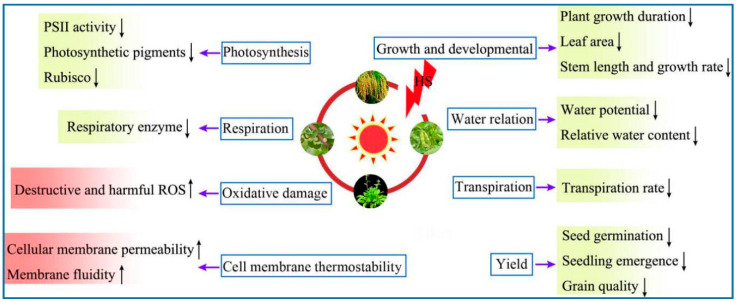
Figure 1
Figure 1
Effects of heat stress on plant physiological responses. Upward-pointing arrows indicate activated/upregulated physiological indices. Downward-pointing arrows indicate deactivated/downregulated physiological indices. Abbreviations: HS, heat stress; PSII, photosystem II; Rubisco, ribulose-1,5-bisphosphate carboxylase/oxygenase; ROS, reactive oxygen species.
Figure 2
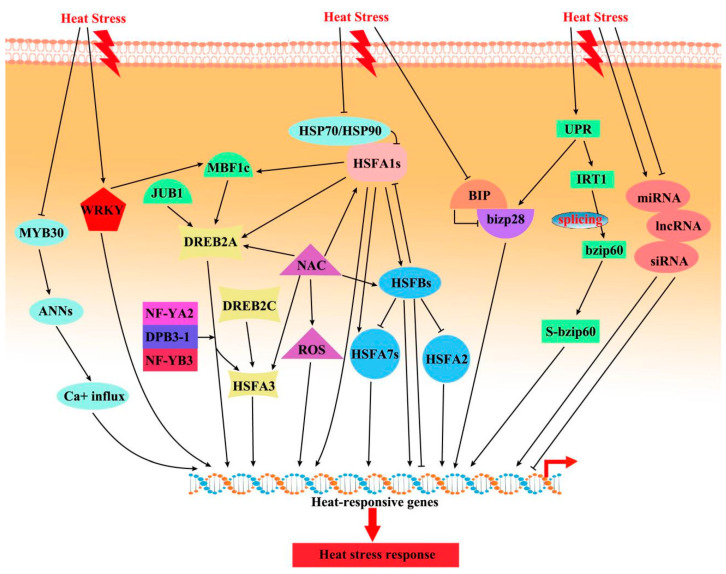
Figure 2
Schematic of the main regulatory pathways that respond to HS transcription factors. The binding of heat shock protein (HSP)70/90 and heat shock transcription factor (HSF)A1s represses the activity of HSFA1s under nonstress conditions, whereas heat stress elicits the dissociation of HSFA1 from HSP70 and HSP90, leading to HSFA1 activation. Abbreviations: HSP, heat shock protein; HSF, heat shock transcription factor; ANN, annexin; JUB1, jungbrunnen 1; MBF1c, multiprotein-bridging factor 1c; DREB2A/2C dehydration-responsive element binding protein 2A/2C; NF-Y, nuclear factor Y; DPB3-1, DNA polymerase II subunit B3-1; ROS, reactive oxygen species; BIP, binding immunoglobulin protein; bIZP, basic leucine zipper; S-bzip60, spliced bZIP60; UPR, unfolded protein response; IRT1, inositol-requiring enzyme 1; miRNA, microRNA; lncRNA, long non-coding RNA; siRNA, small interfering RNA.
Figure 3
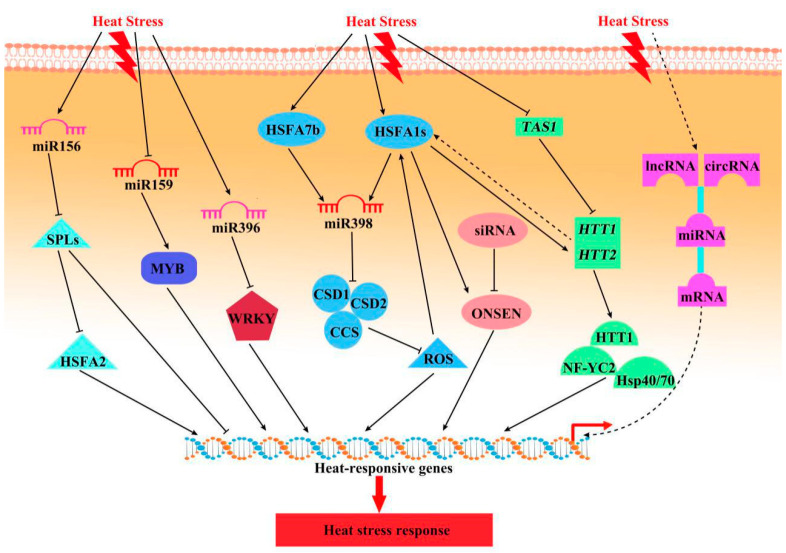
Figure 3
Roles of non-coding RNAs in the plant HS response. Dotted lines represent as yet unidentified factors in the corresponding pathways. Abbreviations: SPL, squamosa promoter-binding protein-like; HSF, heat shock transcription factor; CSD, copper/zinc superoxide dismutase; CCS, copper chaperone for superoxide dismutase; ROS, reactive oxygen species; TAS1, trans-acting siRNA precursor 1; HTT, heat-induced tas1 target; NF-YC2, nuclear factor Y, subunit C; lncRNA, long non-coding RNA; circRNA, circular RNA; siRNA, small interfering RNA; miRNA, microRNA; mRNA, messenger RNA.
Figure 4
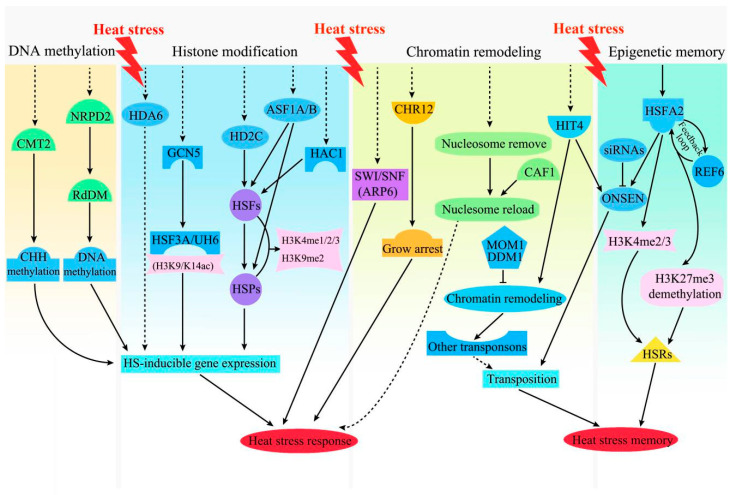
Figure 4
Epigenetic regulation of the plant response to HS, including DNA methylation, histone modification, chromatin remodeling, and epigenetic memory. Dotted lines represent as yet unidentified factors in the corresponding pathways. Abbreviations: CMT2, chromomethylase 2; NRPD2, nuclear RNA polymerase D2; RdDM, RNA-directed DNA methylation; HDA6, histone deacetylase 6; GCN5, general control nonderepressible 5; HD2C, histone deacetylase 2C; ASF1A/B, anti-silencing function 1A/B; HAC1, histone acetyltransferase 1; SWI/SNF, SWItch/sucrose non-fermentable; ARP6, actin-related protein 6; CHR, chromatin remodeling; CAF1, chromatin assembly factor 1; MOM1, morpheus’ molecule 1; DDM1, decrease in DNA methylation 1; HIT4, heat-intolerant 4; REF6, relative of early flowering 6; H3K4/9/27me, H3K4/9/27 methylation; H3K9/K14ac, H3K9/K14 acetylation; HSR, heat stress response.

References

    1. Lippmann R., Babben S., Menger A., Delker C., Quint M. Development of wild and cultivated plants under global warming conditions. Curr. Biol. 2019;29:R1326–R1338. doi: 10.1016/j.cub.2019.10.016. - DOI - PubMed
    1. Hedhly A., Hormaza J., Herrero M. Global warming and sexual plant reproduction. Trends Plant Sci. 2009;14:30–36. doi: 10.1016/j.tplants.2008.11.001. - DOI - PubMed
    1. Liu J., Zhang R., Xu X., Fowler J.C., Miller T.E.X., Dong T. Effect of summer warming on growth, photosynthesis and water status in female and male Populus cathayana: Implications for sex-specific drought and heat tolerances. Tree Physiol. 2020;40:1178–1191. doi: 10.1093/treephys/tpaa069. - DOI - PubMed
    1. Akter N., Islam M.R. Heat stress effects and management in wheat. A review. Agron. Sustain. Dev. 2017;37:37. doi: 10.1007/s13593-017-0443-9. - DOI
    1. Xalxo R., Yadu B., Chandra J., Chandrakar V., Keshavkant S. Alteration in Carbohydrate Metabolism Modulates Thermotolerance of Plant under Heat Stress. In: Wani S.H., Kumar V., editors. Heat Stress Tolerance in Plants: Physiological, Molecular and Genetic Perspectives. 1st ed. John Wiley & Sons Ltd.; Hoboken, NJ, USA: 2020. pp. 77–115. - DOI

LinkOut - more resources