Review
. 2020 Dec 23;13(1):13.
doi: 10.3390/v13010013.

Beyond the Surface: Endocytosis of Mosquito-Borne Flaviviruses

Affiliations
Review

Beyond the Surface: Endocytosis of Mosquito-Borne Flaviviruses

Stephen D Carro et al. Viruses. .

Abstract

Flaviviruses are a group of positive-sense RNA viruses that are primarily transmitted through arthropod vectors and are capable of causing a broad spectrum of diseases. Many of the flaviviruses that are pathogenic in humans are transmitted specifically through mosquito vectors. Over the past century, many mosquito-borne flavivirus infections have emerged and re-emerged, and are of global importance with hundreds of millions of infections occurring yearly. There is a need for novel, effective, and accessible vaccines and antivirals capable of inhibiting flavivirus infection and ameliorating disease. The development of therapeutics targeting viral entry has long been a goal of antiviral research, but most efforts are hindered by the lack of broad-spectrum potency or toxicities associated with on-target effects, since many host proteins necessary for viral entry are also essential for host cell biology. Mosquito-borne flaviviruses generally enter cells by clathrin-mediated endocytosis (CME), and recent studies suggest that a subset of these viruses can be internalized through a specialized form of CME that has additional dependencies distinct from canonical CME pathways, and antivirals targeting this pathway have been discovered. In this review, we discuss the role and contribution of endocytosis to mosquito-borne flavivirus entry as well as consider past and future efforts to target endocytosis for therapeutic interventions.

Keywords: LY6E; RNASEK; clathrin-mediated; endocytosis; entry inhibitor; flavivirus; mosquito-borne; nanchangmycin; receptors.


Conflict of interest statement

The authors declare no conflict of interest.

Figures
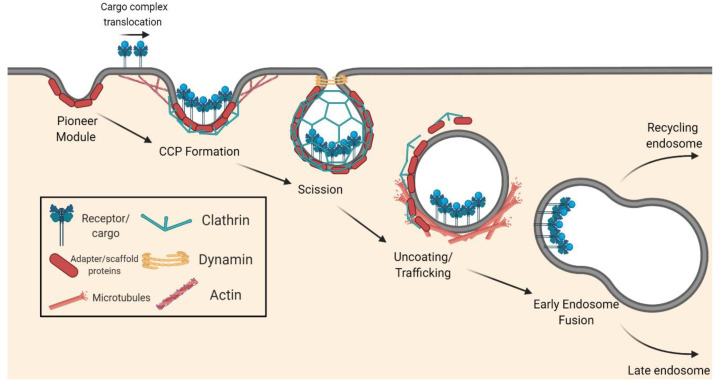
Figure 1
Figure 1
Schematic of the canonical clathrin-mediated endocytosis (CME) pathway. Initially, a group of adapter and scaffold proteins associate at the endocytic site, forming a pioneer module. This pioneer module then recruits coat-associated proteins, including clathrin, to the developing membrane invagination. The coat-associated proteins bind to the cytosolic regions of cargo complexes to recruit the cargo to the endocytic site. Membrane bending continues, in part due to mechanical forces from actin, and the clathrin coat expands until the clathrin-coated pit (CCP) is formed. Scission of the CCP is mediated by dynamin, which releases the clathrin-coated vesicle (CCV). The CCV then uncoats and undergoes trafficking via the cytoskeleton to the sorting endosome for further processing. Figure created with BioRender.com.
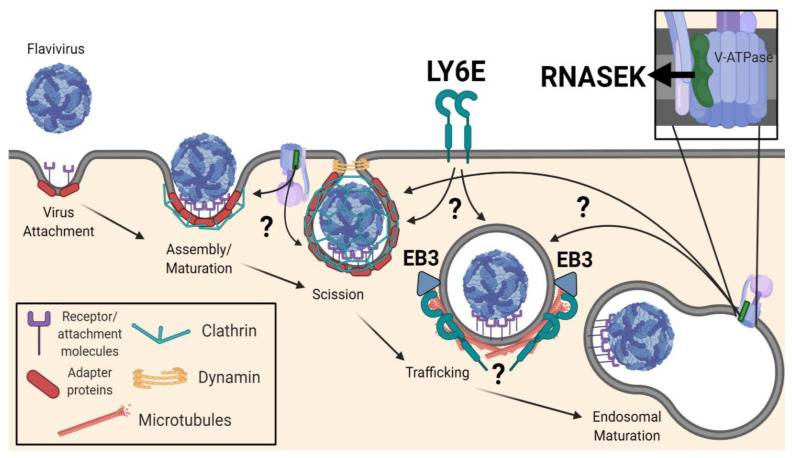
Figure 2
Figure 2
Schematic of the proposed size-dependent clathrin-mediated endocytic (CME) pathway. Following initial binding of an incoming flavivirus virion to the cell membrane, virions can bind attachment factors and receptors. Next, internalization begins and a clathrin coat forms around the membrane invagination via adapter molecules. Scission of the clathrin-coated vesicle is mediated by the GTPase dynamin. The internalized virion then traffics to the endosomal compartment for acid-mediated membrane fusion. During the internalization process, the GPI-anchored LY6E and V-ATPase-associated RNASEK perform essential roles outside of the canonical CME pathway. LY6E tubularization is induced by viral entry, a process dependent on microtubule function, the end-binding protein EB3, and RNASEK. Figure created with BioRender.com.

References

    1. Huang Y.-J.S., Higgs S., Horne K.M., van Landingham D.L. Flavivirus-mosquito interactions. Viruses. 2014;6:4703–4730. doi: 10.3390/v6114703. - DOI - PMC - PubMed
    1. Kemenesi G., Bányai K. Tick-borne flaviviruses, with a focus on powassan virus. Clin. Microbiol. Rev. 2018;32:106–117. doi: 10.1128/cmr.00106-17. - DOI - PMC - PubMed
    1. Moureau G., Cook S., Lemey P., Nougairede A., Forrester N.L., Khasnatinov M., Charrel R.N., Firth A.E., Gould E.A., de Lamballerie X. New insights into flavivirus evolution, taxonomy and biogeographic history, extended by analysis of canonical and alternative coding sequences. PLoS ONE. 2015;10:e0117849. doi: 10.1371/journal.pone.0117849. - DOI - PMC - PubMed
    1. Messina J.P., Brady O.J., Scott T.W., Zou C., Pigott D.M., Duda K.A., Bhatt S., Katzelnick L., Howes R.E., Battle K.E., et al. Global spread of dengue virus types: Mapping the 70-year history. Trends Microbiol. 2014;22:138–146. doi: 10.1016/j.tim.2013.12.011. - DOI - PMC - PubMed
    1. Ganeshkumar P., Murhekar M., Poornima V., Saravanakumar V., Sukumaran K., Anandaselvasankar A., John D., Mehendale S.M. Dengue infection in India: A systematic review and meta-analysis. PLoS Negl. Trop. Dis. 2018;12:e0006618. doi: 10.1371/journal.pntd.0006618. - DOI - PMC - PubMed

Publication types

MeSH terms