. 2020 Dec 23;22(1):87.
doi: 10.3390/ijms22010087.

Transient Receptor Potential Ankyrin 1 (TRPA1) Is Involved in Upregulating Interleukin-6 Expression in Osteoarthritic Chondrocyte Models

Affiliations

Transient Receptor Potential Ankyrin 1 (TRPA1) Is Involved in Upregulating Interleukin-6 Expression in Osteoarthritic Chondrocyte Models

Elina Nummenmaa et al. Int J Mol Sci. .

Abstract

Transient receptor potential ankyrin 1 (TRPA1) is a membrane-bound ion channel found in neurons, where it mediates nociception and neurogenic inflammation. Recently, we have discovered that TRPA1 is also expressed in human osteoarthritic (OA) chondrocytes and downregulated by the anti-inflammatory drugs aurothiomalate and dexamethasone. We have also shown TRPA1 to mediate inflammation, pain, and cartilage degeneration in experimental osteoarthritis. In this study, we investigated the role of TRPA1 in joint inflammation, focusing on the pro-inflammatory cytokine interleukin-6 (IL-6). We utilized cartilage/chondrocytes from wild-type (WT) and TRPA1 knockout (KO) mice, along with primary chondrocytes from OA patients. The results show that TRPA1 regulates the synthesis of the OA-driving inflammatory cytokine IL-6 in chondrocytes. IL-6 was highly expressed in WT chondrocytes, and its expression, along with the expression of IL-6 family cytokines leukemia inhibitory factor (LIF) and IL-11, were significantly downregulated by TRPA1 deficiency. Furthermore, treatment with the TRPA1 antagonist significantly downregulated the expression of IL-6 in chondrocytes from WT mice and OA patients. The results suggest that TRPA1 is involved in the upregulation of IL-6 production in chondrocytes. These findings together with previous results on the expression and functions of TRPA1 in cellular and animal models point to the role of TRPA1 as a potential mediator and novel drug target in osteoarthritis.

Keywords: IL-6; TRPA1; chondrocyte; inflammation; osteoarthritis.


Conflict of interest statement

The authors declare no conflict of interest. The funders had no role in the design of the study; in the collection, analyses, or interpretation of data; in the writing of the manuscript, or in the decision to publish the results.

Figures
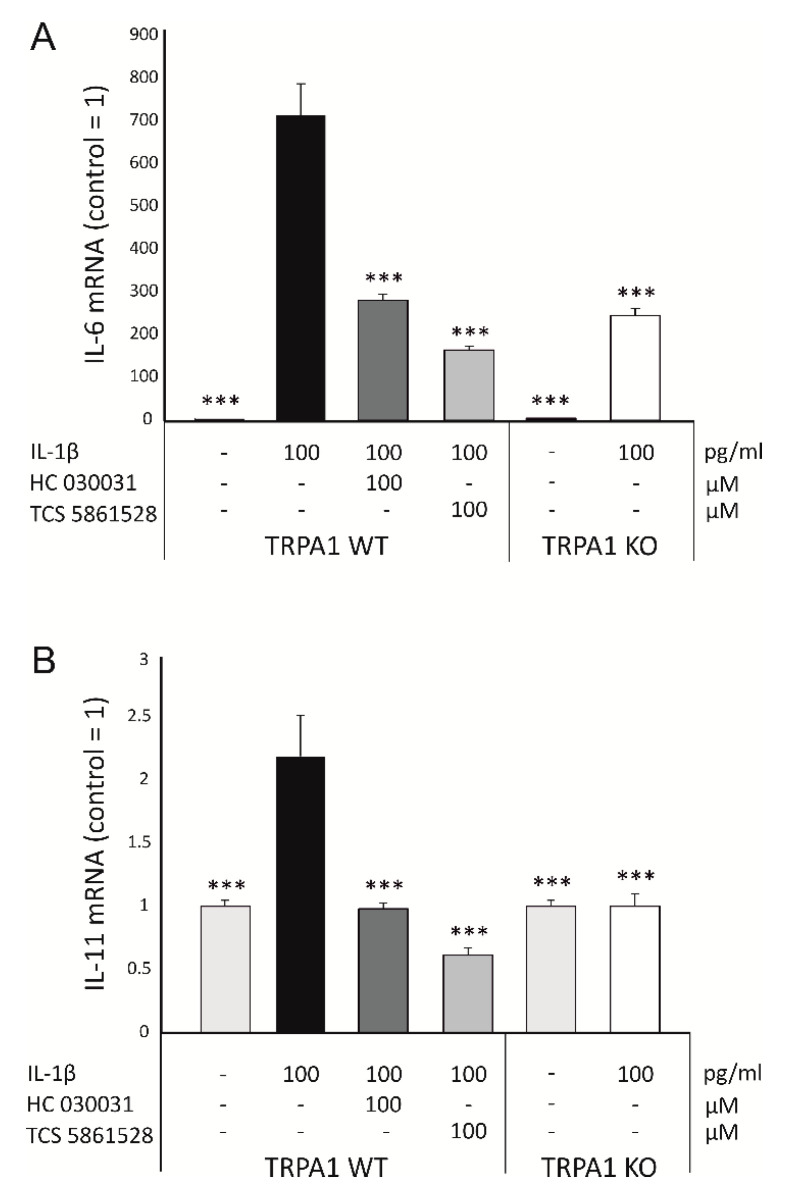
Figure 1
Figure 1
IL-1β-induced IL-6 (A) and IL-11 (B) expression is attenuated by genetic deletion and pharmacological inhibition of TRPA1 in murine chondrocytes. Chondrocytes were obtained from TRPA1 deficient (knockout, KO) mice and corresponding wild-type (WT) mice. The chondrocytes were cultured with IL-1β (100 pg/mL) alone, or together with the selective TRPA1 antagonist HC-030031 (100 μM) or TCS 5861528 (100 μM) for 24 h and thereafter total RNA was extracted. IL-6 and IL-11 mRNA levels were measured with qRT-PCR and normalized against glyceraldehyde 3-phosphate dehydrogenase (GAPDH) mRNA levels. The results are expressed as fold change in comparison to the control samples of each genotype. WT n = 13 (TCS treatment n = 10), KO n = 15. Results are expressed as mean + SEM. One-way ANOVA followed by Bonferroni post-test was performed; *** p < 0.001. (Adapted from the doctoral dissertation of the first author [28]).
Figure 2
Figure 2
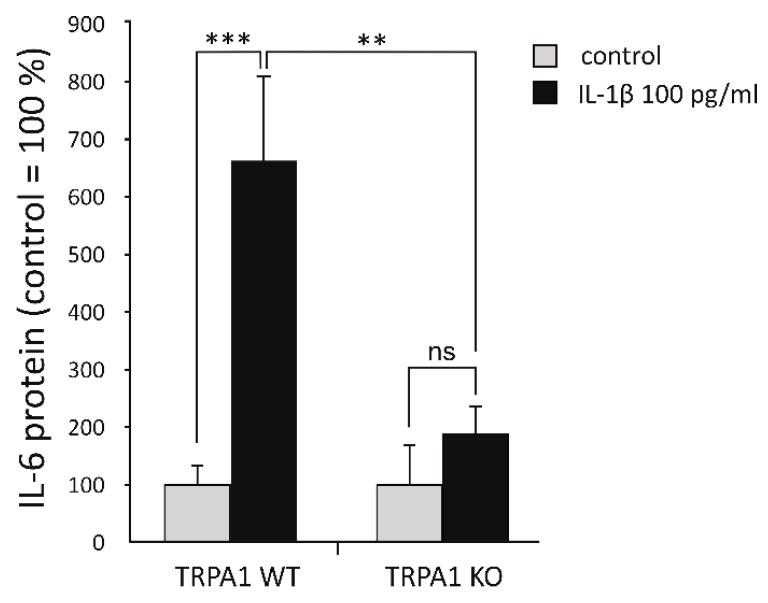
IL-1β-induced production of IL-6 in cartilage is attenuated by genetic deletion of TRPA1. Cartilage samples (from femoral heads) were obtained from six TRPA1 deficient (KO) mice and six corresponding wild-type (WT) mice. The cartilage pieces were cultured in the presence of IL-1β (100 pg/mL) or without stimulation for 42 h, after which the culture medium was collected, and IL-6 was measured by immunoassay. The results are expressed as mean + SEM, n = 6. One-way ANOVA followed by Bonferroni post-test was performed; ** p < 0.01, *** p < 0.001, ns: not significant. (Adapted from the doctoral dissertation of the first author [28]).
Figure 3
Figure 3
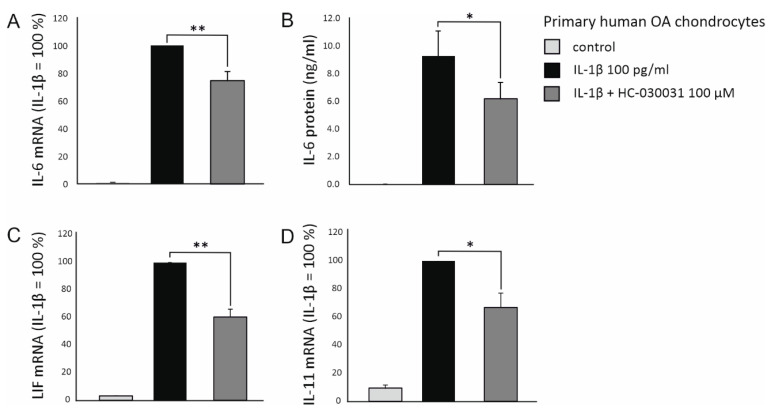
IL-1β-enhanced expression of IL-6 (A,B), leukemia inhibitory factor (LIF) (C) and IL-11 (D) in primary human osteoarthritic (OA) chondrocytes is attenuated by pharmacological inhibition of TRPA1. Primary human OA chondrocytes were stimulated with IL-1β (100 pg/mL) in the presence and absence of the selective TRPA1 antagonist HC-030031 (100 μM) for 24 h, after which the cell culture media were collected, and total RNA was extracted. IL-6 was measured from the cell culture medium with immunoassay, and IL-6, LIF and IL-11 mRNA was measured by qRT-PCR and normalized against GAPDH mRNA levels. The results are expressed as mean + SEM, n = 7. Samples were obtained from seven patients and the experiments were carried out in duplicate. Paired t-test was used in the statistical analysis; * p < 0.05 and ** p < 0.01. (Adapted from the doctoral dissertation of the first author [28]).

References

    1. Zygmunt P.M., Högestätt E.D. Trpa1. Handb. Exp. Pharmacol. 2014;222:583–630. doi: 10.1007/978-3-642-54215-2_23. - DOI - PubMed
    1. Koivisto A., Chapman H., Jalava N., Korjamo T., Saarnilehto M., Lindstedt K., Pertovaara A. TRPA1: A transducer and amplifier of pain and inflammation. Basic Clin. Pharmacol. Toxicol. 2014;114:50–55. doi: 10.1111/bcpt.12138. - DOI - PubMed
    1. Bautista D.M., Movahed P., Hinman A., Axelsson H.E., Sterner O., Hogestatt E.D., Julius D., Jordt S.E., Zygmunt P.M. Pungent products from garlic activate the sensory ion channel TRPA1. Proc. Natl. Acad. Sci. USA. 2005;102:12248–12252. doi: 10.1073/pnas.0505356102. - DOI - PMC - PubMed
    1. Jordt S.E., Bautista D.M., Chuang H.H., McKemy D.D., Zygmunt P.M., Hogestatt E.D., Meng I.D., Julius D. Mustard oils and cannabinoids excite sensory nerve fibres through the TRP channel ANKTM1. Nature. 2004;427:260–265. doi: 10.1038/nature02282. - DOI - PubMed
    1. Bandell M., Story G.M., Hwang S.W., Viswanath V., Eid S.R., Petrus M.J., Earley T.J., Patapoutian A. Noxious cold ion channel TRPA1 is activated by pungent compounds and bradykinin. Neuron. 2004;41:849–857. doi: 10.1016/S0896-6273(04)00150-3. - DOI - PubMed