Review
. 2020 Dec 22;11(1):1.
doi: 10.3390/life11010001.

The ER Stress/UPR Axis in Chronic Obstructive Pulmonary Disease and Idiopathic Pulmonary Fibrosis

Affiliations
Review

The ER Stress/UPR Axis in Chronic Obstructive Pulmonary Disease and Idiopathic Pulmonary Fibrosis

Mahmoud Aghaei et al. Life (Basel). .

Abstract

Cellular protein homeostasis in the lungs is constantly disrupted by recurrent exposure to various external and internal stressors, which may cause considerable protein secretion pressure on the endoplasmic reticulum (ER), resulting in the survival and differentiation of these cell types to meet the increased functional demands. Cells are able to induce a highly conserved adaptive mechanism, known as the unfolded protein response (UPR), to manage such stresses. UPR dysregulation and ER stress are involved in numerous human illnesses, such as metabolic syndrome, fibrotic diseases, and neurodegeneration, and cancer. Therefore, effective and specific compounds targeting the UPR pathway are being considered as potential therapies. This review focuses on the impact of both external and internal stressors on the ER in idiopathic pulmonary fibrosis (IPF) and chronic obstructive pulmonary disease (COPD) and discusses the role of the UPR signaling pathway activation in the control of cellular damage and specifically highlights the potential involvement of non-coding RNAs in COPD. Summaries of pathogenic mechanisms associated with the ER stress/UPR axis contributing to IPF and COPD, and promising pharmacological intervention strategies, are also presented.

Keywords: UPR; autophagy; endoplasmic reticulum; fibrosis; lung disease; non-coding RNA; tissue remodeling.


Conflict of interest statement

The authors have no conflict of interest.

Figures
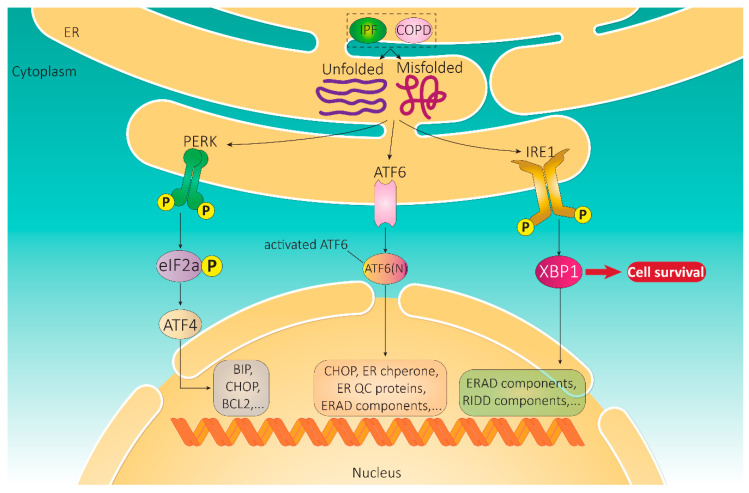
Figure 1
Figure 1
Schematic representation of the unfolded protein response (UPR) pathway. Idopathic pulmonary fibrosis (IPF) and chronic obstructive pulmonary disease (COPD)-involved mechanisms are generally involved in UPR induction. Incorrectly folded proteins bind to (UPR) sensor proteins in the endoplasmic reticulum (ER) lumen, resulting in activation of the UPR. Protein kinase R-like ER kinase (PERK), activating transcription factor 6 (ATF6), and serine/threonine-protein kinase/endoribonuclease inositol-requiring enzyme (IRE)-1 activate a series of reactions and signaling pathways, which eventually leads to transcription initiation and translation regulation of the effector genes. These genes include C/EBP-homologous protein (CHOP) and components of the ER-associated degradation (ERAD) system and regulated IRE1-dependent decay (RIDD), which regulate apoptosis/autophagy, ER expansion, and protein folding. Abbreviations: eIF2α (eukaryotic initiation factor 2 alpha), ATF4 (activating transcription factor 4), XBP-1 (X-box binding protein-1), ER chaperone-binding immunoglobulin protein (BiP).
Figure 2
Figure 2
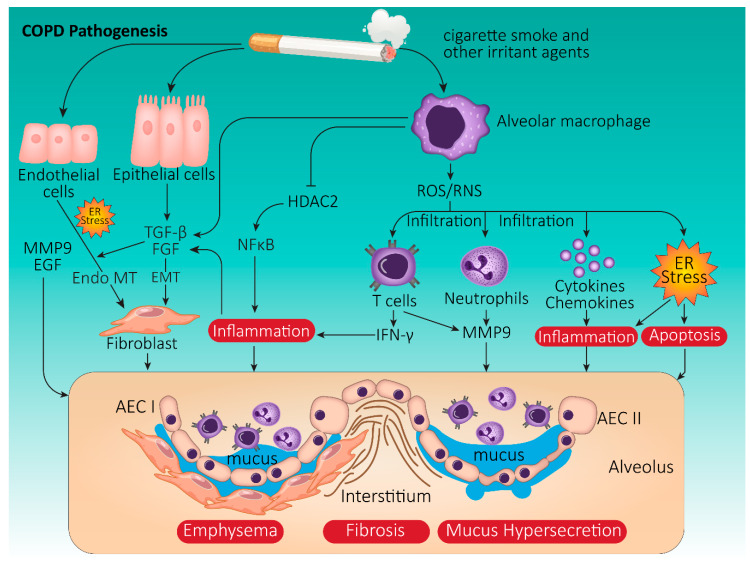
Schematic summary of COPD pathogenesis. Cigarette smoking is the most common risk factor triggering the development of chronic obstructive pulmonary disease (COPD). In response to irritant exposure, alveolar macrophage activation generates excessive reactive oxygen (ROS) and nitrogen (RNS) species, leading to T cell and neutrophil infiltration, cytokine/chemokine release, inflammation, and endoplasmic reticulum (ER) stress. Smoking damages resident epithelial cells in the lung, which promotes further release of pro-inflammatory factors, transforming growth factor-β (TGF-β), and matrix metalloproteinase-9 (MMP-9). All these factors trigger inflammation, alveolar epithelial cell (AEC) I and II apoptosis, fibrosis, and mucus hypersecretion, contributing to the development of airflow obstruction and emphysema. Abbreviations: FGF (fibroblast growth factor), HDAC2 (histone deacetylase 2), EGF (epidermal growth factor), INF-γ (interferon gamma).
Figure 3
Figure 3
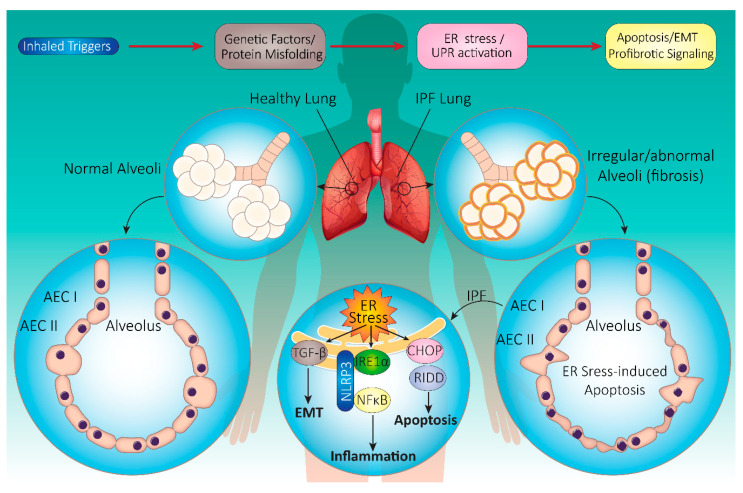
Schematic summary of IPF pathogenesis. Inhaled triggers along with genetic factors contribute to the induction of UPR in IPF pathogenesis. UPR activation triggers many downstream pathways, which may induce EMT, apoptosis, and pro-fibrotic signaling in the lung. The key histopathological feature of IPF is usually interstitial pneumonia (UIP). Endoplasmic reticulum (ER) stress in IPF triggers apoptosis through UPR system activation, inflammation via nuclear factor kappa-light-chain-enhancer of activated B cells (NFκB) activation, and epithelial–mesenchymal transition (EMT) through transforming growth factor-β (TGF-β) activation. Affected cells include alveolar epithelial cell (AEC) I and II, resident macrophages, and fibroblasts in the alveoli. Alveolar changes lead to exaggerated fibrosis, lymphocyte infiltration, and honeycomb change. Abbreviations: CHOP (C/EBP-homologous protein), IRE1 (serine/threonine-protein kinase/endoribonuclease inositol-requiring enzyme 1), RIDD (regulated IRE1-dependent decay), NLRP3 (NOD-, LRR-, and pyrin domain-containing protein 3).

References

    1. Wang M., Kaufman R.J. Protein misfolding in the endoplasmic reticulum as a conduit to human disease. Nature. 2016;529:326–335. doi: 10.1038/nature17041. - DOI - PubMed
    1. Dastghaib S., Shojaei S., Mostafavi-Pour Z., Sharma P., Patterson J.B., Samali A., Mokarram P., Ghavami S. Simvastatin Induces Unfolded Protein Response and Enhances Temozolomide-Induced Cell Death in Glioblastoma Cells. Cells. 2020;9:2339. doi: 10.3390/cells9112339. - DOI - PMC - PubMed
    1. Dastghaib S., Kumar P.S., Aftabi S., Damera G., Dalvand A., Sepanjnia A., Kiumarsi M., Aghanoori M.R., Sohal S.S., Ande S.R., et al. Mechanisms Targeting the Unfolded Protein Response in Asthma. Am. J. Respir. Cell Mol. Biol. 2020 doi: 10.1165/rcmb.2019-0235TR. - DOI - PubMed
    1. Madden E.C., Gorman A.M., Logue S.E., Samali A. Tumour Cell Secretome in Chemoresistance and Tumour Recurrence. Trends Cancer. 2020;6:489–505. doi: 10.1016/j.trecan.2020.02.020. - DOI - PubMed
    1. Barua D., Abbasi B., Gupta A., Gupta S. XBP1 increases transactivation of somatic mutants of ESR1 and loss of XBP1 reverses endocrine resistance conferred by gain-of-function Y537S ESR1 mutation. Heliyon. 2020;6:05217. doi: 10.1016/j.heliyon.2020.e05217. - DOI - PMC - PubMed