Review
. 2020 Dec 22;22(1):23.
doi: 10.3390/ijms22010023.

Amino Acid Transporters Are a Vital Focal Point in the Control of mTORC1 Signaling and Cancer

Affiliations
Review

Amino Acid Transporters Are a Vital Focal Point in the Control of mTORC1 Signaling and Cancer

Yann Cormerais et al. Int J Mol Sci. .

Abstract

The mechanistic target of rapamycin complex 1 (mTORC1) integrates signals from growth factors and nutrients to control biosynthetic processes, including protein, lipid, and nucleic acid synthesis. Dysregulation in the mTORC1 network underlies a wide array of pathological states, including metabolic diseases, neurological disorders, and cancer. Tumor cells are characterized by uncontrolled growth and proliferation due to a reduced dependency on exogenous growth factors. The genetic events underlying this property, such as mutations in the PI3K-Akt and Ras-Erk signaling networks, lead to constitutive activation of mTORC1 in nearly all human cancer lineages. Aberrant activation of mTORC1 has been shown to play a key role for both anabolic tumor growth and resistance to targeted therapeutics. While displaying a growth factor-independent mTORC1 activity and proliferation, tumors cells remain dependent on exogenous nutrients such as amino acids (AAs). AAs are an essential class of nutrients that are obligatory for the survival of any cell. Known as the building blocks of proteins, AAs also act as essential metabolites for numerous biosynthetic processes such as fatty acids, membrane lipids and nucleotides synthesis, as well as for maintaining redox homeostasis. In most tumor types, mTORC1 activity is particularly sensitive to intracellular AA levels. This dependency, therefore, creates a targetable vulnerability point as cancer cells become dependent on AA transporters to sustain their homeostasis. The following review will discuss the role of AA transporters for mTORC1 signaling in cancer cells and their potential as therapeutic drug targets.

Keywords: ASCT2; LAT1; SNAT2; amino acid transporters; cancer; growth factors; mTORC1; nutrients; xCT.


Conflict of interest statement

The authors declare that they have no conflict of interest. All co-authors have seen and agreed with the contents of the manuscript and there is no financial interest to report.

Figures
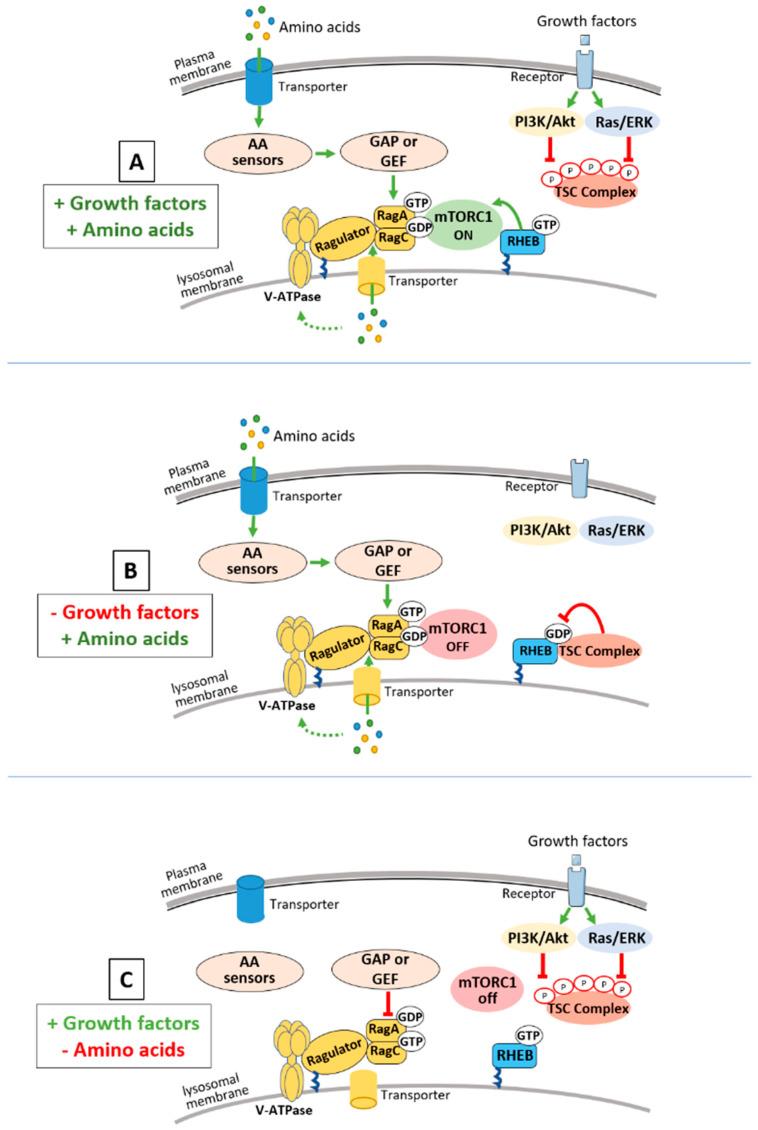
Figure 1
Figure 1
Mechanistic target of rapamycin complex 1 (mTORC1) integrates signals from growth factors and amino acids. This schematic represents different nucleotide loaded states of the Rheb and Rags GTPases in the presence or absence of amino acid (AA) and Growth factors and their influence on mTORC1 activity. (A) The presence of growth factors and hormones leads to an Akt- or Erk-dependent phosphorylation of tuberous sclerosis complex (TSC), resulting in the immediate release of the TSC complex from the lysosome promoting the accumulation of Rheb-GTP and therefore mTORC1 activation. (B) During a cellular stress or growth factors withdrawal, the TSC complex is recruited to the lysosome where it decreases Rheb-GTP levels and turns off mTORC1 signaling. AAs are sensed via a complex upstream network composed of AA sensors, AA transporters and GAP and GTP exchange factors (GEFs) factors that regulate the nucleotide loaded state of RagA/B and RagC/D. When AAs are present, the Rag heterodimer is converted to its active conformation, RagA/B-GTP and RagC/D-GDP, which leads to the lysosomal recruitment of mTORC1. (Panel C) When AAs are absent, the Rag heterodimer is converted to its inactive conformation RagA/B-GDP and RagC/D-GTP which promotes the release of mTORC1 into the cytoplasm (C). Signals from both AAs and growth factors/hormones are required to promote a full activation of mTORC1.
Figure 2
Figure 2
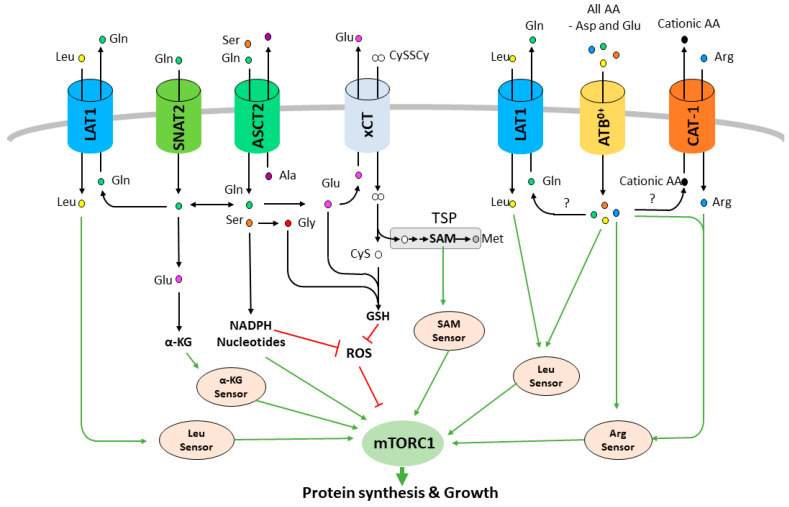
Amino acid transporters regulate mTORC1 activity. Amino acid transporters promote the uptake of leucine, arginine, glutamine, serine, cystine (CySSCy) and other amino acids. These amino acids are sensed directly to activate mTORC1 or converted to downstream metabolites that will activate mTORC1 or inhibit the production of reactive oxygen species (ROS). α-KG: α-ketoglutarate, SAM: S-adenosylmethionine, TSP: Transsulfuration pathway.
Figure 3
Figure 3
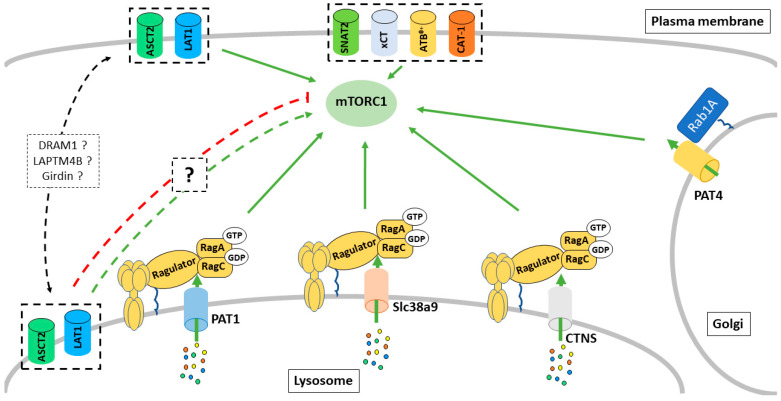
Intracellular amino acid transporters regulate mTORC1 activity. Multiple intracellular transporters have been shown to regulate mTORC1 via possibly Rag GTPase-dependent and independent mechanisms.
Figure 4
Figure 4
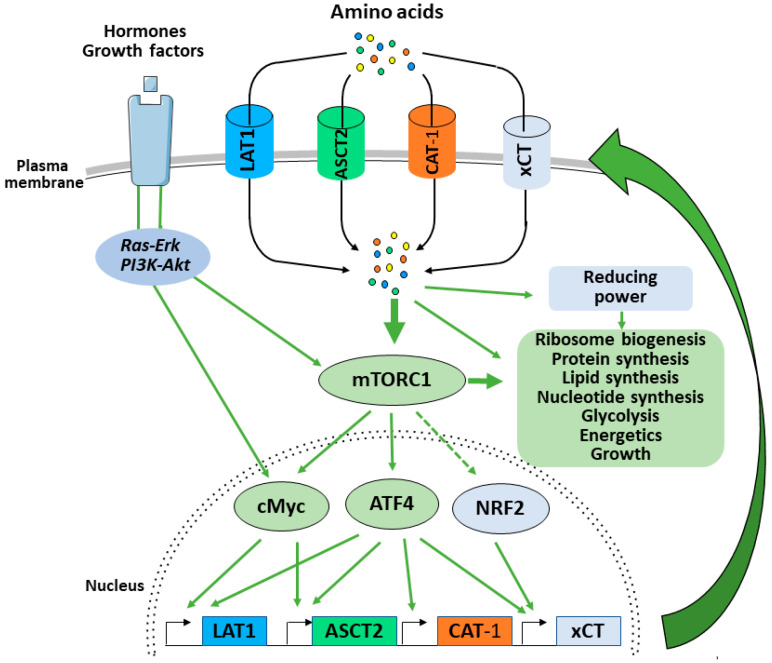
mTORC1 balances supply and demand by promoting amino acid uptake. When activated by growth factor, mTORC1 promotes the translation of cMyc, ATF4 and potentially stabilizes NRF2. These transcription factors will then promote the expression of AA transporters that will increase AA uptake, sustain mTORC1 activity and promote the mTORC1 mediated anabolic program and cell growth.

References

    1. Saxton R.A., Sabatini D.M. mTOR Signaling in Growth, Metabolism, and Disease. Cell. 2017;169:361–371. doi: 10.1016/j.cell.2017.03.035. - DOI - PubMed
    1. Ben-Sahra I., Manning B.D. mTORC1 signaling and the metabolic control of cell growth. Curr. Opin. Cell Biol. 2017;45:72–82. doi: 10.1016/j.ceb.2017.02.012. - DOI - PMC - PubMed
    1. Dibble C.C., Elis W., Menon S., Qin W., Klekota J., Asara J.M., Finan P.M., Kwiatkowski D.J., Murphy L.O., Manning B.D. TBC1D7 is a third subunit of the TSC1-TSC2 complex upstream of mTORC1. Mol. Cell. 2012;47:535–546. doi: 10.1016/j.molcel.2012.06.009. - DOI - PMC - PubMed
    1. Dibble C.C., Manning B.D. Signal integration by mTORC1 coordinates nutrient input with biosynthetic output. Nat. Cell Biol. 2013;15:555–564. doi: 10.1038/ncb2763. - DOI - PMC - PubMed
    1. Menon S., Dibble C.C., Talbott G., Hoxhaj G., Valvezan A.J., Takahashi H., Cantley L.C., Manning B.D. Spatial control of the TSC complex integrates insulin and nutrient regulation of mTORC1 at the lysosome. Cell. 2014;156:771–785. doi: 10.1016/j.cell.2013.11.049. - DOI - PMC - PubMed

MeSH terms

Substances