


Long-Term Carbapenems Antimicrobial Stewardship Program
- PMID: 33375237
- PMCID: PMC7823722
- DOI: 10.3390/antibiotics10010015
Long-Term Carbapenems Antimicrobial Stewardship Program
Abstract
Objective: To evaluate clinical and antibiotic resistance impact of carbapenems stewardship programs.
Methods: descriptive study, pre-post-intervention, between January 2012 and December 2019; 350-bed teaching hospital. Prospective audit and feedback to prescribers was carried out between January 2015 and December 2019. We evaluate adequacy of carbapenems prescription to local guidelines and compare results between cases with accepted or rejected intervention. Analysis of antibiotic-consumption and hospital-acquired multidrug-resistant (MDR) bloodstream infections (BSIs) was performed.
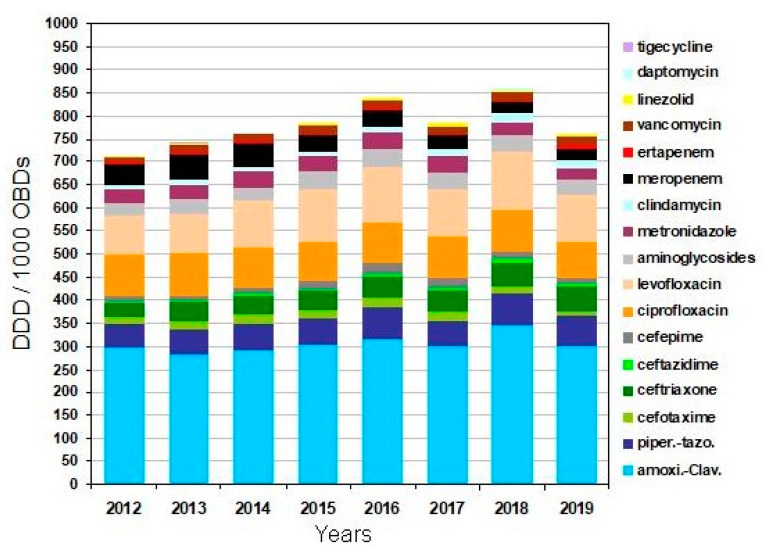
Results: 1432 patients were followed. Adequacy of carbapenems prescription improved from 49.7% in 2015 to 80.9% in 2019 (p < 0.001). Interventions on prescription were performed in 448 (31.3%) patients without carbapenem-justified treatment, in 371 intervention was accepted, in 77 it was not. Intervention acceptance was associated with shorter duration of all antibiotic treatment and inpatient days (p < 0.05), without differences in outcome. During the period 2015-2019, compared with 2012-2014, decreased meropenem consumption (Rate Ratio 0.58; 95%CI: 0.55-0.63), candidemia and hospital-acquired MDR BSIs rate (RR 0.62; 95%CI: 0.41-0.92, p = 0.02), and increased cefepime (RR 2; 95%CI: 1.77-2.26) and piperacillin-tazobactam consumption (RR 1.17; 95%CI: 1.11-1.24), p < 0.001.
Conclusions: the decrease and better use of carbapenems achieved could have clinical and ecological impact over five years, reduce inpatient days, hospital-acquired MDR BSIs, and candidemia, despite the increase in other antibiotic-consumption.
Keywords: antimicrobial stewardship; bloodstream infections; candidemia; carbapenems; hospital infections; multidrug-resistant.
Conflict of interest statement
The authors declare no conflict of interest.
Figures


References
-
- United Nations General Assembly of the United Nations: President of the 71st Session. [(accessed on 30 October 2020)];2016 Available online: http://www.un.org/pga/71/2016/09/21/press-release-hl-meeting-on-antimicr...
-
- Barlam T.F., Cosgrove S.E., Abbo L.M., MacDougall C., Schuetz A.N., Septimus E.J., Hamilton C.W. Implementing an Antibiotic Stewardship Program: Guidelines by the Infectious Diseases Society of America and the Society for Healthcare Epidemiology of America. Clin. Infect. Dis. 2016;62:e51–e77. doi: 10.1093/cid/ciw118. - DOI - PMC - PubMed
-
- Karanika S., Paudel S., Grigoras C., Kalbasi A., Mylonakis E. Systematic Review and Meta-analysis of Clinical and Economic Outcomes from the Implementation of Hospital-Based Antimicrobial Stewardship Programs. Antimicrob. Agents Chemother. 2016;60:4840–4852. doi: 10.1128/AAC.00825-16. - DOI - PMC - PubMed
-
- Lawes T., Lopez-Lozano J.-M., A Nebot C., Macartney G., Subbarao-Sharma R., Dare C.R., Wares K.D., Gould I.M. Effects of national antibiotic stewardship and infection control strategies on hospital-associated and community-associated meticillin-resistant Staphylococcus aureus infections across a region of Scotland: A non-linear time-series study. Lancet Infect. Dis. 2015;15:1438–1449. doi: 10.1016/S1473-3099(15)00315-1. - DOI - PubMed
LinkOut - more resources
Full Text Sources
