


Endoscopic Skull Base Repair Strategy for CSF Leaks Associated with Pneumocephalus
- PMID: 33375669
- PMCID: PMC7796295
- DOI: 10.3390/jcm10010046
Endoscopic Skull Base Repair Strategy for CSF Leaks Associated with Pneumocephalus
Abstract
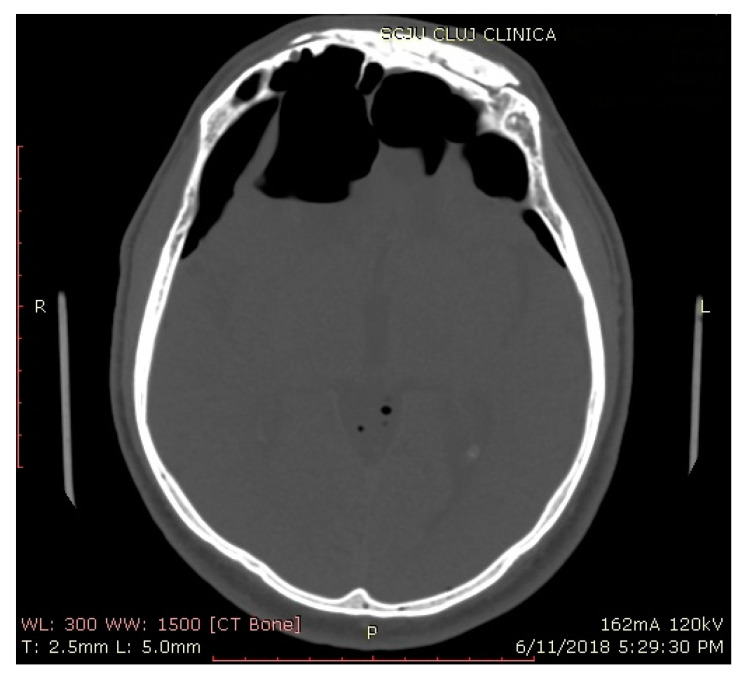
Background: Cerebrospinal (CSF) fluid leaks with associated pneumocephalus (PNC) represent a condition bearing serious risks for the patient, with little data available in the literature. Reported success rates of endoscopic skull base repair are lower when PNC is associated than in the case of simple CSF leaks. The present study represents an analysis of our experience with endoscopic management of this condition.
Methods: Records of patients with pneumocephalus and associated CSF leaks, who underwent endoscopic skull base repair, were reviewed. Demographics, history, etiology of PNC, size of defect, surgical approach, reconstruction technique and complications were evaluated.
Results: Twenty patients with CSF leaks and PNC underwent endonasal repair by the senior author between 2005 and 2019. Defect size was larger than 15 mm in all cases. All patients presented either worsening of PNC under conservative treatment or tension PNC. First-attempt closure of the defect was successful in all patients (100%), with resolution of the pneumocephalus. One patient developed a synechia in the proximity of the frontal ostium, as a postoperative complication. The mean follow-up was 39 months (range: 15-94 months).
Conclusion: The present study represents a proposed argument for earlier endoscopic endonasal treatment in patients presenting CSF leaks and pneumocephalus.
Keywords: CSF leak; cranialization; endoscopic repair; pneumocephalus; skull base.
Conflict of interest statement
The authors declare no conflict of interest.
Figures



References
-
- Wise S.K., Harvey R.J., Patel S.J., Frankel B.M., Schlosser R.J. Endoscopic repair of skull base defects presenting with pneumocephalus. J. Otolaryngol. Head Neck Surg. 2009;38:509–516. - PubMed
-
- Siegel J., Hampton K., Rabinstein A.A., McLaughlin D., Diaz-Gomez J.L. Oxygen Therapy with High-Flow Nasal Cannula as an Effective Treatment for Perioperative Pneumocephalus: Case Illustrations and Pathophysiological Review. Neurocrit. Care. 2018;29:366–373. doi: 10.1007/s12028-017-0464-x. - DOI - PubMed
LinkOut - more resources
Full Text Sources
