Review
. 2020 Dec 25;10(1):50.
doi: 10.3390/jcm10010050.

The Role of Methemoglobin and Carboxyhemoglobin in COVID-19: A Review

Affiliations
Review

The Role of Methemoglobin and Carboxyhemoglobin in COVID-19: A Review

Felix Scholkmann et al. J Clin Med. .

Abstract

Following the outbreak of a novel coronavirus (SARS-CoV-2) associated with pneumonia in China (Corona Virus Disease 2019, COVID-19) at the end of 2019, the world is currently facing a global pandemic of infections with SARS-CoV-2 and cases of COVID-19. Since severely ill patients often show elevated methemoglobin (MetHb) and carboxyhemoglobin (COHb) concentrations in their blood as a marker of disease severity, we aimed to summarize the currently available published study results (case reports and cross-sectional studies) on MetHb and COHb concentrations in the blood of COVID-19 patients. To this end, a systematic literature research was performed. For the case of MetHb, seven publications were identified (five case reports and two cross-sectional studies), and for the case of COHb, three studies were found (two cross-sectional studies and one case report). The findings reported in the publications show that an increase in MetHb and COHb can happen in COVID-19 patients, especially in critically ill ones, and that MetHb and COHb can increase to dangerously high levels during the course of the disease in some patients. The medications given to the patient and the patient's glucose-6-phospate dehydrogenase (G6PD) status seem to be important factors determining the severity of the methemoglobinemia and carboxyhemoglobinemia. Therefore, G6PD status should be determined before medications such as hydroxychloroquine are administered. In conclusion, MetHb and COHb can be elevated in COVID-19 patients and should be checked routinely in order to provide adequate medical treatment as well as to avoid misinterpretation of fingertip pulse oximetry readings, which can be inaccurate and unreliable in case of elevated MetHb and COHb levels in the blood.

Keywords: COVID-19; SARS-CoV-2; carboxyhemoglobin; carboxyhemoglobinemia; methemoglobin; methemoglobinemia.


Conflict of interest statement

The authors declare no conflict of interest.

Figures
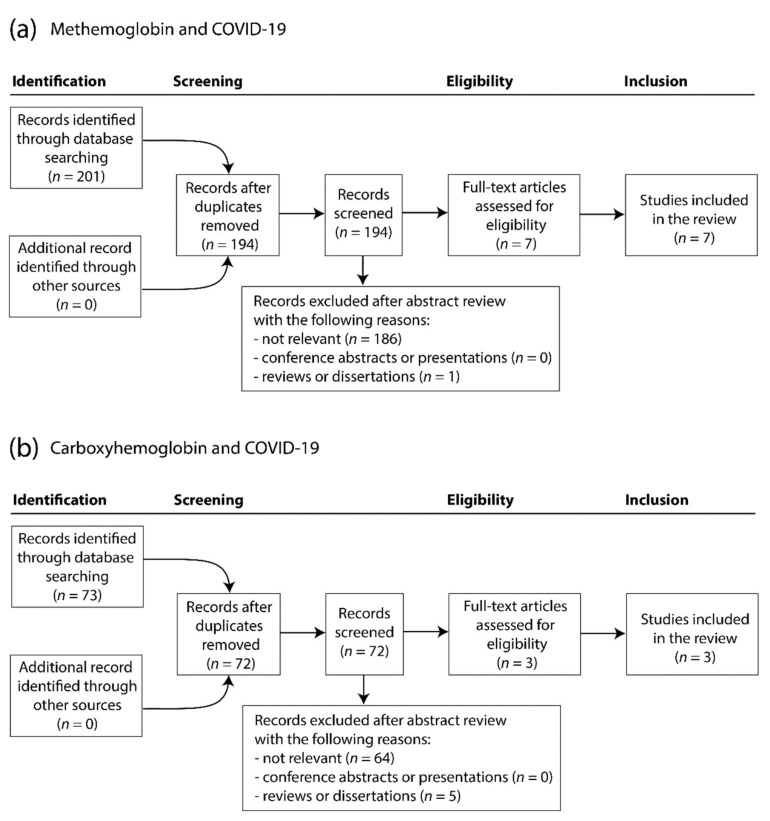
Figure 1
Figure 1
Flow diagram of the literature search process according to the PRISMA criteria. PRISMA: Preferred Reporting Items for Systematic Reviews and Meta-Analyses.
Figure 2
Figure 2
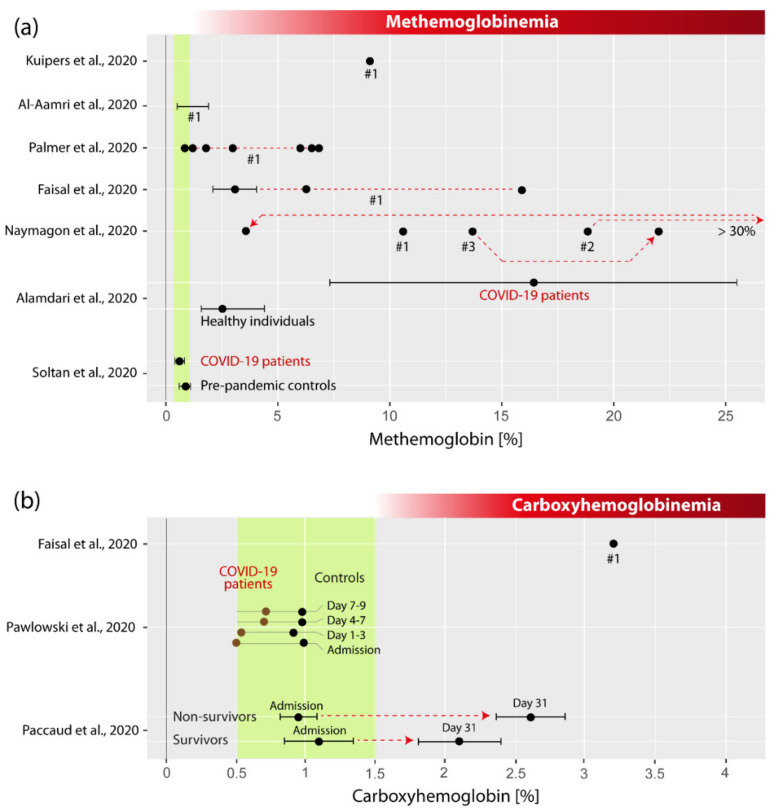
Visualization of (a) methemoglobin (MetHb) and (b) carboxyhemoglobin (COHb) values of COVID-19 patients reported in the literature. The green shaded areas refer to the reference ranges for healthy individuals in case of MetHb (0.67 ± 0.33% for healthy non-smokers [15]) and COHb (0.5–1.5% for healthy non-smokers [16]). Different subjects reported in the case reports are marked with “#”, and red lines with arrows indicate the development of subject-specific values during the course of the disease.
Figure 3
Figure 3
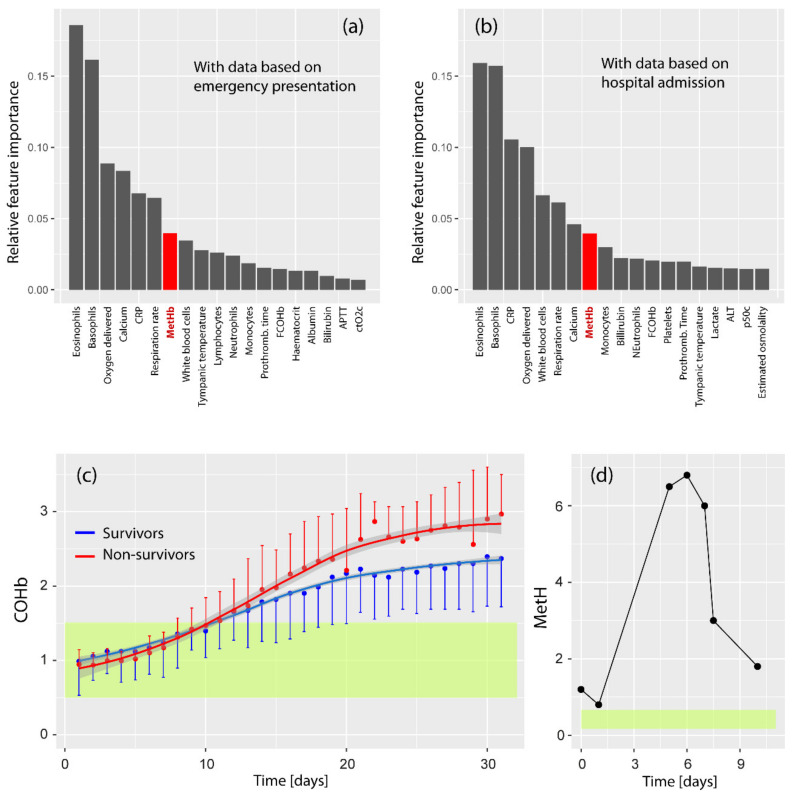
(a,b) Relative feature importance in predicting COVID-19 according to the study of Soltan et al. [19]. Two models were built, one with data based on emergency presentation (a) and one with data based on hospital admission. MetHb was a relevant parameter in both models (indicated in red). (c) COVID-19 non-survivors (n = 22) show a steeper and higher increase of COHb during the curse of the disease compared to COVID-19 survivors (n = 41), according to the study of Paccaudi et al. [24]. The two COHb time-series are statistically significantly different. The yellow bar refers to the COHb reference ranges for healthy non-smokers [16]. (d) Time-course of MetHb of a COVID-19 patient reported by Palmer et al. [22]. The yellow bar refers to the MetHb reference range for healthy non-smokers [15]. The figures show data extracted from the original figures of the respective publications.
Figure 4
Figure 4
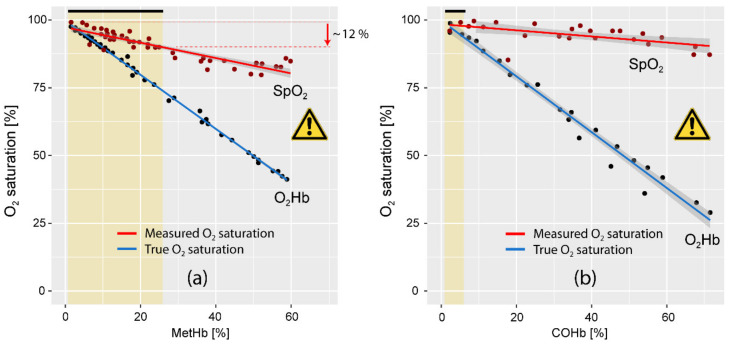
The impact of MetHb and COHb on SpO2 measured with pulse oximetry. (a) Blood MetHb vs. SpO2 and blood Hb O2 saturation (O2Hb). Data extracted from Barker et al. [86]. (b) Blood COHb vs. SpO2 and blood O2Hb saturation. Data extracted from Barker et al. [87]. In both studies, measurements were made on dogs; the inspired O2 fraction (FIO2) was 1, SpO2 was measured on the tongue with a pulse oximeter (Nellcor N-100, USA) and COHb, MetHb and O2Hb saturation with a CO-oximeter (IL-282, Instrumentation Laboratories, Bedford, MA, USA). The figures show data extracted from the original figures of the respective publications.

References

    1. Wu F., Zhao S., Yu B., Chen Y.-M., Wang W., Song Z.-G., Hu Y., Tao Z.-W., Tian J.-H., Pei Y.-Y., et al. A new coronavirus associated with human respiratory disease in China. Nature. 2020;579:265–269. doi: 10.1038/s41586-020-2008-3. - DOI - PMC - PubMed
    1. Zhou P., Yang X.-L., Wang X.-G., Hu B., Zhang L., Zhang W., Si H.-R., Zhu Y., Li B., Huang C.-L., et al. A pneumonia outbreak associated with a new coronavirus of probable bat origin. Nature. 2020;579:270–273. doi: 10.1038/s41586-020-2012-7. - DOI - PMC - PubMed
    1. Lechien J.R., Chiesa-Estomba C.M., Place S., Van Laethem Y., Cabaraux P., Mat Q., Huet K., Plzak J., Horoi M., Hans S., et al. Clinical and epidemiological characteristics of 1420 European patients with mild-to-moderate coronavirus disease 2019. J. Intern. Med. 2020;288:335–344. doi: 10.1111/joim.13089. - DOI - PMC - PubMed
    1. He J., Guo Y., Mao R., Zhang J. Proportion of asymptomatic coronavirus disease 2019: A systematic review and meta-analysis. J. Med. Virol. 2020 doi: 10.1002/jmv.26326. - DOI - PMC - PubMed
    1. Yuki K., Fujiogi M., Koutsogiannaki S. COVID-19 pathophysiology: A review. Clin. Immunol. 2020;215:108427. doi: 10.1016/j.clim.2020.108427. - DOI - PMC - PubMed

LinkOut - more resources