Real-world clinical outcomes following treatment intensification with GLP-1 RA, OADs or insulin in patients with type 2 diabetes on two oral agents (PATHWAY 2-OADs)
- PMID: 33376084
- PMCID: PMC7778743
- DOI: 10.1136/bmjdrc-2020-001830
Real-world clinical outcomes following treatment intensification with GLP-1 RA, OADs or insulin in patients with type 2 diabetes on two oral agents (PATHWAY 2-OADs)
Abstract
Introduction: Most patients with type 2 diabetes require sequential addition of glucose-lowering agents to maintain long-term glycemic control. In this retrospective, observational study, we compared intensification with a glucagon-like peptide-1 receptor agonist (GLP-1 RA), oral antidiabetic drugs (OADs), and insulin in patients receiving two OADs, using US electronic health records and claims data.
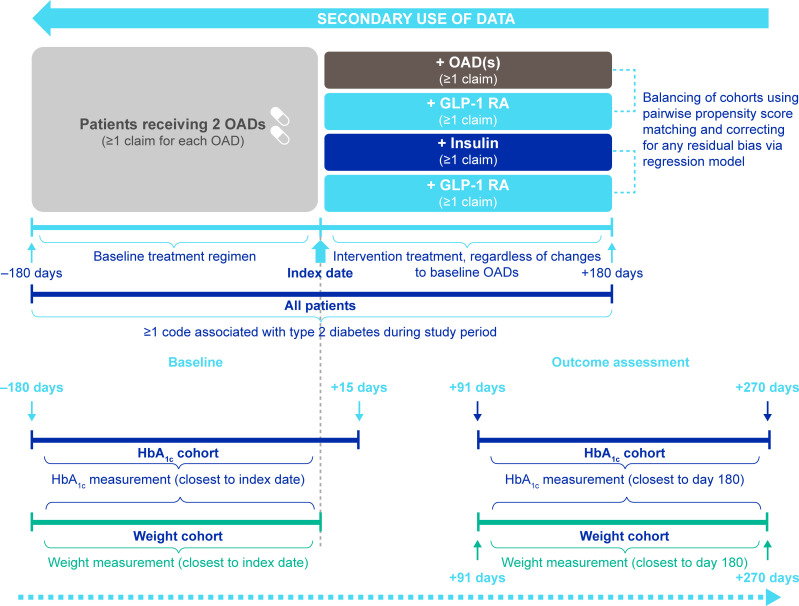
Research design and methods: For inclusion, patients in the IBM MarketScan Explorys database were required to have claims for two different OADs in the 180-day baseline period and ≥1 claim for a different OAD/GLP-1 RA/insulin at index date (treatment intensification). Changes in glycated hemoglobin (HbA1c) and weight from baseline were assessed at 180 days postindex. Patients were propensity score-matched by baseline characteristics and exact-matched by HbA1c category (HbA1c cohort and weight/composite outcomes cohort) and body mass index (BMI) category (weight/composite outcomes cohort only) to obtain balanced treatment arms. The primary endpoint was the percentage of patients reaching target HbA1c <7% (53 mmol/mol).
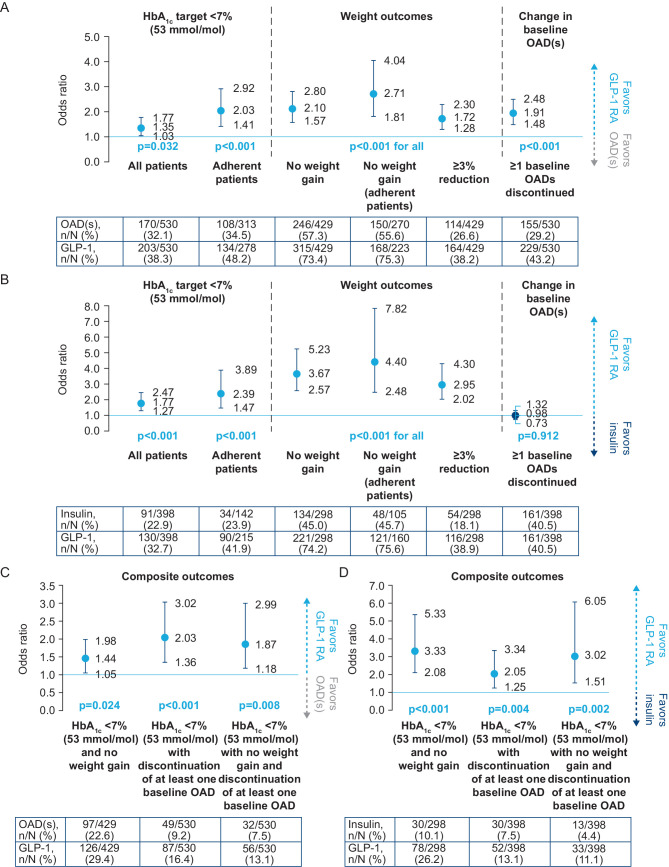
Results: Significantly more patients intensifying with a GLP-1 RA achieved HbA1c <7% than those receiving OAD(s) (OR: 1.35; 95% CI 1.03 to 1.77; p=0.032) or insulin (OR: 1.77; 95% CI 1.27 to 2.47; p<0.001). GLP-1 RAs were also associated with a significantly greater chance of not gaining weight; significantly greater HbA1c and weight decreases from baseline; and a significantly greater chance of HbA1c <7%, no weight gain and discontinuation of ≥1 baseline OAD (composite outcome), compared with OAD(s) or insulin.
Conclusions: In propensity score-matched cohorts, GLP-1 RAs demonstrated significant benefits for both glycemic control and weight management over additional OAD(s) or insulin, respectively, indicating that they may represent the optimal choice at these points in the treatment pathway.
Keywords: blood glucose; glucagon-like peptide 1; observational study; weight loss.
© Author(s) (or their employer(s)) 2020. Re-use permitted under CC BY-NC. No commercial re-use. See rights and permissions. Published by BMJ.
Conflict of interest statement
Competing interests: CD has performed consultancy for AstraZeneca, Bayer AG and Novo Nordisk A/S. ARK and MLW are employees of, and shareholders in, Novo Nordisk A/S. KKM is an employee of Novo Nordisk Global Service Centre India, which is part of Novo Nordisk A/S. IL has performed consultancy for AstraZeneca, Boehringer Ingelheim Pharmaceuticals, Eli Lilly and Company, Intarcia Therapeutics, Janssen Pharmaceuticals, MannKind Corporation, Novo Nordisk A/S, Sanofi, TARGET PharmaSolutions and Valeritas.
Figures
References
Publication types
MeSH terms
Substances
LinkOut - more resources
Full Text Sources
Medical
Miscellaneous