Review
. 2020 Dec;5(4):388-395.
doi: 10.1136/svn-2020-000334. Epub 2020 Mar 26.

Intracerebral haemorrhage: from clinical settings to animal models

Affiliations
Review

Intracerebral haemorrhage: from clinical settings to animal models

Qian Bai et al. Stroke Vasc Neurol. 2020 Dec.

Abstract

Spontaneous intracerebral haemorrhage (ICH) is a devastating type of stroke with high mortality and morbidity and for which no effective treatments are available to date. Much experimental and clinical research have been performed to explore its mechanisms regard the subsequent inflammatory cascade and to seek the potential therapeutic strategies. The aim of this review is to discuss insights from clinical settings that have led to the development of numerous animal models of ICH. Some of the current and future challenges for clinicians to understand ICH are also surveyed.

Keywords: inflammatory response; stroke.


Conflict of interest statement

Competing interests: None declared.

Figures
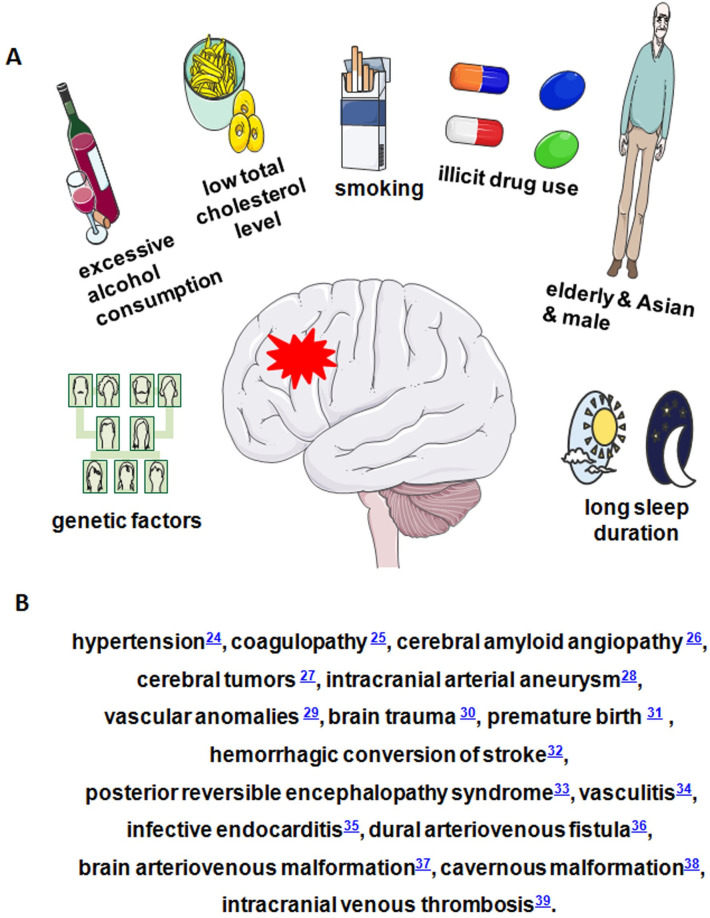
Figure 1
Figure 1
Risk factors of ICH. (A) Risk factors of ICH. (B) Some clinical diseases that can cause ICH. ICH, intracerebral haemorrhage.
Figure 2
Figure 2
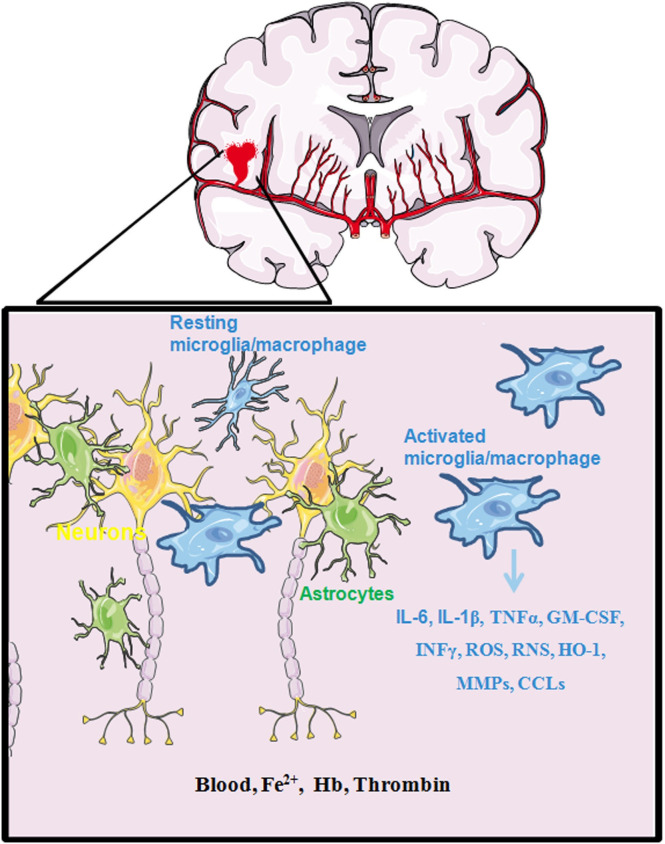
In the earliest stage of ICH, the primary injury causes blood products (Fe2+, Hb, thrombin) to leak into the damage area to activate microglia/macrophages to express high levels of IL-6, IL-1β, TNFα, GM-CSF, INFγ, ROS, RNS, CCLs, HO-1 and MMPs. These changes extend the brain damage such as brain oedema, cell death, blood–brain barrier disruption and neurological deficits. CCLs, chemokines subfamilies; GM-CSF, granulocyte-macrophage colony stimulating factor; Hb, haemoglobin; HO-1, heme oxygenase-1; INFγ, interferon-γ; MMPs, matrix metalloproteinases; RNS, reactive nitrogen species; ROS, reactive oxygen species; TNFα, tumour necrosis factorα.

References

    1. Cordonnier C, Demchuk A, Ziai W, et al. Intracerebral haemorrhage: current approaches to acute management. Lancet 2018;392:1257–68. 10.1016/S0140-6736(18)31878-6 - DOI - PubMed
    1. Gorelick PB. The global burden of stroke: persistent and disabling. Lancet Neurology 2019;18:417–8. 10.1016/S1474-4422(19)30030-4 - DOI - PubMed
    1. Tao C, Hu X, Li H, et al. White matter injury after intracerebral hemorrhage: pathophysiology and therapeutic strategies. Front Hum Neurosci 2017;11:422 10.3389/fnhum.2017.00422 - DOI - PMC - PubMed
    1. Keep RF, Zhou N, Xiang J, et al. Vascular disruption and blood–brain barrier dysfunction in intracerebral hemorrhage. Fluids Barriers CNS 2014;11:18 10.1186/2045-8118-11-18 - DOI - PMC - PubMed
    1. Bai Q, Xue M, Yong VW. Microglia and macrophage phenotypes in intracerebral haemorrhage injury: therapeutic opportunities. Brain 2020;143:1297–1314. 10.1093/brain/awz393. - DOI - PubMed