


Long-term follow-up and outcomes of percutaneous nephron-sparing surgery for upper tract urothelial carcinoma
- PMID: 33376263
- PMCID: PMC7759167
- DOI: 10.4103/iju.IJU_93_20
Long-term follow-up and outcomes of percutaneous nephron-sparing surgery for upper tract urothelial carcinoma
Abstract
Introduction: Upper tract urothelial carcinoma (UTUC) is uncommon, accounting for 5%-10% of all urothelial carcinomas. Current standard of care for localized disease consists of radical nephroureterectomy (RNU) which leads to loss of half the patient's functioning nephrons. Percutaneous nephron-sparing surgery (PCNSS) is an alternative minimally-invasive approach in selected cases where nephron preservation is desired. The long-term outcomes of this procedure at a single center are described.
Methods: All patients undergoing PCNSS, with the operation carried out by a single surgeon, were included. Equipment used was a standard 26Ch resectoscope through a 30Ch Amplatz sheath, with all patients receiving postoperative intrapelvic Mitomycin. Data for each patient were collected on patient age; tumor size at diagnosis; grade; stage; oncological recurrence; requirement for subsequent RNU; and overall survival. Primary outcomes were disease recurrence and overall mortality, and secondary outcome was rate of subsequent RNU.
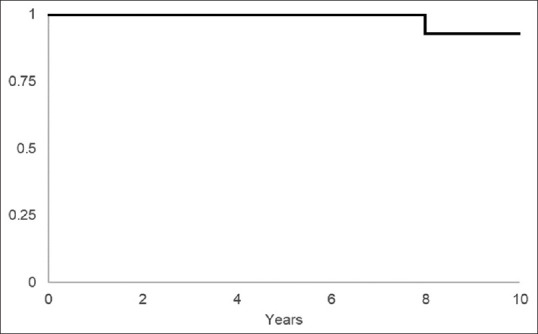
Results: Fifteen patients in total underwent PCNSS, 14 were diagnosed with UTUC; benign leiomyoma was proven in one patient and excluded from final analysis. Overall survival at 5 and 10 years was 92.9% and 78.6%, respectively, with disease-specific mortality at 10 years of 7.1% (one patient who developed metastatic carcinoma); 21.4% of patients had recurrent ipsilateral UTUC and all required subsequent RNU for this indication. No patients had seeding of the percutaneous tract.
Conclusion: PCNSS for UTUC is a feasible approach to consider in carefully selected patients who agree to intensive follow-up, even for higher grade tumors. Where recurrent UTUC occurs, further management options still exist for disease treatment.
Copyright: © 2020 Indian Journal of Urology.
Conflict of interest statement
Conflicts of interest: There are no conflicts of interest.
Figures

Comment in
-
Re; Sarmah PB, Ehsanullah SA, Sarmah BD. Long-term follow-up and outcomes of percutaneous nephron-sparing surgery for upper tract urothelial carcinoma. Indian J Urol 2020;36:276-81.Indian J Urol. 2021 Jan-Mar;37(1):103-104. doi: 10.4103/iju.IJU_538_20. Epub 2021 Jan 1. Indian J Urol. 2021. PMID: 33850371 Free PMC article. No abstract available.
References
-
- Siegel R, Naishadham DJ. Cancer statistics, 2012. CA Cancer J Clin. 2012;62:10–29. - PubMed
-
- Munoz JJ, Ellison LM. Upper tract urothelial neoplasms: Incidence and survival during the last 2 decades. J Urol. 2000;164:1523–5. - PubMed
-
- Rouprêt M, Babjuk M, Böhle A, Burger M, Compéerat E, Cowan N, et al. EAU guidelines on urothelial carcinomas of the upper urinary tract. Eur Urol. 2018;73:111–22. - PubMed
-
- Meyer JP, Delves GH, Sullivan ME, Keoghane SR. The effect of nephroureterectomy on glomerular filtration rate. BJU Int. 2006;98:845–8. - PubMed
-
- Weight CJ, Larson BT, Fergany AF, Gao T, Lane BR, Campbell SC, et al. Nephrectomy induced chronic renal insufficiency is associated with increased risk of cardiovascular death and death from any cause in patients with localized cT1b renal masses. J Urol. 2010;183:1317–23. - PubMed
LinkOut - more resources
Full Text Sources