


Prognostic relevance of clinical and molecular risk factors in children with high-risk medulloblastoma treated in the phase II trial PNET HR+5
- PMID: 33377141
- PMCID: PMC8248855
- DOI: 10.1093/neuonc/noaa301
Prognostic relevance of clinical and molecular risk factors in children with high-risk medulloblastoma treated in the phase II trial PNET HR+5
Abstract
Background: High-risk medulloblastoma is defined by the presence of metastatic disease and/or incomplete resection and/or unfavorable histopathology and/or tumors with MYC amplification. We aimed to assess the 3-year progression-free survival (PFS) and define the molecular characteristics associated with PFS in patients aged 5-19 years with newly diagnosed high-risk medulloblastoma treated according to the phase II trial PNET HR+5.
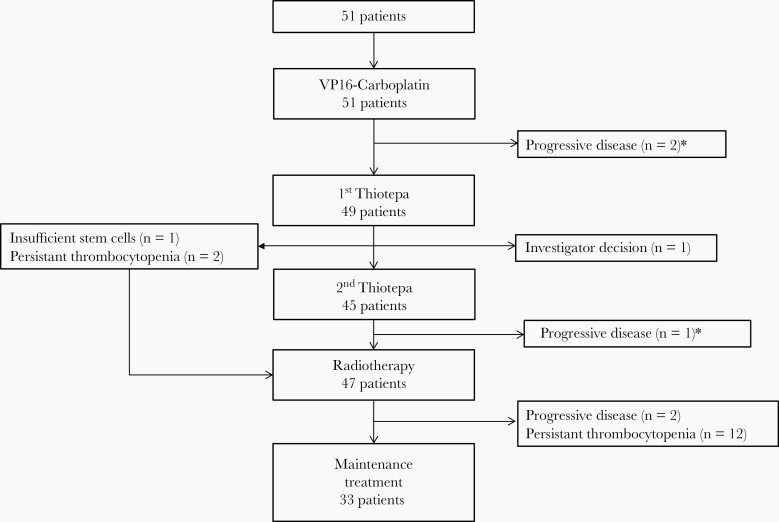
Methods: All children received postoperative induction chemotherapy (etoposide and carboplatin), followed by 2 high-dose thiotepa courses (600 mg/m2) with hematological stem cell support. At the latest 45 days after the last stem cell rescue, patients received risk-adapted craniospinal radiation therapy. Maintenance treatment with temozolomide was planned to start between 1-3 months after the end of radiotherapy. The primary endpoint was PFS. Outcome and safety analyses were per protocol (all patients who received at least one dose of induction chemotherapy).
Results: Fifty-one patients (median age, 8 y; range, 5-19) were enrolled. The median follow-up was 7.1 years (range: 3.4-9.0). The 3 and 5-year PFS with their 95% confidence intervals (95% CI) were 78% (65-88) and 76% (63-86), and the 3 and 5-year OS were 84% (72-92) and 76% (63-86), respectively. Medulloblastoma subtype was a statistically significant prognostic factor (P-value = 0.039) with large-cell/anaplastic being of worse prognosis, as well as a molecular subgroup (P-value = 0.012) with sonic hedgehog (SHH) and group 3 being of worse prognosis than wingless (WNT) and group 4. Therapy was well tolerated.
Conclusions: This treatment based on high-dose chemotherapy and conventional radiotherapy resulted in a high survival rate in children with newly diagnosed high-risk medulloblastoma.
Keywords: children; high-risk medulloblastoma; phase II trial.
© The Author(s) 2020. Published by Oxford University Press on behalf of the Society for Neuro-Oncology. All rights reserved. For permissions, please e-mail: journals.permissions@oup.com.
Figures


Comment in
-
Adjuvant therapy for high-risk medulloblastoma: more is better?Neuro Oncol. 2021 Jul 1;23(7):1048-1049. doi: 10.1093/neuonc/noab104. Neuro Oncol. 2021. PMID: 33903906 Free PMC article. No abstract available.
References
-
- Dufour C, Kieffer V, Varlet P, et al. Tandem high-dose chemotherapy and autologous stem cell rescue in children with newly diagnosed high-risk medulloblastoma or supratentorial primitive neuro-ectodermic tumors. Pediatr Blood Cancer. 2014;61(8):1398–1402. - PubMed
