Association of Frailty and Sex With Wait List Mortality in Liver Transplant Candidates in the Multicenter Functional Assessment in Liver Transplantation (FrAILT) Study
- PMID: 33377947
- PMCID: PMC7774043
- DOI: 10.1001/jamasurg.2020.5674
Association of Frailty and Sex With Wait List Mortality in Liver Transplant Candidates in the Multicenter Functional Assessment in Liver Transplantation (FrAILT) Study
Abstract
Importance: Female liver transplant candidates experience higher rates of wait list mortality than male candidates. Frailty is a critical determinant of mortality in patients with cirrhosis, but how frailty differs between women and men is unknown.
Objective: To determine whether frailty is associated with the gap between women and men in mortality among patients with cirrhosis awaiting liver transplantation.
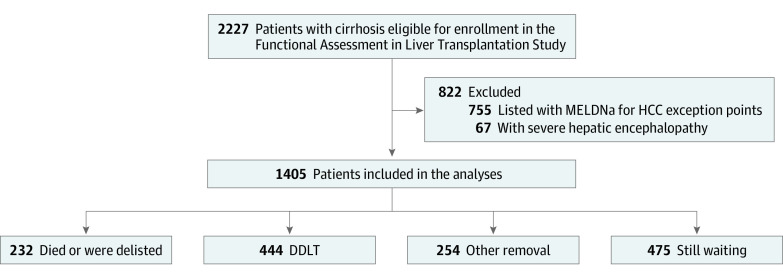
Design, setting, and participants: This prospective cohort study enrolled 1405 adults with cirrhosis awaiting liver transplant without hepatocellular carcinoma seen during 3436 ambulatory clinic visits at 9 US liver transplant centers. Data were collected from January 1, 2012, to October 1, 2019, and analyzed from August 30, 2019, to October 30, 2020.
Exposures: At outpatient evaluation, the Liver Frailty Index (LFI) score was calculated (grip strength, chair stands, and balance).
Main outcomes and measures: The risk of wait list mortality was quantified using Cox proportional hazards regression by frailty. Mediation analysis was used to quantify the contribution of frailty to the gap in wait list mortality between women and men.
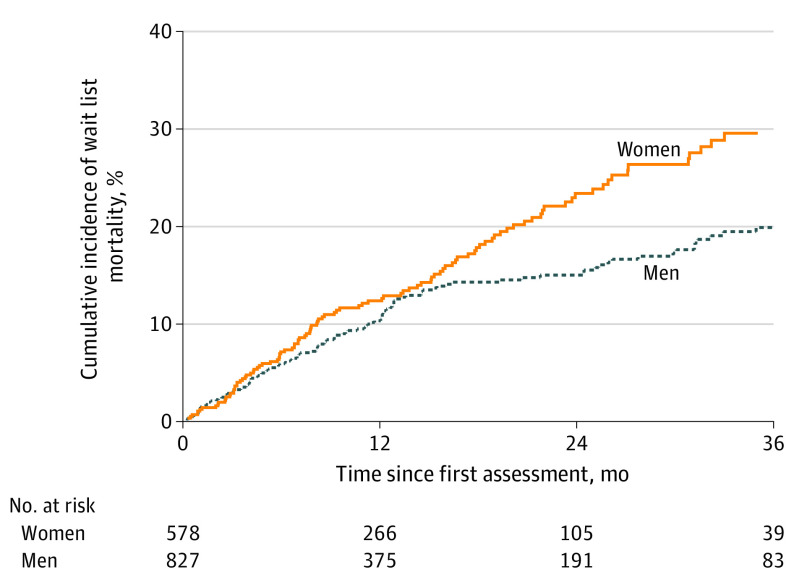
Results: Of 1405 participants, 578 (41%) were women and 827 (59%) were men (median age, 58 [interquartile range (IQR), 50-63] years). Women and men had similar median scores on the laboratory-based Model for End-stage Liver Disease incorporating sodium levels (MELDNa) (women, 18 [IQR, 14-23]; men, 18 [IQR, 15-22]), but baseline LFI was higher in women (mean [SD], 4.12 [0.85] vs 4.00 [0.82]; P = .005). Women displayed worse balance of less than 30 seconds (145 [25%] vs 149 [18%]; P = .003), worse sex-adjusted grip (mean [SD], -0.31 [1.08] vs -0.16 [1.08] kg; P = .01), and fewer chair stands per second (median, 0.35 [IQR, 0.23-0.46] vs 0.37 [IQR, 0.25-0.49]; P = .04). In unadjusted mixed-effects models, LFI was 0.15 (95% CI, 0.06-0.23) units higher in women than men (P = .001). After adjustment for other variables associated with frailty, LFI was 0.16 (95% CI, 0.08-0.23) units higher in women than men (P < .001). In unadjusted regression, women experienced a 34% (95% CI, 3%-74%) increased risk of wait list mortality than men (P = .03). Sequential covariable adjustment did not alter the association between sex and wait list mortality; however, adjustment for LFI attenuated the mortality gap between women and men. In mediation analysis, an estimated 13.0% (IQR, 0.5%-132.0%) of the gender gap in wait list mortality was mediated by frailty.
Conclusions and relevance: These findings demonstrate that women with cirrhosis display worse frailty scores than men despite similar MELDNa scores. The higher risk of wait list mortality that women experienced appeared to be explained in part by frailty.
Conflict of interest statement
Figures
Comment in
-
Leveraging Frailty to Mitigate Sex-Based Disparities in Access to Liver Transplant: Justice in Allocation.JAMA Surg. 2021 Mar 1;156(3):263. doi: 10.1001/jamasurg.2020.5675. JAMA Surg. 2021. PMID: 33377905 No abstract available.
References
Publication types
MeSH terms
Grants and funding
LinkOut - more resources
Full Text Sources
Other Literature Sources
Medical
Miscellaneous