Review
. 2020 Dec 24:13:13191-13200.
doi: 10.2147/OTT.S286867. eCollection 2020.

Targeting BRD9 for Cancer Treatment: A New Strategy

Affiliations
Review

Targeting BRD9 for Cancer Treatment: A New Strategy

Xiuzuo Zhu et al. Onco Targets Ther. .

Abstract

Bromodomain-containing protein 9 (BRD9) is a newly identified subunit of the non-canonical barrier-to-autointegration factor (ncBAF) complex and a member of the bromodomain family IV. Studies have confirmed that BRD9 plays an oncogenic role in multiple cancer types, by regulating tumor cell growth. The tumor biological functions of BRD9 are mainly due to epigenetic modification mediated by its bromodomain. The bromodomain recruits the ncBAF complex to the promoter to regulate gene transcription. This review summarizes the potential mechanisms of action of BRD9 in carcinogenesis and the emerging strategies for targeting BRD9 for cancer therapeutics. Although the therapeutic potential of BRD9 has been exploited to some extent, research on the detailed biological mechanisms of BRD9 is still in its infancy. Therefore, targeting BRD9 to study its biological roles will be an attractive tool for cancer diagnosis and treatment, but it remains a great challenge.

Keywords: BRD9; bromodomain; cancer; inhibitor; ncBAF.


Conflict of interest statement

The authors declare that they have no competing interests.

Figures
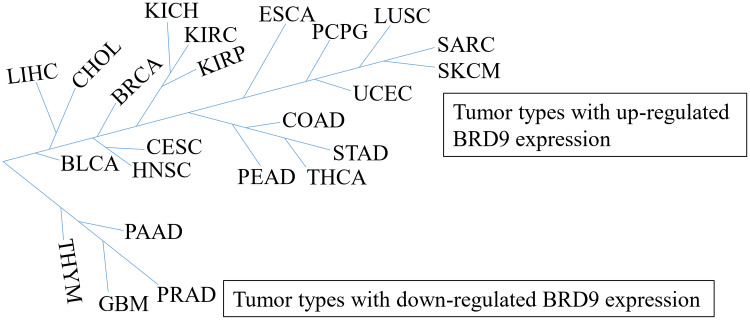
Figure 1
Figure 1
The tumor types with BRD9 differential expression. BDR9 is highly expressed in 19 cancer types including CHOL, LIHC, and BRCA, but is lowly expressed in four cancer types, such as THYM, PAAD, GBM and PRAD. According to the AIPuFu database, the URL: http://www.aipufu.com/index.html.
Figure 2
Figure 2
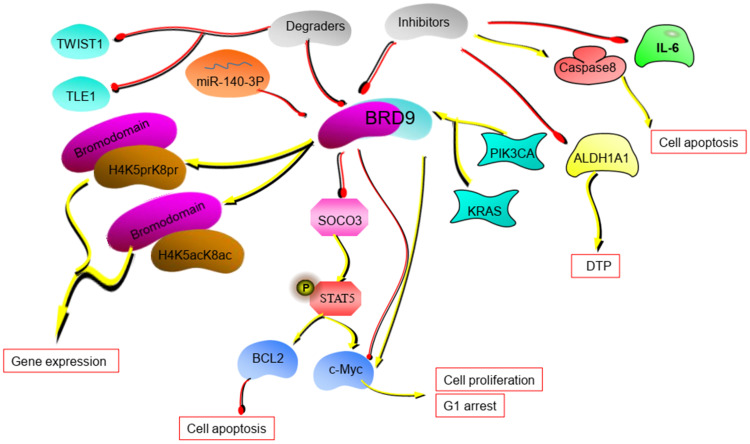
The potential mechanism of BRD9. BRD9 regulates tumor progression through the miR-140-3P-BRD9 axis and BRD9-STAT5 axis. BRD9 inhibitors and degraders can disrupt the tumor process. (The yellow lines in the figure represent the promotion between molecules, and the red lines represent the inhibition between molecules.).

References

    1. Savas S, Skardasi G. The SWI/SNF complex subunit genes: their functions, variations, and links to risk and survival outcomes in human cancers. Crit Rev Oncol Hematol. 2018;123:114–131. doi:10.1016/j.critrevonc.2018.01.009 - DOI - PubMed
    1. Masliah-Planchon J, Bieche I, Guinebretiere JM, Bourdeaut F, Delattre O. SWI/SNF chromatin remodeling and human malignancies. Annu Rev Pathol. 2015;10:145–171. doi:10.1146/annurev-pathol-012414-040445 - DOI - PubMed
    1. Wu JI, Lessard J, Crabtree GR. Understanding the words of chromatin regulation. Cell. 2009;136(2):200–206. doi:10.1016/j.cell.2009.01.009 - DOI - PMC - PubMed
    1. Kadoch C, Hargreaves DC, Hodges C, et al. Proteomic and bioinformatic analysis of mammalian SWI/SNF complexes identifies extensive roles in human malignancy. Nat Genet. 2013;45(6):592–601. doi:10.1038/ng.2628 - DOI - PMC - PubMed
    1. Calderaro J, Masliah-Planchon J, Richer W, et al. Balanced translocations disrupting SMARCB1 are hallmark recurrent genetic alterations in renal medullary carcinomas. Eur Urol. 2016;69(6):1055–1061. doi:10.1016/j.eururo.2015.09.027 - DOI - PubMed