


What do we do about atrial high rate episodes?
- PMID: 33380943
- PMCID: PMC7753882
- DOI: 10.1093/eurheartj/suaa179
What do we do about atrial high rate episodes?
Abstract
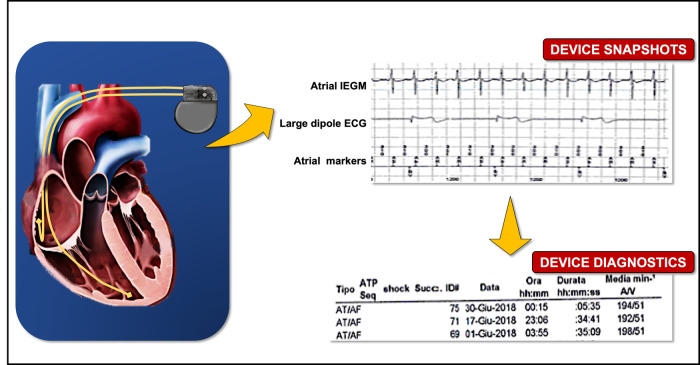
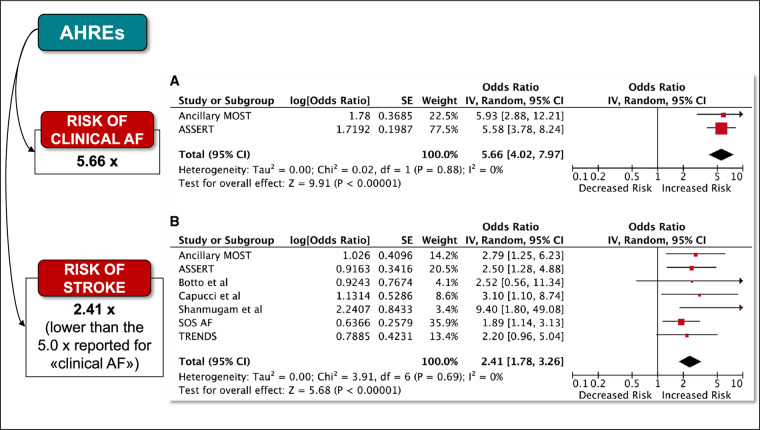
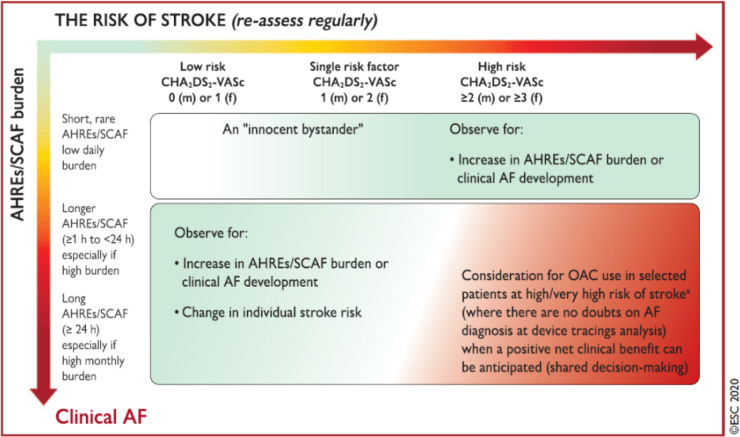
Atrial high rate episodes (AHREs) are defined as asymptomatic atrial tachyarrhythmias detected by cardiac implantable electronic devices with atrial sensing, providing automated continuous monitoring and tracings storage, occurring in subjects with no previous clinical atrial fibrillation (AF) and with no AF detected at conventional electrocardiogram recordings. AHREs are associated with an increased thrombo-embolic risk, which is not negligible, although lower than that of clinical AF. The thrombo-embolic risk increases with increasing burden of AHREs, and moreover, AHREs burden shows a dynamic pattern, with tendency to progression along with time, with potential transition to clinical AF. The clinical management of AHREs, in particular with regard to prophylactic treatment with oral anticoagulants (OACs), remains uncertain and heterogeneous. At present, in patients with confirmed AHREs, as a result of device tracing analysis, an integrated, individual and clinically-guided assessment should be applied, taking into account the patients' risk of stroke (to be reassessed regularly) and the AHREs burden. The use of OACs, preferentially non-vitamin K antagonists OACs, may be justified in selected patients, such as those with longer AHREs durations (in the range of several hours or ≥24 h), with no doubts on AF diagnosis after device tracing analysis and with an estimated high/very high individual risk of stroke, accounting for the anticipated net clinical benefit, and informed patient's preferences. Two randomized clinical trials on this topic are currently ongoing and are likely to better define the role of anticoagulant therapy in patients with AHREs.
Keywords: Anticoagulation; Atrial fibrillation; Atrial high rate episodes; Continuous monitoring; Pacemaker; Stroke; Subclinical atrial fibrillation; Thrombo-embolic risk.
Published on behalf of the European Society of Cardiology. © The Author(s) 2020.
Figures
References
-
- Boriani G, Diemberger I, Martignani C, Biffi M, Branzi A. The epidemiological burden of atrial fibrillation: a challenge for clinicians and health care systems. Eur Heart J 2006;27:893–894. - PubMed
-
- Camm AJ, Kirchhof P, Lip GYH, Schotten U, Savelieva I, Ernst S, Van Gelder IC, Al-Attar N, Hindricks G, Prendergast B, Heidbuchel H, Alfieri O, Angelini A, Atar D, Colonna P, De Caterina R, De Sutter J, Goette A, Gorenek B, Heldal M, Hohloser SH, Kolh P, Le Heuzey J-Y, Ponikowski P, Rutten FH; Developed with the special contribution of the European Heart Rhythm Association (EHRA). Guidelines for the management of atrial fibrillation: the task force for the management of atrial fibrillation of the European Society of Cardiology (ESC). Europace 2010;12:1360–1420. - PubMed
-
- Kirchhof P, Benussi S, Kotecha D, Ahlsson A, Atar D, Casadei B, Castella M, Diener H-C, Heidbuchel H, Hendriks J, Hindricks G, Manolis AS, Oldgren J, Popescu BA, Schotten U, Van Putte B, Vardas P, Agewall S, Camm J, Baron Esquivias G, Budts W, Carerj S, Casselman F, Coca A, De Caterina R, Deftereos S, Dobrev D, Ferro JM, Filippatos G, Fitzsimons D, Gorenek B, Guenoun M, Hohnloser SH, Kolh P, Lip GYH, Manolis A, McMurray J, Ponikowski P, Rosenhek R, Ruschitzka F, Savelieva I, Sharma S, Suwalski P, Tamargo JL, Taylor CJ, Van Gelder IC, Voors AA, Windecker S, Zamorano JL, Zeppenfeld K. 2016 ESC Guidelines for the management of atrial fibrillation developed in collaboration with EACTS. Europace 2016;18:1609–1678. - PubMed
-
- Hindricks G, Potpara T, Dagres N, Arbelo E, Bax JJ, Blomström-Lundqvist C, Boriani G, Castella M, Dan GA, Dilaveris PE, Fauchier L, Filippatos G, Kalman JM, La Meir M, Lane DA, Lebeau JP, Lettino M, Lip GYH, Pinto FJ, Thomas GN, Valgimigli M, Van Gelder IC, Van Putte BP, Watkins CL. 2020 ESC Guidelines for the diagnosis and management of atrial fibrillation developed in collaboration with the European Association of Cardio-Thoracic Surgery (EACTS). Eur Heart J 2020:doi:10.1093/eurheartj/ehaa612. - PubMed