


Young people feel wise and older people feel energetic: comparing age stereotypes and self-evaluations across adulthood
- PMID: 33380997
- PMCID: PMC7752929
- DOI: 10.1007/s10433-019-00548-4
Young people feel wise and older people feel energetic: comparing age stereotypes and self-evaluations across adulthood
Abstract
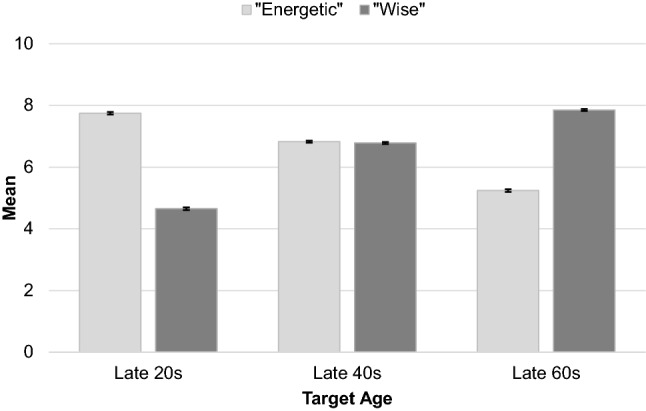
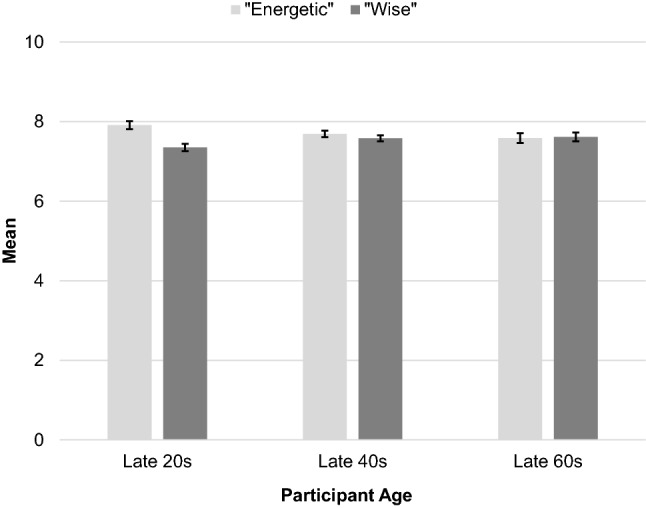
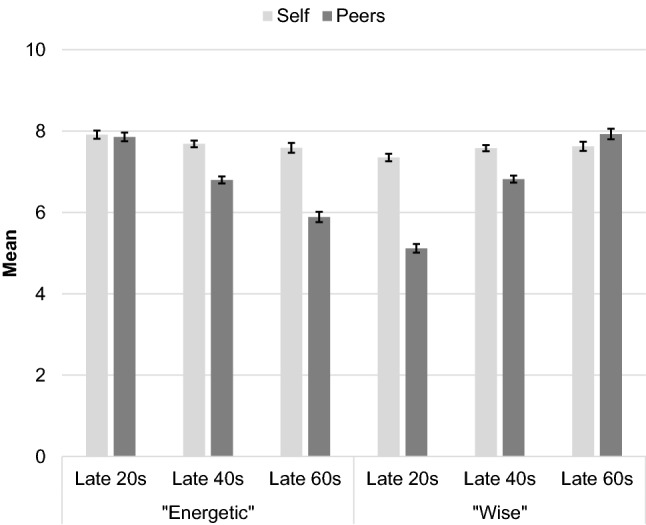
We use questionnaire data from the MIDUS study (N = 6325 and a subsample n = 2120) to examine the extent to which people in their late 20s, late 40s and late 60s think that positive characteristics apply to themselves, their age peers and other age groups. Results based on factor analysis confirmed the existence of age stereotypes, such that one constellation of characteristics (wise, caring, calm, knowledgeable, generative; "wise") was seen as more descriptive of older adults, while another constellation of characteristics (energetic, healthy, willing to learn; "energetic") was seen as more descriptive of younger adults. Self-evaluations were, however, highly positive and largely independent of age. As a group, younger adults saw themselves as being as "energetic" but "wiser" than their age peers, while older adults saw themselves as being more "energetic" but less "wise" than their age peers. In sum, the results suggest that self-views are relatively independent of existing age stereotypes but also indicate that the "better-than-average effect" depends on age and whether the considered characteristics represent a relative strength or weakness of one's own age group. The results also indicate that, at the aggregate level, older adults' tendency to use stereotypes about their age group's weaknesses as a frame of reference for making flattering self-evaluations seems to outweigh the effects of stereotype internalization.
Keywords: Age stereotypes; Better-than-average effect; Life span; Self-evaluations; Self-perceptions of ageing; Social comparison.
© Springer Nature B.V. 2019.
Figures
References
-
- Alicke MD, Govorun O. The Better-Than-Average Effect. In: Alicke MD, Dunning A, Krueger JI, editors. Studies in self and identity: the self in social judgment. New York: Psychology Press; 2005. pp. 85–106.
-
- Bowen CE, Kornadt A, Kessler E-M. Die Rolle von Altersbildern im Lebenslauf [The role of images of aging in the life course] In: Wahl H-W, Kruse A, editors. Lebensläufe im Wandel–Sichtweisen verschiedener Disziplinen. Stuttgart: Kohlhammer; 2014. pp. 287–298.
-
- Brandtstädter J, Greve W. The aging self: stabilizing and protective processes. Dev Rev. 1994;14:52–80. doi: 10.1006/drev.1994.1003. - DOI
-
- Brim OG, Ryff CD, Kessler RC. MIDUS national survey: an overview. In: Brim OG, Ryff CD, Kessler RC, editors. How healthy are we? A national study of well-being at midlife. Chicago: University of Chicago Press; 2004. pp. 1–34.
Grants and funding
LinkOut - more resources
Full Text Sources
Research Materials
