Review
. 2020 Dec 29;8(1):4.
doi: 10.3390/bioengineering8010004.

Electrospun Fiber Scaffolds for Engineering Glial Cell Behavior to Promote Neural Regeneration

Affiliations
Review

Electrospun Fiber Scaffolds for Engineering Glial Cell Behavior to Promote Neural Regeneration

Devan L Puhl et al. Bioengineering (Basel). .

Abstract

Electrospinning is a fabrication technique used to produce nano- or micro- diameter fibers to generate biocompatible, biodegradable scaffolds for tissue engineering applications. Electrospun fiber scaffolds are advantageous for neural regeneration because they mimic the structure of the nervous system extracellular matrix and provide contact guidance for regenerating axons. Glia are non-neuronal regulatory cells that maintain homeostasis in the healthy nervous system and regulate regeneration in the injured nervous system. Electrospun fiber scaffolds offer a wide range of characteristics, such as fiber alignment, diameter, surface nanotopography, and surface chemistry that can be engineered to achieve a desired glial cell response to injury. Further, electrospun fibers can be loaded with drugs, nucleic acids, or proteins to provide the local, sustained release of such therapeutics to alter glial cell phenotype to better support regeneration. This review provides the first comprehensive overview of how electrospun fiber alignment, diameter, surface nanotopography, surface functionalization, and therapeutic delivery affect Schwann cells in the peripheral nervous system and astrocytes, oligodendrocytes, and microglia in the central nervous system both in vitro and in vivo. The information presented can be used to design and optimize electrospun fiber scaffolds to target glial cell response to mitigate nervous system injury and improve regeneration.

Keywords: Schwann cells; astrocytes; electrospun fibers; glia; microglia; oligodendrocytes.


Conflict of interest statement

The authors declare no conflict of interest.

Figures
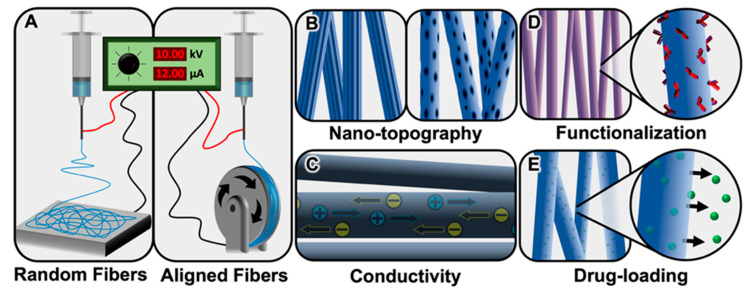
Figure 1
Figure 1
Electrospinning apparatus configurations and examples of electrospun fiber features that affect glial cell behavior. (A) Electrospinning apparatus configuration for generating randomly oriented fibers on a flat plate (left) and aligned fibers on a rotating mandrel (right). Electrospinning apparatus parameters and the materials used for electrospinning can be tuned to alter fiber (B) nanotopography, (C) conductivity, (D) functionalization, or (E) drug-loading to engineer a desired cell response.
Figure 2
Figure 2
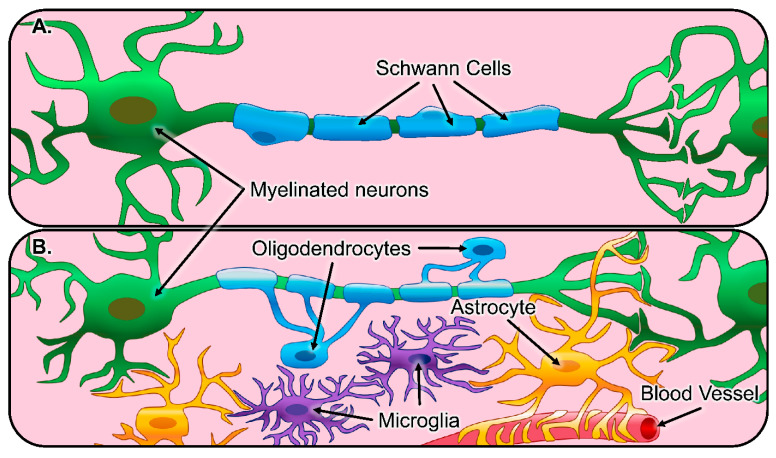
Illustration of glial cells and their function in the healthy nervous system. (A) The peripheral nervous system consists of Schwann cells (blue) that myelinate the axons of peripheral neurons (green). (B) The central nervous system consists of astrocytes (yellow) that regulate synaptic connections and comprise the blood–brain barrier, oligodendrocytes (blue) that myelinate axons of neurons, and microglia (purple), which act as resident innate immune cells.
Figure 3
Figure 3
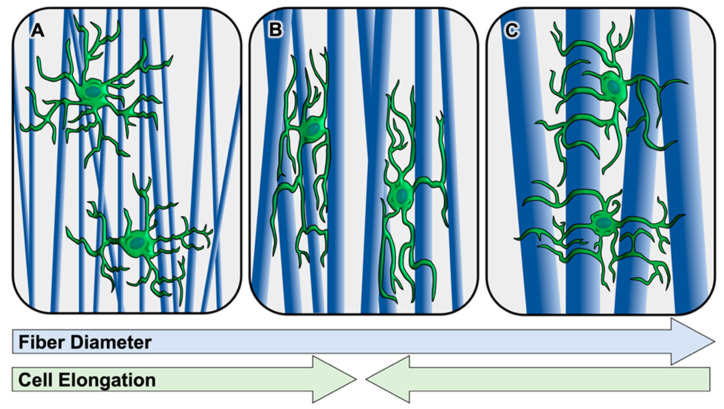
Effect of aligned fiber diameter on glial cell elongation. (A) Glial cells spread radially on small diameter fibers. (B) Glial cells elongate along the orientation of the aligned fibers on medium diameter fibers. (C) Glial cells spread radially on large diameter fibers.
Figure 4
Figure 4
Aligned electrospun fiber conduits promote greater Schwann cell migration and axonal extension over large peripheral nerve gap distances. Synthetic nerve graft bridging the gap between peripheral nerve stumps with either (A) a smooth film, (B) randomly oriented electrospun fibers, or (C) aligned electrospun fibers.

References

    1. Pertici V., Martrou G., Gigmes D., Trimaille T. Synthetic Polymer-Based Electrospun Fibers: Biofunctionalization Strategies and Recent Advances in Tissue Engineering, Drug Delivery and Diagnostics. Curr. Med. Chem. 2018;25:2385–2400. doi: 10.2174/0929867325666171129133120. - DOI - PubMed
    1. Lyu S., Huang C., Yang H., Zhang X. Electrospun Fibers as a Scaffolding Platform for Bone Tissue Repair. J. Orthop. Res. Off. Publ. Orthop. Res. Soc. 2013;31:1382–1389. doi: 10.1002/jor.22367. - DOI - PMC - PubMed
    1. Memic A., Abudula T., Mohammed H.S., Joshi Navare K., Colombani T., Bencherif S.A. Latest Progress in Electrospun Nanofibers for Wound Healing Applications. ACS Appl. Bio Mater. 2019;2:952–969. doi: 10.1021/acsabm.8b00637. - DOI - PubMed
    1. Liu M., Zhang Y., Sun S., Khan A.R., Ji J., Yang M., Zhai G. Recent Advances in Electrospun for Drug Delivery Purpose. J. Drug Target. 2019;27:270–282. doi: 10.1080/1061186X.2018.1481413. - DOI - PubMed
    1. Seif S., Planz V., Windbergs M. Delivery of Therapeutic Proteins Using Electrospun Fibers—Recent Developments and Current Challenges. Arch. Pharm. (Weinheim) 2017;350:1700077. doi: 10.1002/ardp.201700077. - DOI - PubMed

LinkOut - more resources