. 2020 Dec 31;10(1):22454.
doi: 10.1038/s41598-020-80007-8.

TW-SIR: time-window based SIR for COVID-19 forecasts

Affiliations

TW-SIR: time-window based SIR for COVID-19 forecasts

Zhifang Liao et al. Sci Rep. .

Abstract

Since the outbreak of COVID-19, many COVID-19 research studies have proposed different models for predicting the trend of COVID-19. Among them, the prediction model based on mathematical epidemiology (SIR) is the most widely used, but most of these models are adapted in special situations based on various assumptions. In this study, a general adapted time-window based SIR prediction model is proposed, which is characterized by introducing a time window mechanism for dynamic data analysis and using machine learning method predicts the basic reproduction number and the exponential growth rate of the epidemic. We analyzed COVID-19 data from February to July 2020 in seven countries---China, South Korea, Italy, Spain, Brazil, Germany and France, and the numerical results showed that the framework can effectively measure the real-time changes of the parameters during the epidemic, and error rate of predicting the number of COVID-19 infections in a single day is within 5%.


Conflict of interest statement

The authors declare no competing interests.

Figures
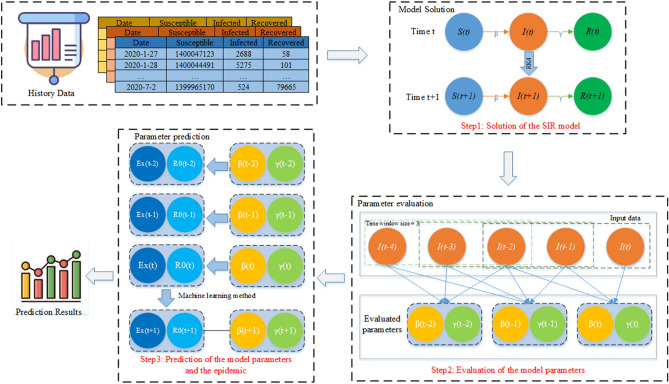
Figure 1
Figure 1
The main workflow of the TW-SIR model.
Figure 2
Figure 2
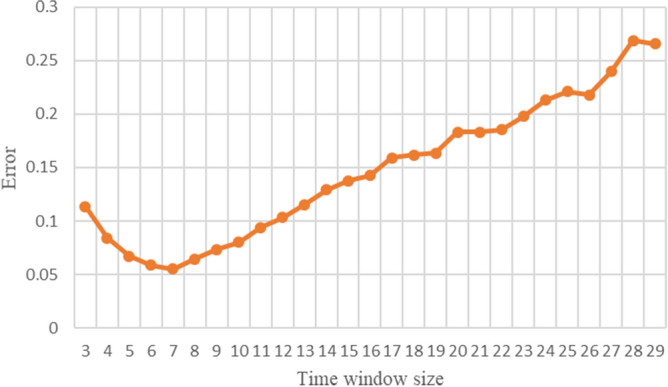
Changes in prediction error when the time window size is 3–29.
Figure 3
Figure 3
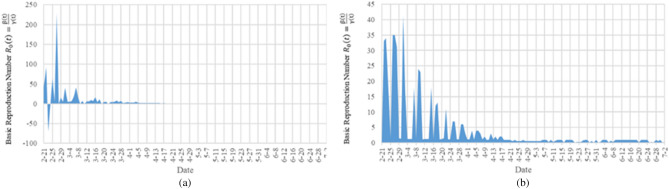
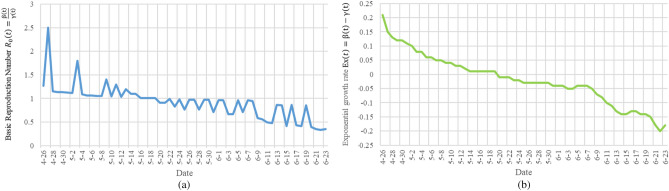
Basic reproduction number R0t in Italy.
Figure 4
Figure 4
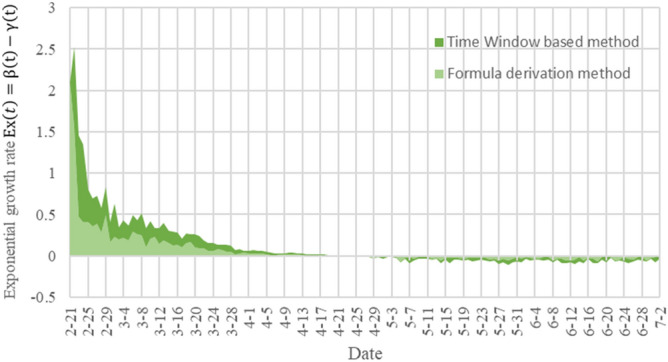
The result of the exponential growth rate Ex(t) in Italy from February 21 to July 2, 2020. (The dark green curve represents the measurement result of our proposed TW-SIR prediction model, and the light green curve is the formula-based method used in).
Figure 5
Figure 5
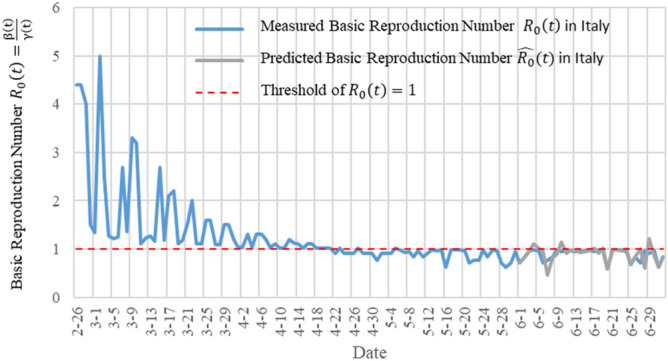
R0t and the predicted R0^t in Italy measured by the TW-SIR prediction model.
Figure 6
Figure 6
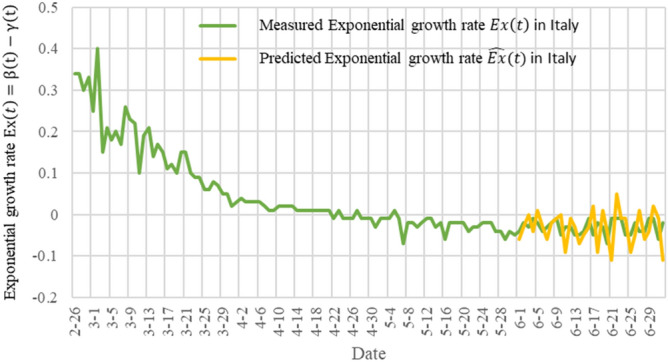
The basic number of infections Ex(t) and the predicted basic number of infections Ex^(t) of COVID in Italy measured by the TW-SIR prediction model.
Figure 7
Figure 7
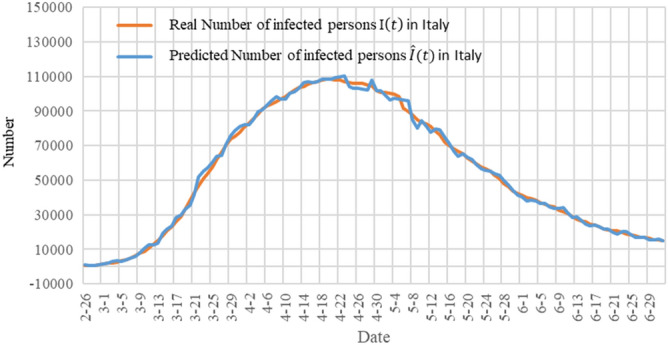
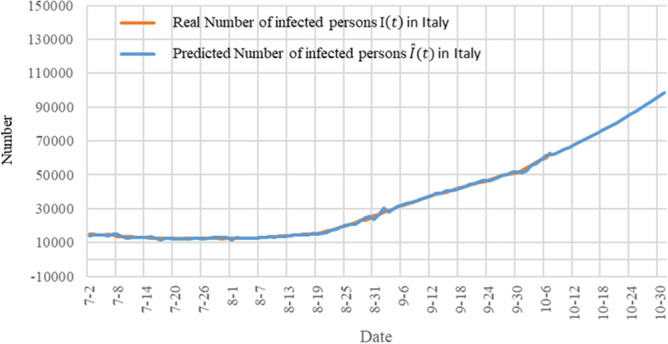
A single-day forecast of the number of infections in Italy. The orange curve represents the actual number of infections I(t) in Italy, and the blue curve represents the predicted number of infections I^(t).
Figure 8
Figure 8
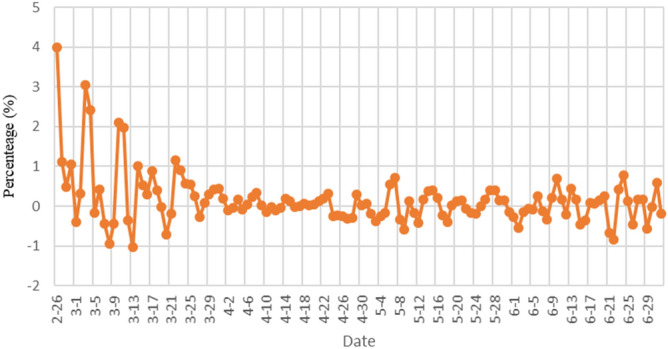
The forecast error of the single-day forecast of the number of infections in Italy.
Figure 9
Figure 9
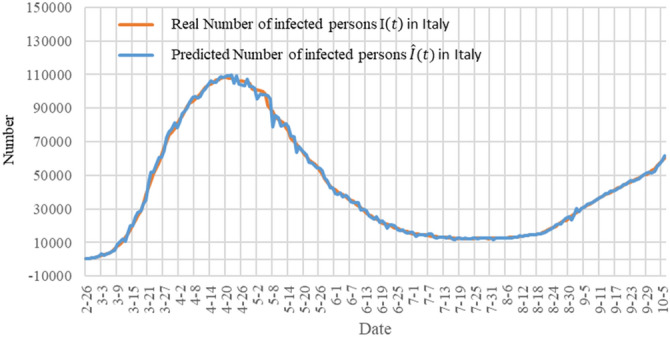
A single-day forecast of the number of infections in Italy from February to October 2020.
Figure 10
Figure 10
A forecast of the number of infections in Italy from October 2020.
Figure 11
Figure 11
R0t and Ext of the SARS in Beijing, China in 2003.

References

    1. Zhao S, et al. Preliminary estimation of the basic reproduction number of novel coronavirus (2019-nCoV) in China, from 2019 to 2020: A data-driven analysis in the early phase of the outbreak. Int. J. Infect. Diseases. 2020;92:214–217. doi: 10.1016/j.ijid.2020.01.050. - DOI - PMC - PubMed
    1. Sanche, S. et al. The novel coronavirus, 2019-ncov, is highly contagious and more infectious than initially estimated. Preprint at https://arxiv.org/abs/2002.03268 (2020).
    1. Pike, W. T. & Saini, V. An international comparison of the second derivative of COVID-19 deaths after implementation of social distancing measures. Preprint at https://www.medrxiv.org/content/10.1101/2020.03.25.20041475v1 (2020). - DOI
    1. Li L-X, et al. Propagation analysis and prediction of the COVID-19. Infect. Disease Model. 2020;5:282–292. doi: 10.1016/j.idm.2020.03.002. - DOI - PMC - PubMed
    1. Tang B, et al. An updated estimation of the risk of transmission of the novel coronavirus (2019-nCov) Infect. Disease Model. 2020;5:248–255. doi: 10.1016/j.idm.2020.02.001. - DOI - PMC - PubMed

Publication types