Review
. 2020 Dec 15:11:590683.
doi: 10.3389/fmicb.2020.590683. eCollection 2020.

Antimicrobial Resistance as a Hidden Menace Lurking Behind the COVID-19 Outbreak: The Global Impacts of Too Much Hygiene on AMR

Affiliations
Review

Antimicrobial Resistance as a Hidden Menace Lurking Behind the COVID-19 Outbreak: The Global Impacts of Too Much Hygiene on AMR

Sama Rezasoltani et al. Front Microbiol. .

Abstract

The severe acute respiratory syndrome coronavirus 2 (SARS-CoV-2) is a new coronavirus that was recently discovered in 2019. While the world is working hard to overcome and control the coronavirus disease 2019 (COVID-19) pandemic, it is also crucial to be prepared for the great impacts of this outbreak on the development of antimicrobial resistance (AMR). It is predicted that inappropriate and too much use of antibiotics, biocides, and disinfectants during this pandemic may raise disastrous effects on antibiotic stewardship programs and AMR control all around the world. Furthermore, the use of certain antibiotics alone or in combination with antiviral agents or other medications for the treatment of secondary bacterial infections among COVID-19 patients may be regarded as a major factor that negatively affects host immune response by disrupting mitochondrial function and activity. Herein, we suggest that the current management strategies to control AMR and prioritize antibiotic stewardship schemes should be extremely highlighted in relation to the COVID-19 outbreak. The rising concerns about excessive use of antimicrobials and biocides and taking too much hygiene also need to be addressed during this pandemic due to their impacts on AMR, public health, and the environment.

Keywords: antibiotics; antimicrobial resistance; biocides; coronavirus disease 2019 (COVID-19); disinfectants; mitochondria; selective pressure.


Conflict of interest statement

The authors declare that the research was conducted in the absence of any commercial or financial relationships that could be construed as a potential conflict of interest.

Figures
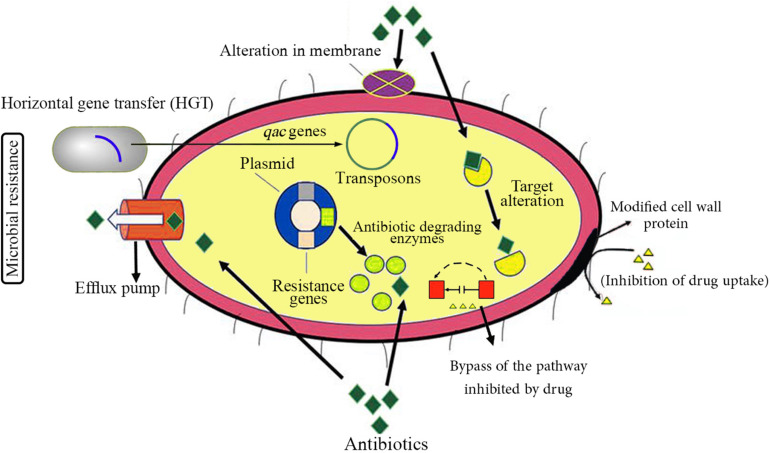
FIGURE 1
FIGURE 1
Schematic representation of different antibiotic resistance mechanisms in bacteria. Apparently, most pathogenic bacterial species have the potential capability of developing resistance to at least some antimicrobial agents. There are two types of antibiotic resistance: intrinsic (or inherent) resistance and acquired resistance. Intrinsic antibiotic mechanisms are normally chromosome-encoded; on the other hand, acquired resistance mechanisms are generally obtained by horizontal gene transfer (HGT) and include plasmid-encoded and transposons-mediated antibiotic resistance. The main mechanisms of antibiotic resistance are alteration in membrane components leading to reduced permeability of the cell membrane, modification in cell wall proteins as the common antibiotic targets, inhibiting or limiting uptake of a drug, bypassing the pathway (compensatory tack) inhibited by a drug, degrading and inactivation of a drug by modification/degradation enzymes, and pumping out of a drug by various types of active efflux pumps.
FIGURE 2
FIGURE 2
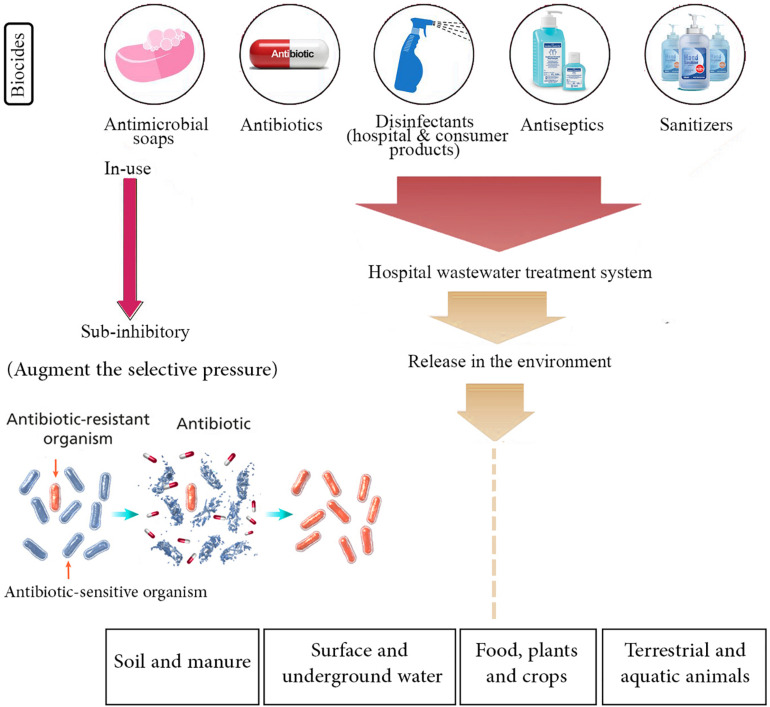
Negative impact of high-concentration release of different kinds of biocides and antibiotics in the environment, which may result in antibiotic resistance enrichment and resistance dissemination. It is presumed that during the COVID-19 pandemic, these antimicrobials are excessively released in the soil and manure, surface and underground water, food, plants and crops, and terrestrial and aquatic animals. On the other hand, enrichment of biocide and antibiotic concentrations at the sub-minimum inhibitory concentration (sub-MIC) in the environment may augment the selective pressure phenomenon, boost the horizontal gene transfer (HGT), and drive the evolution of antimicrobial resistance (AMR) that lead to the selection of antibiotic-resistant bacteria. Therefore, current management practices and strategies to prevent and control AMR should be extremely highlighted in relation to the COVID-19 outbreak.

References

    1. Baron S. A., Devaux C., Colson P., Raoult D., Rolain J. M. (2020). Teicoplanin: an alternative drug for the treatment of coronavirus COVID-19? Int. J. Antimicrob. Agents. 55:105944 10.1016/j.ijantimicag.2020.105944 - DOI - PMC - PubMed
    1. Braga T., Marujo P., Pomba C., Lopes M. (2011). Involvement and dissemination of the enterococcal small multidrug resistance transporter QacZ in resistance to quaternary ammonium compounds. J. Antimicrob. Chemother. 66:2. 10.1093/jac/dkq460 - DOI - PubMed
    1. Buffet-Bataillon S., Tattevin P., Bonnaure-Mallet M., Jolivet-Gougeon A. (2012). Emergence of resistance to antibacterial agents: the role of quaternary ammonium compounds-a critical review. Int. J. Antimicrob. Agents. 39:5. 10.1016/j.ijantimicag.2012.01.011 - DOI - PubMed
    1. Cao J., Tu W., Cheng W., Yu L., Liu Y., Hu X., et al. (2020). Clinical features and short-term outcomes of 102 patients with corona virus disease 2019 in Wuhan, China. Clin. Infect. Dis. 71:15 10.1093/cid/ciaa243 - DOI - PMC - PubMed
    1. Centers for Disease Control and Prevention (2009). Bacterial Coinfections in Lung Tissue Specimens from Fatal Cases of 2009 Pandemic influenza A (H1N1)-United States, May-August 2009. MMWR Morb Mortal Wkly Rep. 58:38. Available online at: https://www.cdc.gov/mmwr/preview/mmwrhtml/mm58e0929a1.htm (accessed September 29, 2009). - PubMed