


Influence of psychological factors on the prognosis of temporomandibular disorders pain
- PMID: 33384819
- PMCID: PMC7770244
- DOI: 10.1016/j.jds.2020.02.007
Influence of psychological factors on the prognosis of temporomandibular disorders pain
Abstract
Background/purpose: The leading symptom of temporomandibular disorders (TMD) is pain, and psychological factors are involved in the persistence of TMD-related pain. Therefore, this study was aimed to analyze the influence of psychological factors on the prognosis of TMD-related pain.
Materials and methods: The medical records of 486 patients with TMD-related pain were analyzed. Each patient's psychological profile was assessed using the Symptom Checklist-90-Revised (SCL-90-R). Patients were classified into two groups according to a post-treatment numeric rating scale (NRS). Patients with an NRS score of 0 or 1 at the last visit were classified into group G, and those with an NRS score of 2 or greater were classified into group P. Following this, all patients were re-classified into groups N and R according to pain recurrence. Statistical analysis was performed to evaluate differences in the SCL-90-R T scores between the groups. In addition, multiple logistic regression analysis was used to identify psychological factors that affected treatment outcome.
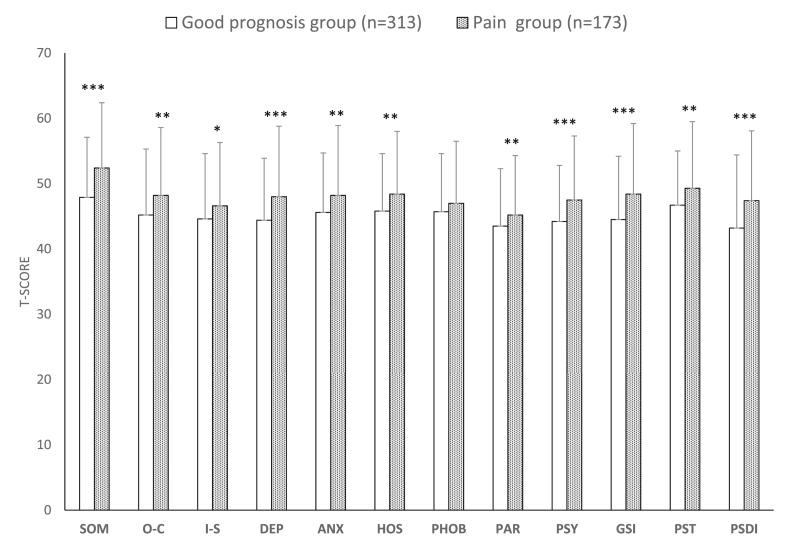
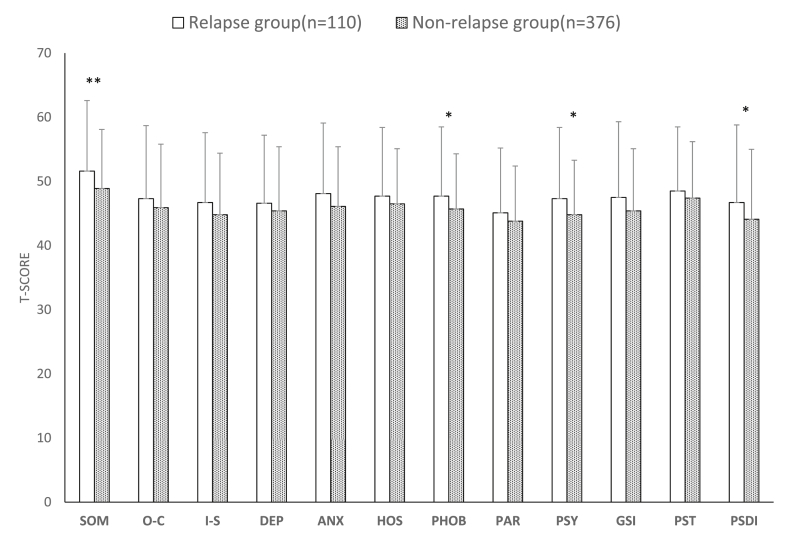
Results: The patients in groups P and R had higher scores in all subscales of the SCL-90-R than groups G and N, respectively. In particular, somatization (SOM) and psychoticism (PSY) scores showed significant differences between the groups in the treatment outcome.
Conclusion: A correlation is identified between psychological factors and treatment outcome in patients with TMD-related pain. In particular, patients with elevated SOM and PSY scores are more likely to develop refractory pain, and thus require additional interventions to control this risk.
Keywords: Psychiatric status rating scales; Temporomandibular joint disorder/psychology; Temporomandibular joint disorders/etiology; Temporomandibular joint dysfunction syndrome/psychology.
© 2020 Association for Dental Sciences of the Republic of China. Publishing services by Elsevier B.V.
Conflict of interest statement
No potential conflict of interest relevant to this article was reported.
Figures
References
-
- McNeill C. Management of temporomandibular disorders: concepts and controversies. J Prosthet Dent. 1997;77:510–522. - PubMed
-
- Okeson J.P., de Leeuw R. Differential diagnosis of temporomandibular disorders and other orofacial pain disorders. Dent Clin North Am. 2011;55:105–120. - PubMed
-
- Okeson J.P. 7th ed. Elsevier; St. Louis: 2012. Management of temporomandibular disorders and occlusion; pp. 102–117.
-
- McNeill C., Mohl N.D., Rugh J.D., Tanaka T.T. Temporomandibular disorders: diagnosis, management, education, and research. J Am Dent Assoc. 1990;120:253–263. - PubMed
-
- Manfredini D., Marini M., Pavan C., Pavan L., Guarda-Nardini L. Psychosocial profiles of painful TMD patients. J Oral Rehabil. 2009;36:193–198. - PubMed
LinkOut - more resources
Full Text Sources
Other Literature Sources
Research Materials
Miscellaneous
