


Risk factors and action thresholds for the novel coronavirus pandemic. Insights from the Italian Society of Nephrology COVID-19 Survey
- PMID: 33387336
- PMCID: PMC7776284
- DOI: 10.1007/s40620-020-00946-3
Risk factors and action thresholds for the novel coronavirus pandemic. Insights from the Italian Society of Nephrology COVID-19 Survey
Abstract
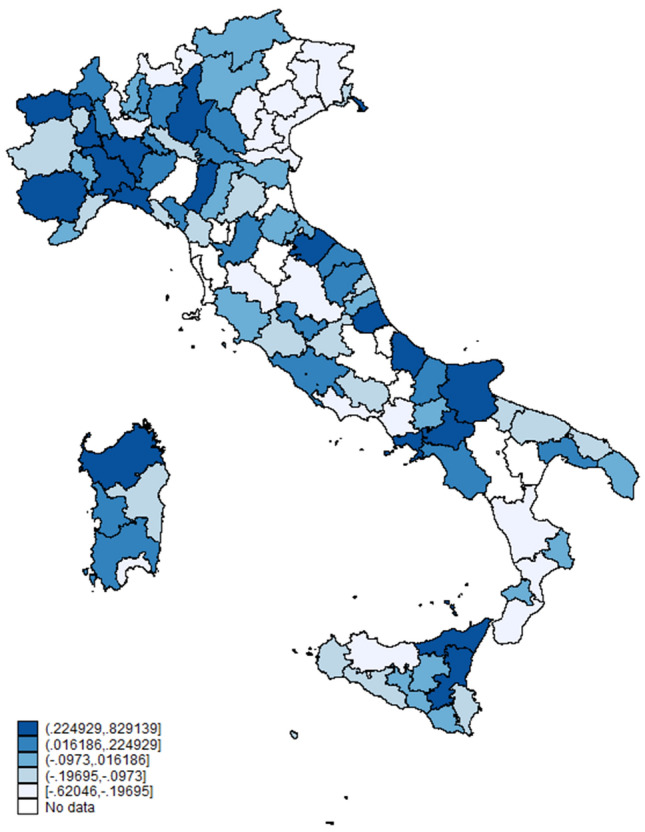
Background and aim: Over 80% (365/454) of the nation's centers participated in the Italian Society of Nephrology COVID-19 Survey. Out of 60,441 surveyed patients, 1368 were infected as of April 23rd, 2020. However, center-specific proportions showed substantial heterogeneity. We therefore undertook new analyses to identify explanatory factors, contextual effects, and decision rules for infection containment.
Methods: We investigated fixed factors and contextual effects by multilevel modeling. Classification and Regression Tree (CART) analysis was used to develop decision rules.
Results: Increased positivity among hemodialysis patients was predicted by center location [incidence rate ratio (IRR) 1.34, 95% confidence interval (CI) 1.20-1.51], positive healthcare workers (IRR 1.09, 95% CI 1.02-1.17), test-all policy (IRR 5.94, 95% CI 3.36-10.45), and infected proportion in the general population (IRR 1.002, 95% CI 1.001-1.003) (all p < 0.01). Conversely, lockdown duration exerted a protective effect (IRR 0.95, 95% CI 0.94-0.98) (p < 0.01). The province-contextual effects accounted for 10% of the total variability. Predictive factors for peritoneal dialysis and transplant cases were center location and infected proportion in the general population. Using recursive partitioning, we identified decision thresholds at general population incidence ≥ 229 per 100,000 and at ≥ 3 positive healthcare workers.
Conclusions: Beyond fixed risk factors, shared with the general population, the increased and heterogeneous proportion of positive patients is related to the center's testing policy, the number of positive patients and healthcare workers, and to contextual effects at the province level. Nephrology centers may adopt simple decision rules to strengthen containment measures timely.
Keywords: COVID-19; Classification tree; Contextual analysis; Renal replacement therapy.
Conflict of interest statement
On behalf of all authors, the corresponding author states that there is no conflict of interest.
Figures


References
-
- Quintaliani G, Reboldi GP, Di Napoli A, Nordio M, Limido A, Aucella F, Messa PG, Brunori G, on behalf of the Italian Society of Nephrology COVID-19 Research Group Exposure to novel coronavirus in patients on renal replacement therapy during the exponential phase of COVID-19 pandemic: survey of the Italian Society of Nephrology. J Nephrol. 2020;33:725–736. doi: 10.1007/s40620-020-00794-1. - DOI - PMC - PubMed
-
- Rombolà G, Heidempergher M, Pedrini L, Farina M, Aucella F, Messa P, Brunori G. Practical indications for the preventions and management of SARS-CoV-2 in ambulatory dialysis patients: lessons from the first phase of the epidemics in Lombardy. J Nephrol. 2020;33:193–196. doi: 10.1007/s40620-020-00727-y. - DOI - PMC - PubMed
-
- Basile C, Combe C, Pizzarelli F, Covic A, Davenport A, Kanbay M, Kirmizis D, Schneditz D, van der Sande F, Mitra S, on behalf of the EUDIAL Working Group of ERA-EDTA Recommendations for the prevention, mitigation and containment of the emerging SARS-CoV-2 (COVID-19) pandemic in haemodialysis centers. Nephrol Dial Transplant. 2020;35:737–741. doi: 10.1093/ndt/gfaa069. - DOI - PMC - PubMed
Publication types
MeSH terms
LinkOut - more resources
Full Text Sources
Other Literature Sources
Medical
Miscellaneous
