The effect of different levels of pneumoperitoneum pressures on regional cerebral oxygenation during robotic assisted laparoscopic prostatectomy
- PMID: 33387989
- PMCID: PMC8283475
- DOI: 10.3906/sag-2005-368
The effect of different levels of pneumoperitoneum pressures on regional cerebral oxygenation during robotic assisted laparoscopic prostatectomy
Abstract
Background/aim: This study aimed to evaluate the effect of low- and high-pressure pneumoperitoneum pressures applied during robotic-assisted laparoscopic prostatectomy (RALP) using near-infrared spectroscopy (NIRS) on regional cerebral oxygenation saturation (rSO2).
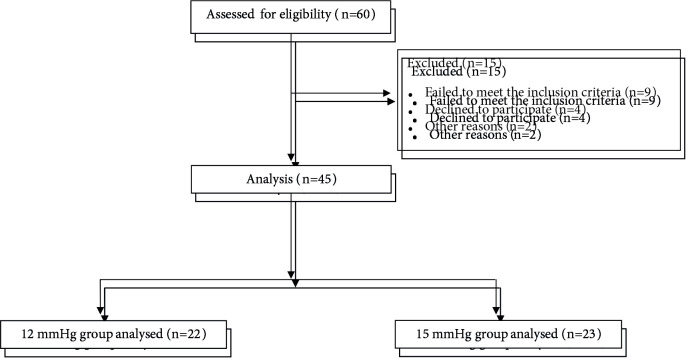
Materials and methods: The prospective, comparative, and observational study included patients aged 18–80 years, with the American Society of Anesthesiologists (ASA) physical status I-II, who would undergo elective RALP. The patients were divided into two groups (12 mmHg of pneumoperitoneum pressure group, n=22 and 15 mmHg of pneumoperitoneum pressure group, n=23). Patients’ demographic data, durations of anesthesia, surgery, pneumoperitoneum, and Trendelenburg position, intraoperative estimated blood loss, fluid therapy, urine output, hemodynamic and respiratory data, and rSO2 values were recorded at regular intervals.
Results: The rSO2 values increased significantly during the pneumoperitoneum combined with steep Trendelenburg position (from t3 to t6) and at the end of the surgery (t7) in both groups, compared to the values 5 min after the onset of pneumoperitoneum in the supine position (t2) (P < 0.05), but no statistical significance was observed between the two groups. No cerebral desaturation was observed in any of our patients. Hemodynamic and respiratory parameters were preserved in both groups. The blood lactate levels were significantly higher in patients operated at high-pressure pneumoperitoneum, compared to those with low-pressure pneumoperitoneum (P < 0.05).
Conclusion: We believe that low-pressure pneumoperitoneum, especially in robotic surgeries, such as robotic-assisted laparoscopic prostatectomy (RALP), can be applied safely.
Keywords: Near-infrared spectroscopy; pneumoperitoneum; prostatectomy; robotic-assisted surgery; trendelenburg position.
This work is licensed under a Creative Commons Attribution 4.0 International License.
Conflict of interest statement
The authors have no funding, financial relationships, or conflicts of interest to disclose.
Figures
References
-
- Matanes E Weissman A Rivlin A Lauterbach R Amit A Effects of pneumoperitoneum and the steep trendelenburg position on heart rate variability and cerebral oxygenation during robotic sacrocolpopexy. Journal of Minimally Invasive Gynecology . 2018;25:70–75. - PubMed
-
- Rohloff M Cicic A Christensen C Maatman TK Lindberg J Reduction in postoperative ileus rates utilizing lower pressure pneumoperitoneum in robotic-assisted radical prostatectomy. Journal of Robotic Surgery . 2019;13:671–674. - PubMed
-
- Christensen CR Maatman TK Maatman TJ Tran TT Examining clinical outcomes utilizing low-pressure pneumoperitoneum during robotic-assisted radical prostatectomy. Journal of Robotic Surgery . 2016;10:215–219. - PubMed
-
- Moerman A De Hert S Cerebral oximetry: the standard monitor of the future? Current Opinion in Anaesthesiology. 2015;28:703–709. - PubMed
-
- Ozgun A Sargin A Karaman S Gunusen I Alper I The relationship between the Trendelenburg position and cerebral hypoxia inpatients who have undergone robot-assisted hysterectomy and prostatectomy. Turkish Journal of Medical Sciences . 2017;47:1797–1803. - PubMed
Publication types
MeSH terms
LinkOut - more resources
Full Text Sources
Other Literature Sources