


Transcriptomic and proteomic profiling revealed reprogramming of carbon metabolism in acetate-grown human pathogen Candida glabrata
- PMID: 33388061
- PMCID: PMC7778802
- DOI: 10.1186/s12929-020-00700-8
Transcriptomic and proteomic profiling revealed reprogramming of carbon metabolism in acetate-grown human pathogen Candida glabrata
Abstract
Background: Emergence of Candida glabrata, which causes potential life-threatening invasive candidiasis, has been widely associated with high morbidity and mortality. In order to cause disease in vivo, a robust and highly efficient metabolic adaptation is crucial for the survival of this fungal pathogen in human host. In fact, reprogramming of the carbon metabolism is believed to be indispensable for phagocytosed C. glabrata within glucose deprivation condition during infection.
Methods: In this study, the metabolic responses of C. glabrata under acetate growth condition was explored using high-throughput transcriptomic and proteomic approaches.
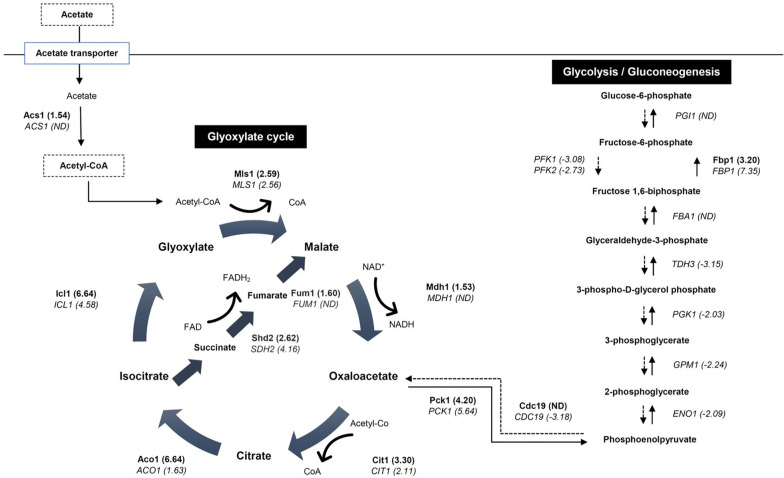
Results: Collectively, a total of 1482 transcripts (26.96%) and 242 proteins (24.69%) were significantly up- or down-regulated. Both transcriptome and proteome data revealed that the regulation of alternative carbon metabolism in C. glabrata resembled other fungal pathogens such as Candida albicans and Cryptococcus neoformans, with up-regulation of many proteins and transcripts from the glyoxylate cycle and gluconeogenesis, namely isocitrate lyase (ICL1), malate synthase (MLS1), phosphoenolpyruvate carboxykinase (PCK1) and fructose 1,6-biphosphatase (FBP1). In the absence of glucose, C. glabrata shifted its metabolism from glucose catabolism to anabolism of glucose intermediates from the available carbon source. This observation essentially suggests that the glyoxylate cycle and gluconeogenesis are potentially critical for the survival of phagocytosed C. glabrata within the glucose-deficient macrophages.
Conclusion: Here, we presented the first global metabolic responses of C. glabrata to alternative carbon source using transcriptomic and proteomic approaches. These findings implicated that reprogramming of the alternative carbon metabolism during glucose deprivation could enhance the survival and persistence of C. glabrata within the host.
Keywords: Acetate; Candida; Candida glabrata; Carbon metabolism; Liquid chromatography tandem-mass spectrometry; Proteomic; RNA-sequencing; Transcriptomic.
Conflict of interest statement
The authors declare that they have no competing interests.
Figures


References
-
- Pfaller MA, Andes DR, Diekema DJ, Horn DL, Reboli AC, Rotstein C, et al. Epidemiology and outcomes of invasive candidiasis due to non-albicans species of Candida in 2496 patients: data from the Prospective Antifungal Therapy (PATH) registry 2004–2008. PLoS ONE. 2014;9:e101510. doi: 10.1371/journal.pone.0101510. - DOI - PMC - PubMed
MeSH terms
Substances
Grants and funding
LinkOut - more resources
Full Text Sources
Other Literature Sources
Miscellaneous
