


The 12 items Amharic version WHODAS-2 showed cultural adaptation and used to measure disability among road traffic trauma victims in Ethiopia
- PMID: 33388086
- PMCID: PMC7777354
- DOI: 10.1186/s40359-020-00492-4
The 12 items Amharic version WHODAS-2 showed cultural adaptation and used to measure disability among road traffic trauma victims in Ethiopia
Abstract
Background: Adapting and translating already developed tools to different cultures is a complex process, but once done, it increases the validity of the construct to be measured. This study aimed to assess the 12 items WHODAS-2 and test its psychometric properties among road traffic injury victims in Ethiopia. This study aimed to translate the 12 items WHODAS- 2 interview-based tools into Amharic and examine the psychometric properties of the new version among road traffic injury victims.
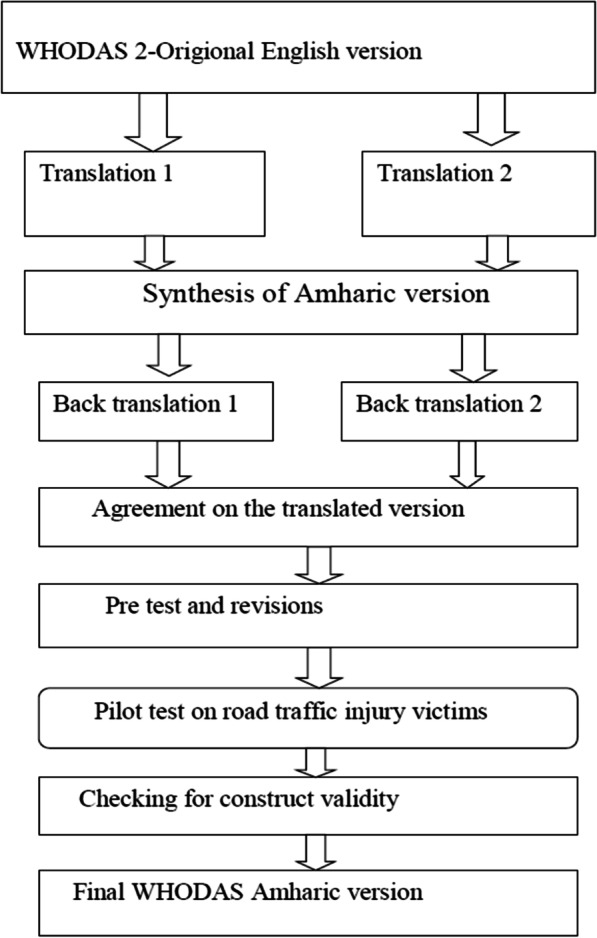
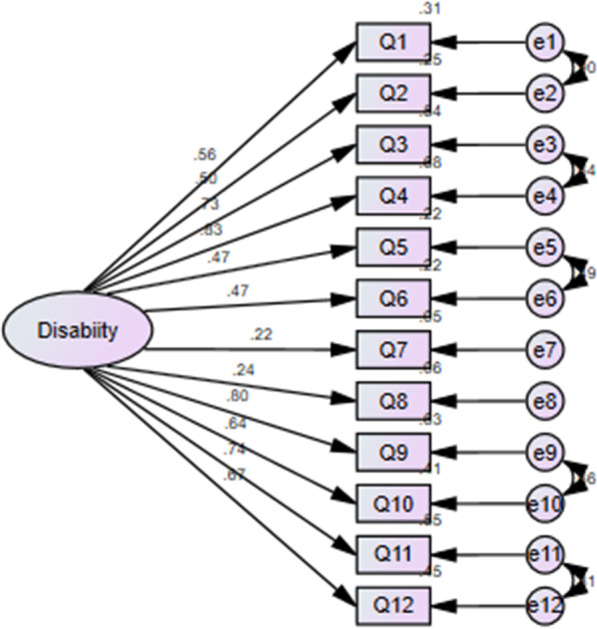
Methods: The 12 items WHODAS 2 was first translated into Amharic by two experts. Back translation was done by two English experts. A group of experts reviewed the forward and backward translation. A total of 240 patients with road traffic injury completed the questionnaires at three selected Hospitals in Amhara Regional State. Internal consistency was; assessed using Chronbach's alpha, convergent, and divergent validity, which were; tested via factor analysis. Confirmatory factor analysis (CFA); was computed, and the model fit; was examined.
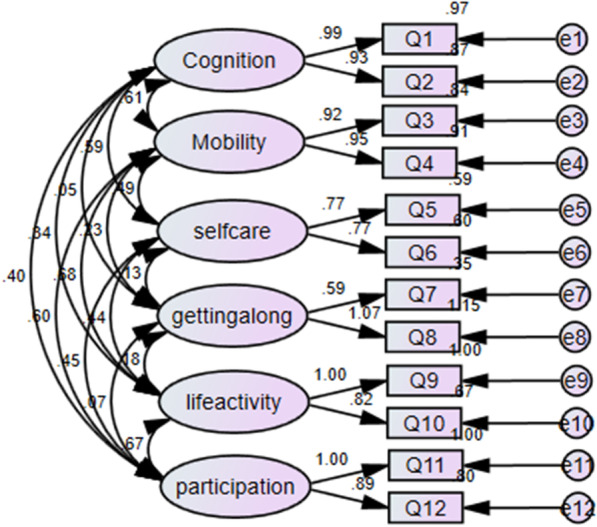
Results: The translated Amharic version 12 -items WHODAS-2 showed that good cross-cultural adaptation and internal consistency (Chronbach's α =0.88). The six factor structure best fits data (model fitness indices; CFI = 0.962, RMSEA = 0.042, RMR = 0.072, GFI = 0.961, chi-square value/degree of freedom = 1.42, TLI = 0.935 and PCLOSE = 0.68). Our analysis showed that from the six domains, mobility is the dominant factor explaining 95% of variability in disability.
Conclusion: The 12 items interview-based Amharic version WHODAS-2; showed good cultural adaptation at three different settings of Amhara Regional State and can be used to measure dis-ability following a road traffic injury.
Keywords: Amhara; Dis-ability; Ethiopia; Gondar; Road traffic injury; Validation.
Conflict of interest statement
The authors declare no conflict of interest.
Figures
References
-
- Mock C LJ, Gossen J, Joshipura M, Peden M. Guidelines for essential trauma care. Geneva: World Health Organization. 2004.
-
- Sasser SVM, Kellermann A, Lormand J. Prehospital trauma care systems. Geneva: World Health Organization; 2005.
-
- Organization WHO. Injury-related disability and rehabilitation. WHO. 2014.
MeSH terms
LinkOut - more resources
Full Text Sources
Other Literature Sources
Medical
Miscellaneous
