. 2021 Feb 3;29(2):691-701.
doi: 10.1016/j.ymthe.2020.12.031. Epub 2021 Jan 1.

Enhanced Efficacy and Increased Long-Term Toxicity of CNS-Directed, AAV-Based Combination Therapy for Krabbe Disease

Affiliations

Enhanced Efficacy and Increased Long-Term Toxicity of CNS-Directed, AAV-Based Combination Therapy for Krabbe Disease

Yedda Li et al. Mol Ther. .

Abstract

Infantile globoid cell leukodystrophy (GLD, Krabbe disease) is a demyelinating disease caused by the deficiency of the lysosomal enzyme galactosylceramidase (GALC) and the progressive accumulation of the toxic metabolite psychosine. We showed previously that central nervous system (CNS)-directed, adeno-associated virus (AAV)2/5-mediated gene therapy synergized with bone marrow transplantation and substrate reduction therapy (SRT) to greatly increase therapeutic efficacy in the murine model of Krabbe disease (Twitcher). However, motor deficits remained largely refractory to treatment. In the current study, we replaced AAV2/5 with an AAV2/9 vector. This single change significantly improved several endpoints primarily associated with motor function. However, nearly all (14/16) of the combination-treated Twitcher mice and all (19/19) of the combination-treated wild-type mice developed hepatocellular carcinoma (HCC). 10 out of 10 tumors analyzed had AAV integrations within the Rian locus. Several animals had additional integrations within or near genes that regulate cell growth or death, are known or potential tumor suppressors, or are associated with poor prognosis in human HCC. Finally, the substrate reduction drug L-cycloserine significantly decreased the level of the pro-apoptotic ceramide 18:0. These data demonstrate the value of AAV-based combination therapy for Krabbe disease. However, they also suggest that other therapies or co-morbidities must be taken into account before AAV-mediated gene therapy is considered for human therapeutic trials.

Keywords: Krabbe disease; adeno-associated virus; bone marrow transplantation; gene therapy; hepatocellular carcinoma.


Conflict of interest statement

Declaration of Interests The authors declare no competing interests.

Figures
None
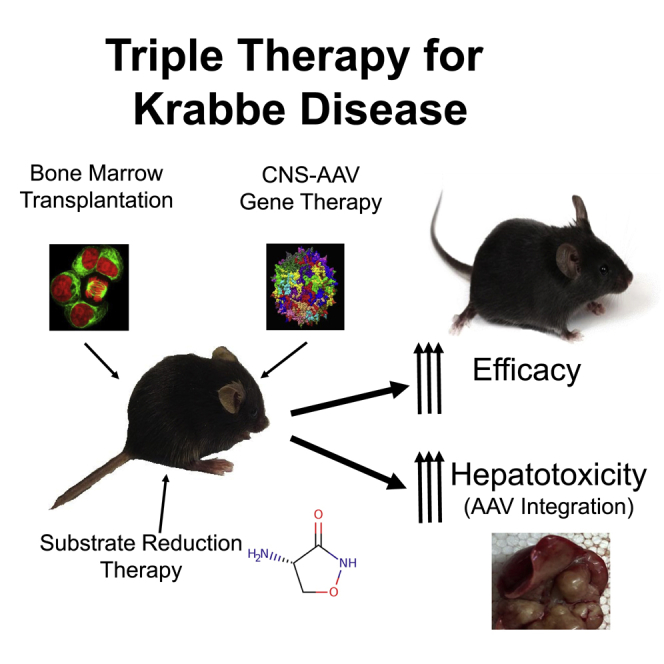
Graphical abstract
Figure 1
Figure 1
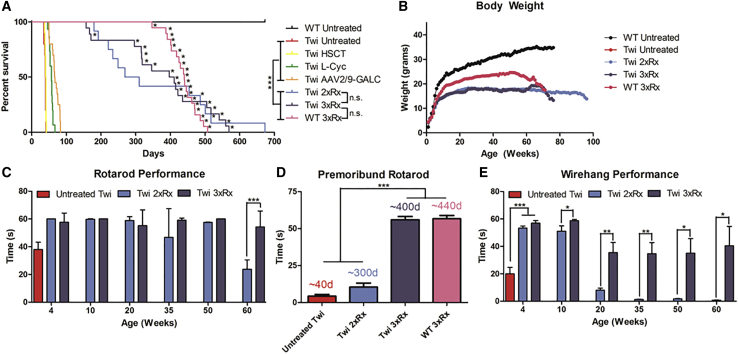
Triple Combination Therapy Increases Lifespan and Improves Clinicobehavioral Performance in Twi Mice (A) Kaplan-Meier curves showing increased lifespan in 3xRx Twi mice (n = 16), 2xRx Twi mice (n = 14), and AAV2/9-GALC alone Twi mice (n = 25) compared to untreated Twi mice (n = 10). WT mice treated with 3xRx therapy (n = 19) had a significantly shorter lifespan than untreated WT mice (n = 11). Asterisks indicate mice that had large hepatocellular carcinoma tumors at death. The lifespan data for Twi mice treated with HSCT or L-cycloserine alone are from previous publications, and shown as a comparison for monotherapy animals. (B) Combination therapies improve weight gain in Twi mice but cause weight loss in WT mice. Untreated Twi mice (Twi untreated) have profoundly impaired weight gain compared to WT mice (WT untreated). Double (Twi 2xRx) and triple (Twi 3xRx) combination therapy partially improve weight gain in Twi mice, but WT mice receiving 3xRx therapy (WT 3xRx) have mildly impaired weight gain compared to untreated WT mice. (C) Rotarod testing shows nearly normal performance in 3xRx-treated Twi mice (Twi 3xRx) throughout life. Twi 2xRx also significantly improves rotarod performance. However, 2xRx Twi mice eventually are unable to remain on the rotarod. In contrast, only a few untreated Twi (untreated Twi) mice are able to stay on the rotating rod for the full 60 s, even early in life, and are dead by 5–6 weeks of age. (D) Premoribund rotarod performance was assessed 1–7 days prior to death. Twi mice treated with 3xRx therapy perform as well as untreated WT (data not shown) and 3xRx-treated WT mice (WT 3xRx) up until death. In contrast, untreated Twi mice and 2xRx-treated Twi mice can no longer perform rotarod when premoribund. The median age at premoribund testing for mice in each experimental group is indicated above the corresponding column. (E) 2xRx and 3xRx Twi mice have near-normalized wirehang performance at 10 weeks of age. Although performance is impaired at subsequent time points, 3xRx-treated Twi mice perform significantly better than 2xRx-treated Twi mice at every time point starting at 10 weeks. Untreated WT mice are able to remain on the wirehang for 60 s throughout life. The error bars represent one standard error of the mean, *p < 0.05, **p < 0.01, ***p < 0.005.
Figure 2
Figure 2
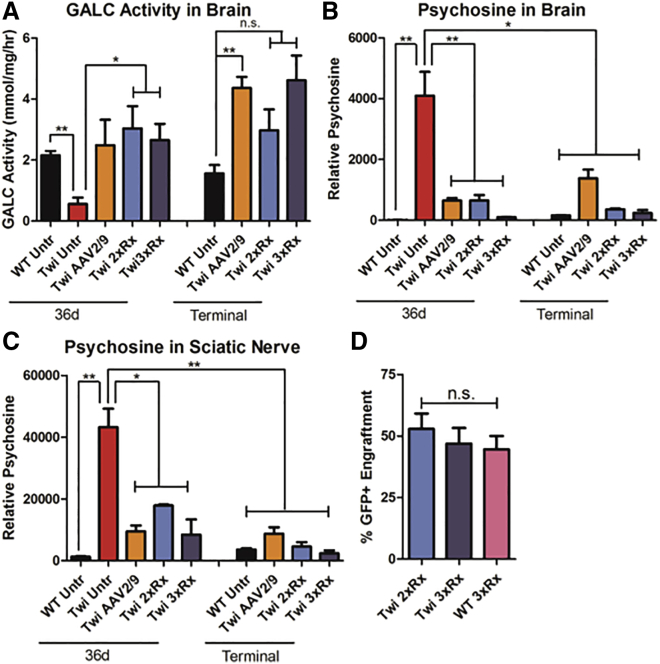
Combination Therapies Normalize Biochemical Features of Murine Krabbe Disease (A) GALC activity is deficient in untreated Twi brains (Twi Untr). Compared to untreated WT mice (WT Untr), Twi mice treated with AAV2/9-GALC alone (Twi AAV2/9), 2xRx therapy (Twi 2xRx), and 3xRx therapy (Twi 3xRx) have at least physiologic levels of GALC activity in the brain. Psychosine levels in (B) brain and (C) sciatic nerve are much higher in Twi Untr mice compared to WT Untr mice and Twi mice treated with AAV2/9-GALC alone, 2xRx therapy, or 3xRx therapy. All therapies significantly decrease psychosine accumulation in brain and sciatic nerves throughout the lives of Twi mice. (D) There is no significant difference in donor (GFP+) bone-marrow engraftment between Twi or WT mice receiving 2xRx or 3xRx therapies. The error bars represent one standard error of the mean, *p < 0.05, **p < 0.01.
Figure 3
Figure 3
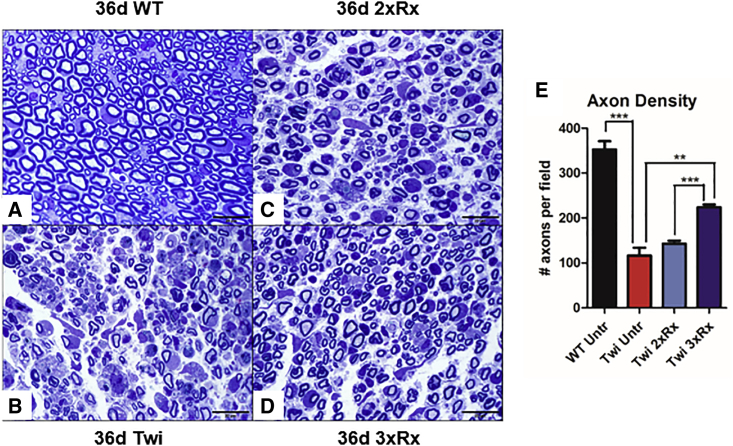
Combination Therapy Significantly Delays Progression of Sciatic Nerve Pathology Compared to (A) 36-day-old WT mice (36d WT), (B) untreated Twi mice (36d Twi) have severe sciatic nerve pathology with decreased myelination, periaxonal edema, profound axonal degeneration, and macrophage infiltration. (C) 36-day 2xRx is less effective than (D) 36-day 3xRx at preserving overall sciatic nerve architecture in 36-day-old Twi mice. (E) Twi Untr mice have decreased axon density in the sciatic nerve. Twi 3xRx is significantly more effective than Twi 2xRx at preventing axonal loss. The error bars represent one standard error of the mean, **p < 0.01, ***p < 0.005.
Figure 4
Figure 4
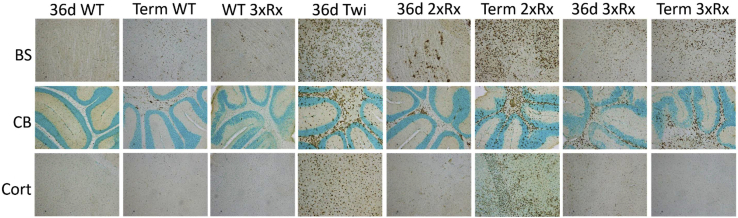
3xRx Attenuates Microgliosis Early in the GLD Disease Course Anti-CD68 immunohistochemistry shows profound microglial activation (brown staining) in untreated Twi (36d Twi) brainstem (BS), cerebellum (CB), and cortex (Cort). 36-day 2xRx Twi decreases microgliosis at 36 days but is unable to prevent eventual disease progression and development of severe neuroinflammation at a terminal time point (Term 2xRx). Microgliosis in terminal 3xRx-treated Twi mice (Term 3xRx) is less severe than that in Term 2xRx mice, especially in the cortex. Aging WT brains (Term WT) develop mild microglial activation throughout the brain.
Figure 5
Figure 5
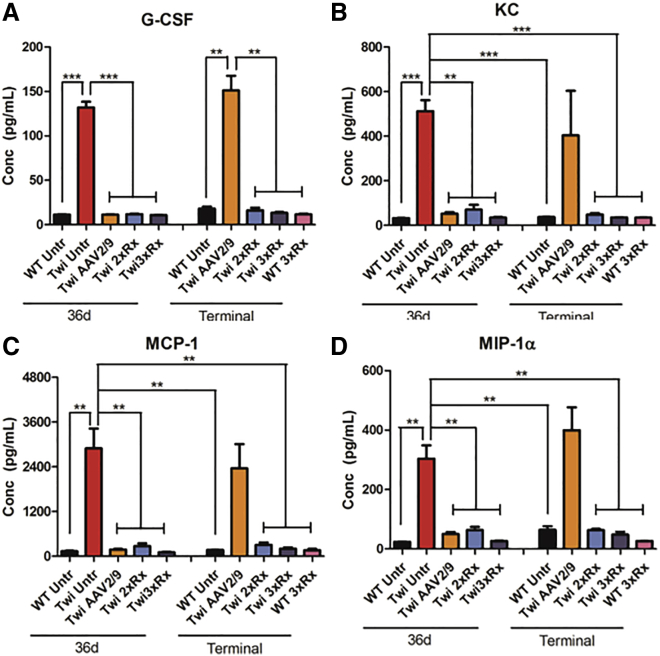
Combination Therapies Normalize Cytokine Expression in the Twi Brain (A) G-CSF, (B) KC, (C) MCP-1, and (D) MIP-1α are significantly elevated in Twi Untr brains at 36 days of age. Gene therapy alone (Twi AAV2/9) decreases the expression of these cytokines at 36 days. However, by the time these mice are terminal, cytokine expression in Twi mice receiving AAV2/9 alone no longer differs from that of 36-day-old Twi Untr mice. Both 2xRx (Twi 2xRx) and 3xRx (Twi 3xRx) therapies normalize cytokine expression for the life of the animals. The error bars represent one standard error of the mean, **p < 0.01, ***p < 0.005.
Figure 6
Figure 6
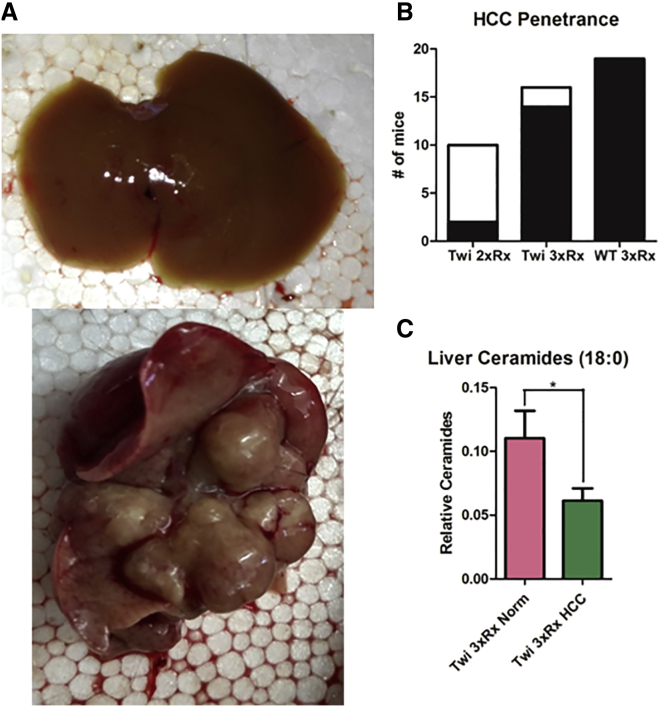
3xRx Significantly Increases the Penetrance of AAV-Induced HCC in Twi and WT Mice (A) Representative images of gross normal liver (top panel) and HCC tumor (bottom panel) isolated from a terminal 3xRx-treated mouse. (B) The incidence of HCC (black fill) is increased in 3xRx-treated Twi (Twi 3xRx) and WT (WT 3xRx) mice compared to 2xRx-treated Twi mice (Twi 2xRx). (C) The level of the pro-apoptotic ceramide, 18:0, is significantly lower in tumor tissue (Twi 3xRx HCC) compared to normal-appearing liver tissue (Twi 3xRx Norm). The error bars represent one standard error of the mean, *p < 0.05.
Figure 7
Figure 7
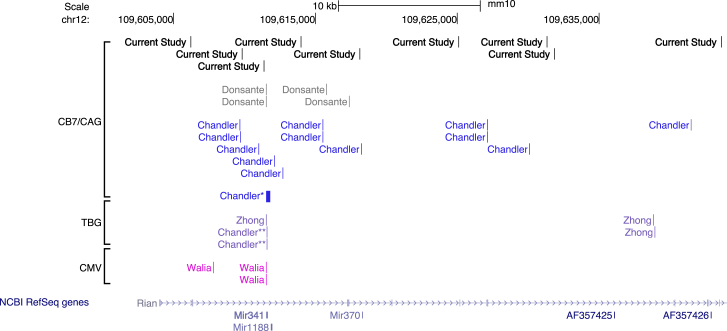
Pattern of Genotoxic AAV Integrations into RIAN The genomic locations (UCSC Genome Browser, Genome Reference Consortium Mouse Build 38 December 2012, mm10) on chromosome 12 of rAAV HCC integrations in the Rian locus identified by previous studies, , in comparison to those identified in the current study. Many of these integrations are within or near the miR-341 locus, which is 96 base pairs in length. The thick bar designated by Chandler∗ represents 19 integrations that are within this locus. Junctions designated by Chandler∗∗ arise from a vector with a TBG promotor.

Comment in

  • AAV Joins the Rank of Genotoxic Vectors.
    Davé UP, Cornetta K. Davé UP, et al. Mol Ther. 2021 Feb 3;29(2):418-419. doi: 10.1016/j.ymthe.2021.01.007. Epub 2021 Jan 20. Mol Ther. 2021. PMID: 33472035 Free PMC article. No abstract available.

References

    1. Krabbe K. A new familial, infantile form of diffuse brain-sclerosis. Brain. 1916;39:74–114. - PubMed
    1. Wenger D.A., Rafi M.A., Luzi P. Krabbe disease: One Hundred years from the bedside to the bench to the bedside. J. Neurosci. Res. 2016;94:982–989. - PubMed
    1. Wright M.D., Poe M.D., DeRenzo A., Haldal S., Escolar M.L. Developmental outcomes of cord blood transplantation for Krabbe disease: A 15-year study. Neurology. 2017;89:1365–1372. - PMC - PubMed
    1. Duchen L.W., Eicher E.M., Jacobs J.M., Scaravilli F., Teixeira F. Hereditary leucodystrophy in the mouse: the new mutant twitcher. Brain. 1980;103:695–710. - PubMed
    1. Kobayashi T., Yamanaka T., Jacobs J.M., Teixeira F., Suzuki K. The Twitcher mouse: an enzymatically authentic model of human globoid cell leukodystrophy (Krabbe disease) Brain Res. 1980;202:479–483. - PubMed

Publication types

MeSH terms