


Relationships between inflammatory markers and suicide risk status in major depression
- PMID: 33388702
- PMCID: PMC8830592
- DOI: 10.1016/j.jpsychires.2020.12.029
Relationships between inflammatory markers and suicide risk status in major depression
Abstract
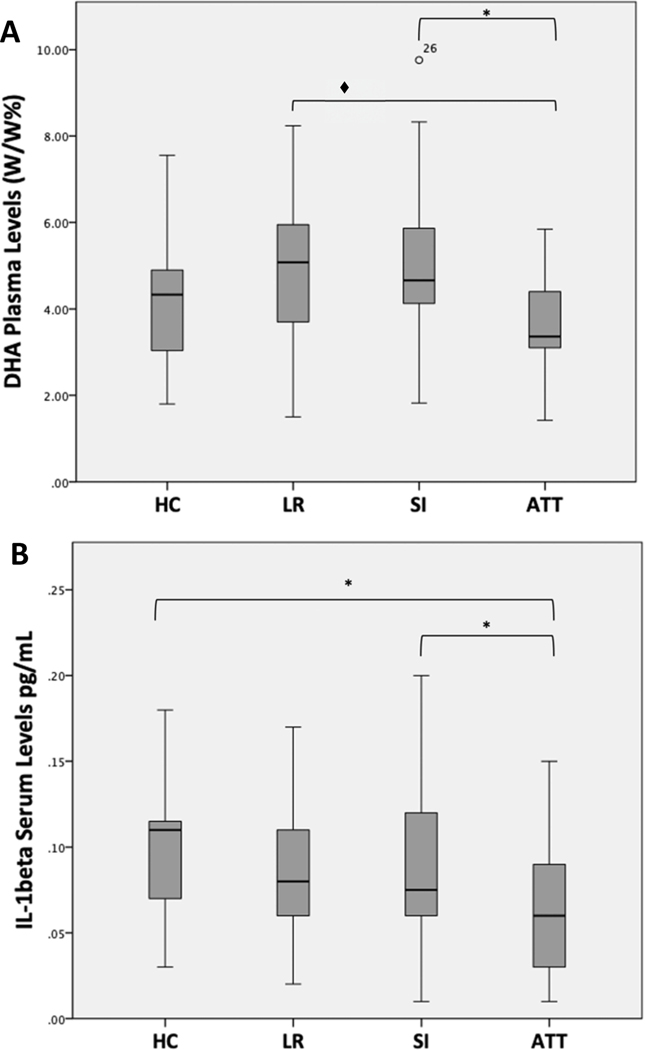
Pro-inflammatory status has been implicated in depression and suicidal behaviors. Polyunsaturated fatty acids (PUFAs) and cytokines, two types of inflammatory biomarkers, have been associated with suicide, independent of depression severity. How these biomarkers relate to each other is less clear. We measured plasma phospholipid levels of arachidonic acid (AA%), docosahexaenoic acid (DHA%), and eicosapentaenoic acid (EPA%) as a percentage of total phospholipids, as well as serum interleukin-6 (IL-6), interleukin-1β (IL-1β) and tumor necrosis factor α (TNF-α), in 80 patients with major depressive disorder (MDD) and 24 healthy controls (HC). Individual PUFA and cytokine species were compared using ANOVA across four suicide risk-stratified groups: 1) highest-risk, recent (within 5 years) suicide attempters (n = 20); 2) high-risk, severe current suicidal ideators (having intent or plan) with no recent attempt history (n = 22); 3) low-risk, current non-ideators who were also lifetime non-attempters (n = 38); and 4) HC (n = 24). None of the participants were enrolled following an acute suicide attempt. Of biomarkers studied, only DHA% (p = 0.012) and IL-1β (p = 0.002) differed between groups. In post-hoc testing, DHA% was lower in attempters than ideators (p = 0.018) or MDD non-ideators (trend level, p = 0.073). IL-1β was lowest in attempters, differentiating them from ideators (p = 0.009) and HC (p = 0.004). Recent suicide attempt, one of the most powerful predictors of suicide risk, was also most closely tied to inflammatory indices in this study. Low DHA% as an indicator of suicide risk is consistent with previous reports; however, lower IL-1β was unexpected and may relate to acuity/chronicity of inflammation. There is a need for prospective studies of immune status with respect to suicidal behaviors.
Keywords: Cytokines; Depression; Inflammation; Omega-3 polyunsaturated fatty acids (PUFA); Suicide.
Copyright © 2020 Elsevier Ltd. All rights reserved.
Conflict of interest statement
Figures
References
-
- Achtyes E, Keaton SA, Smart L, Burmeister AR, Heilman PL, Krzyzanowski S, Nagalla M, Guillemin GJ, Escobar Galvis ML, Lim CK, Muzik M, Postolache T, Leach R, Brundin L, 2019. Inflammation and kynurenine pathway dysregulation in post-partum women with severe and suicidal depression. Brain Behav Immun. - PMC - PubMed
-
- Alfaidi MA, Chamberlain J, Rothman A, Crossman D, Villa-Uriol MC, Hadoke P, Wu J, Schenkel T, Evans PC, Francis SE, 2018. Dietary Docosahexaenoic Acid Reduces Oscillatory Wall Shear Stress, Atherosclerosis, and Hypertension, Most Likely Mediated via an IL-1-Mediated Mechanism. J Am Heart Assoc 7(13). - PMC - PubMed
-
- Buss AH, Perry M, 1992. The aggression questionnaire. J. Pers. Soc. Psychol. 63(3), 452–459. - PubMed
Publication types
MeSH terms
Substances
Grants and funding
LinkOut - more resources
Full Text Sources
Other Literature Sources
Research Materials
